
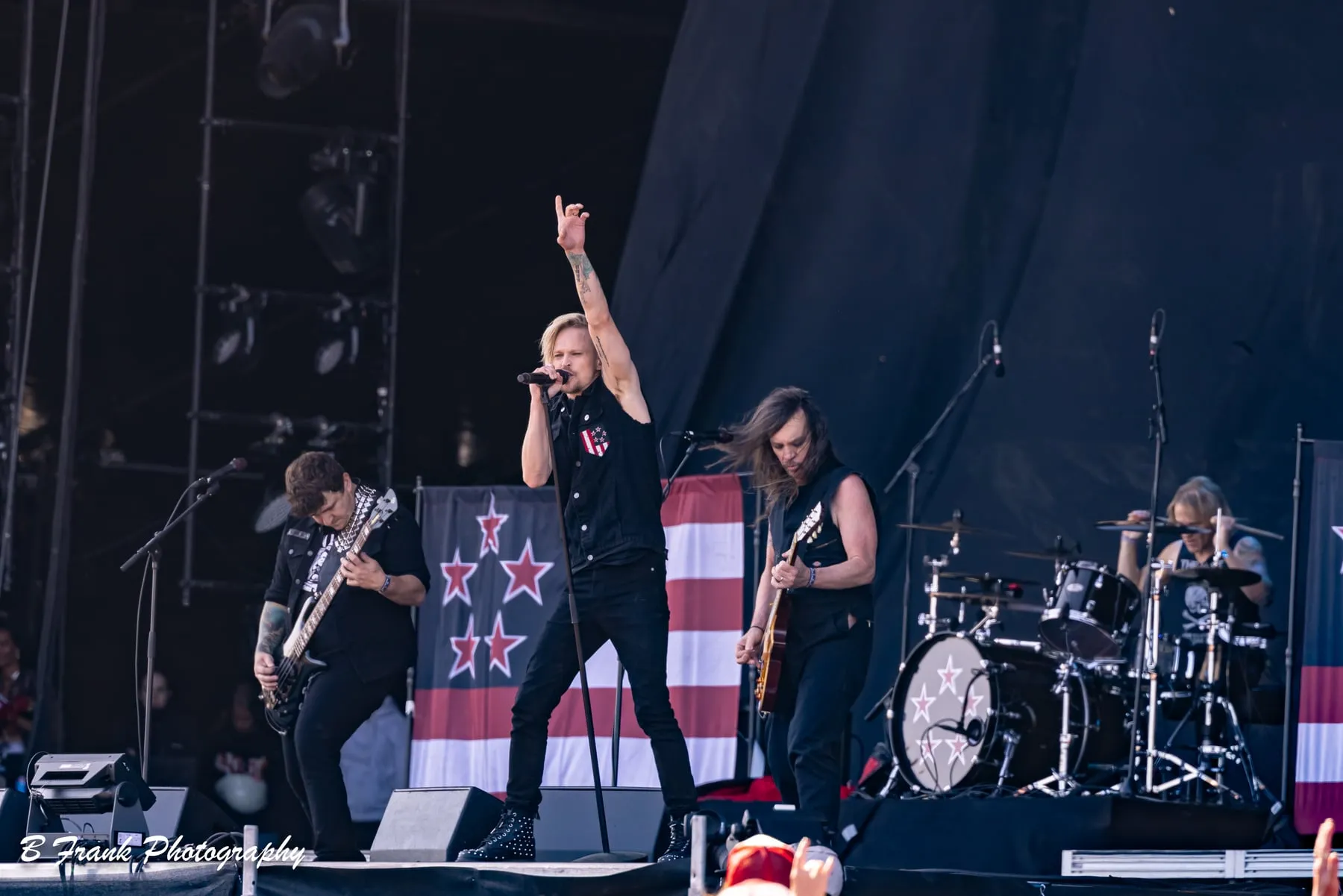
Photo by Björn Frank , licensed under CC BY-SA 2.0 · Wikimedia Commons
Rank #403
Skid Row
From Wikipedia
Skid Row is an American heavy metal band formed in 1986 in Toms River, New Jersey. Their current lineup comprises bassist Rachel Bolan, guitarists Dave Sabo and Scotti Hill and drummer Rob Hammersmith. The group achieved commercial success in the late 1980s and early 1990s, with its first two albums Skid Row (1989) and Slave to the Grind (1991) certified multi-platinum, the latter of which reached number one on the Billboard 200. Those two albums also produced some of Skid Row's most popular hits, both in and outside of the United States, including "18 and Life" and "I Remember You", which peaked in the top 10 of the Billboard Hot 100, and other charting singles such as "Youth Gone Wild", "Monkey Business", "Slave to the Grind", "Wasted Time", and "In a Darkened Room". The band's third album Subhuman Race (1995) was also critically acclaimed, but failed to repeat the success of its predecessors. Those three albums featured the band's "classic" lineup, which consisted of Bolan, Sabo, Hill, drummer Rob Affuso and frontman Sebastian Bach. The band had sold 20 million albums worldwide by the end of 1996. Amid rising tensions, Bach was fired and Affuso left Skid Row towards the end of that year, after which the band entered a three-year hiatus.
Members
- Dave Gara
- Dave Sabo
- Erik Grönwall
- Johnny Solinger
- Matt Fallon
- Phil Varone
- Rachel Bolan
- Rob Affuso
- Scotti Hill
- Sebastian Bach
- Timothy DiDuro
- Tony Harnell
- ZP Theart
Discography & Previews
Browse through and click an album to open and play 30-second previews streamed from Apple Music.

Slave to the Grind
1991 · 12 tracks

Subhuman Race
1995 · 13 tracks

Revolutions per Minute
2006 · 12 tracks
- 1 Disease ↗ 3:33
- 2 Another Dick in the System ↗ 3:16
- 3 Pulling My Heart out from Under Me ↗ 3:28
- 4 When God Can't Wait ↗ 2:14
- 5 Shut up Baby, I Love You ↗ 3:18
- 6 Strength ↗ 5:08
- 7 White Trash ↗ 2:52
- 8 You Lie ↗ 2:44
- 9 Nothing ↗ 3:29
- 10 Love Is Dead ↗ 3:38
- 11 Let It Ride ↗ 3:52
- 12 You Lie (Corn Fed Mix) ↗ 2:45

-
 Skid RowSkid Row198911 tracks
 -
 Slave to the GrindSkid Row199112 tracks
 -
 Subhuman RaceSkid Row199513 tracks
 -
 Revolutions per MinuteSkid Row200612 tracks
 -
 The Gang’s All HereSkid Row202210 tracks
Deep Dive
Overview
Skid Row is an American heavy metal band that emerged from Toms River, New Jersey in 1986 and became one of the defining acts of late 1980s and early 1990s hard rock. The group achieved massive commercial success during a concentrated three-year period spanning 1989 to 1995, selling 20 million albums worldwide by the end of 1996. Their sound married the accessibility of mainstream hard rock with the virtuosity of metal musicianship, creating a template that influenced countless bands in the decade that followed.
Formation Story
Skid Row coalesced in Toms River, New Jersey, in 1986 around guitarists Dave Sabo and Scotti Hill, bassist Rachel Bolan, and the vocal charisma of Sebastian Bach. The band arrived at a cultural moment when hair metal was beginning to eclipse the more blues-oriented rock traditions of the 1970s, yet mainstream rock radio remained hungry for high-energy anthems with genuine musicianship beneath the production sheen. The classic lineup that would define the band’s commercial peak was completed by drummer Rob Affuso, whose thunderous, precise playing became integral to their signature sound.
Breakthrough Moment
Skid Row’s self-titled debut album, released in 1989, announced their arrival with immediate chart impact and radio-friendly songwriting. The album produced two songs that would become generational touchstones: “18 and Life” and “Youth Gone Wild,” both of which reached the top 10 of the Billboard Hot 100 and secured the band’s position in heavy rotation on MTV and rock radio. The debut established the formula—sharply crafted hooks, soaring vocal melodies, and technically accomplished but accessible guitar work—that would define their initial success. This early validation set the stage for what would become their commercial peak.
Peak Era
The band’s true commercial zenith arrived with their second album, Slave to the Grind, released in 1991. This record debuted at number one on the Billboard 200, an extraordinary achievement for a heavy metal album. The album sustained the band’s momentum with charting singles including “Monkey Business,” “Slave to the Grind,” “Wasted Time,” and “In a Darkened Room,” all of which penetrated both mainstream rock and international markets. A third album, Subhuman Race, released in 1995, found critical favor and proved the band’s ability to sustain quality songwriting, though it failed to replicate the commercial tsunami of its predecessor. By the end of 1996, the classic lineup had begun to fracture amid internal tensions, with Sebastian Bach fired and drummer Rob Affuso departing, events that precipitated a three-year hiatus from recording and touring.
Musical Style
Skid Row’s music sat at the intersection of heavy metal precision and hard rock accessibility. The guitar work of Sabo and Hill combined fluid lead playing and rhythmic solidity without sacrificing hookiness; their approach suggested a lineage extending from classic 1970s rock but filtered through the amplified intensity of 1980s metal production. Sebastian Bach’s vocal approach—a wide-ranging baritone capable of both whispered vulnerability and operatic belting—became the band’s most immediately recognizable signature. Lyrically, their early material addressed themes of youthful disaffection and romantic longing with enough specificity to resonate beyond the typical glam-metal clichés of the era. The production was polished and radio-ready without sacrificing the heaviness that anchored the band’s identity as metal musicians rather than pure pop acts.
Major Albums
Skid Row (1989)
The debut album introduced the band’s core sound with two platinum-certified singles, “18 and Life” and “Youth Gone Wild,” alongside album cuts that demonstrated the band’s range from power ballads to uptempo rockers. The record’s success established Skid Row as major-label players virtually overnight.
Slave to the Grind (1991)
Debuting at number one on the Billboard 200, this second album represented the band’s commercial and creative peak, sustaining airplay with “Monkey Business,” “Wasted Time,” and “In a Darkened Room.” The album confirmed that their debut success was not a one-off and cemented their position among the decade’s most commercially viable metal bands.
Subhuman Race (1995)
The third and final album of the classic lineup era, Subhuman Race earned critical respect for its sophisticated songwriting and ambitious arrangements, demonstrating the band’s continued artistic development even as commercial fortunes began to shift in an era increasingly indifferent to heavy metal.
Thickskin (2003)
Released after the band’s three-year hiatus, this album marked a resurgence with a reformed lineup and charted the band’s navigation of a post-grunge rock landscape that had transformed since their initial commercial heyday.
Revolutions per Minute (2006)
This album further established the band’s post-2000 trajectory and represented their continued recording activity in a marketplace that had moved well beyond the hard rock mainstream.
The Gang’s All Here (2022)
Released in 2022, this recent album confirms the band’s ongoing relevance and touring presence, demonstrating longevity across three decades of changing musical tastes.
Signature Songs
- “18 and Life” — A top-10 Billboard Hot 100 hit that became one of the band’s most enduring songs, balancing hard rock intensity with melodic accessibility.
- “I Remember You” — A softer power ballad that showcased Sebastian Bach’s vocal range and proved the band’s mastery of the emotional melodic rock form.
- “Youth Gone Wild” — A driving anthem that captured the band’s ability to craft radio-ready hooks without compromising heaviness.
- “Monkey Business” — One of several charting singles from Slave to the Grind that exemplified the album’s commercial peak.
- “Wasted Time” — A mid-tempo showcase for the band’s melodic sensibilities that reached radio audiences worldwide.
- “In a Darkened Room” — A track that demonstrated the band’s range across the 1991 album’s tracklist.
Influence on Rock
Skid Row’s success in the late 1980s and early 1990s helped validate a particular strain of heavy metal that prioritized hooks and accessibility without abandoning technical proficiency. Their template—polished production, memorable melodies, virtuosic guitar work, and emotional vocal delivery—became a template for countless bands attempting to balance mainstream appeal with metal credibility. The band’s ability to position themselves at the crossroads of hair metal’s visual spectacle and traditional metal’s musical rigor influenced how subsequent acts approached similar terrain. Their chart dominance during the Slave to the Grind era proved that heavy metal could dominate mainstream rock radio and video channels, a lesson not lost on bands emerging in the 1990s.
Legacy
Skid Row’s commercial dominance was remarkably concentrated—two years of extraordinary chart success followed by a gradual decline as musical tastes shifted—yet the impact of those albums remained substantial. The band’s decision to reunite and continue recording after their hiatus demonstrated resilience and commitment to their fanbase. Their 20 million albums sold by 1996 remain a testament to the genuine appeal their music held for audiences worldwide during their peak. Decades after their initial success, songs like “18 and Life” and “I Remember You” remain staples of rock radio and streaming playlists, ensuring that subsequent generations encounter the band’s music even as the specific cultural moment that birthed their success recedes into the 1980s.
Fun Facts
- Skid Row’s second album, Slave to the Grind, was a rare achievement for a heavy metal band when it debuted at number one on the Billboard 200, a position typically reserved for pop and mainstream rock acts.
- The band sold 20 million albums worldwide by the end of 1996, a figure that placed them among the decade’s most commercially successful rock acts despite their relatively short initial run of success.
- The classic lineup’s dissolution came after a three-year hiatus beginning in 1996, after which the band continued with reformed lineups and released new studio albums across multiple decades.
- Rachel Bolan remains in the current Skid Row lineup alongside original guitarist Dave Sabo and Scotti Hill, ensuring a direct connection to the band’s formation and early success.