
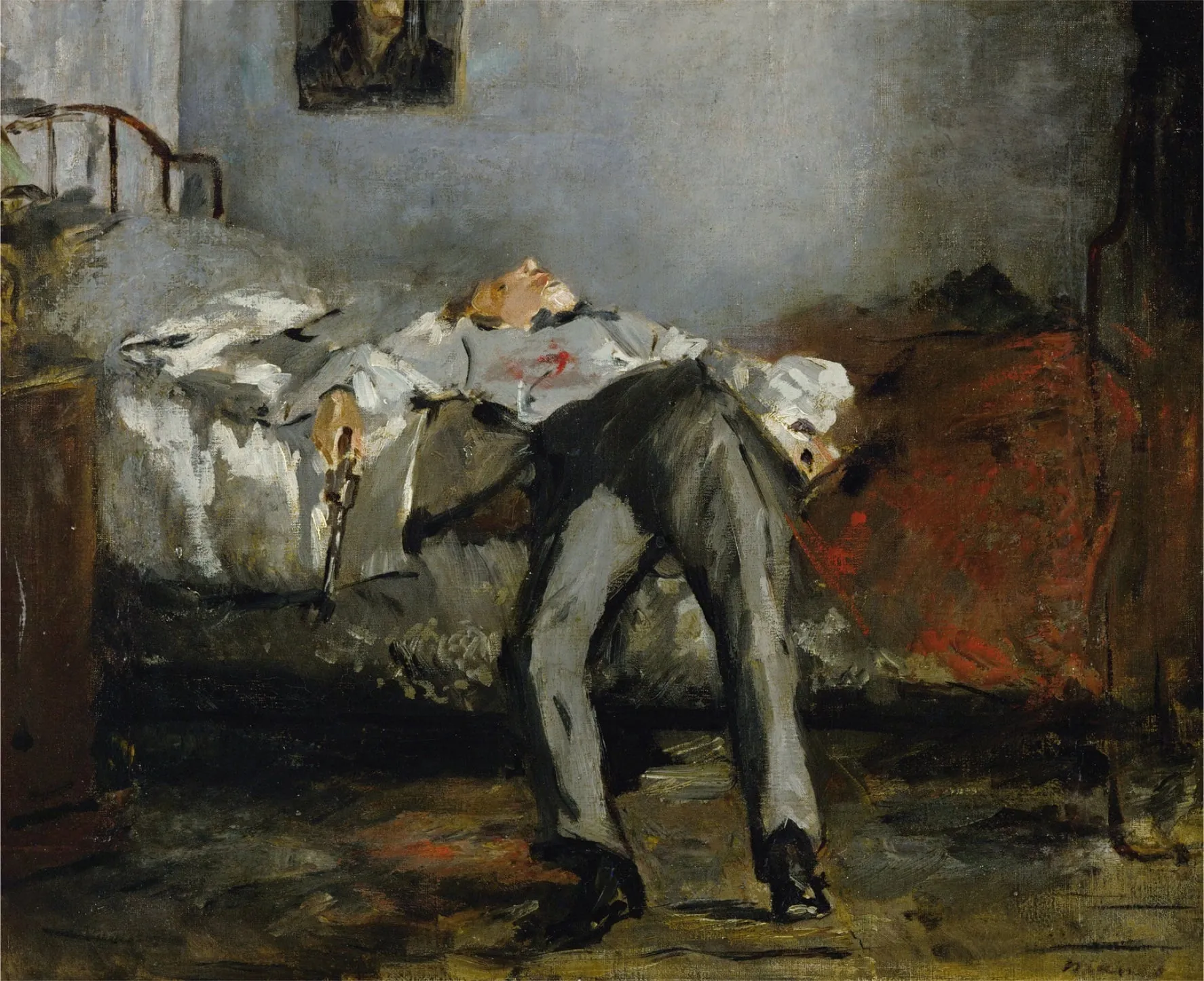
Photo by Édouard Manet , licensed under Public domain · Wikimedia Commons
Rank #460
Suicide
From Wikipedia
Suicide is the act of intentionally causing one's own death. Risk factors for suicide include mental disorders, neurodevelopmental disorders, physical disorders, and substance abuse. Some suicides are impulsive acts driven by stress, relationship problems, or harassment and bullying. Those who have previously attempted suicide are at a higher risk for future attempts. Effective suicide prevention efforts include limiting access to methods of suicide such as firearms, drugs, and poisons; treating mental disorders and substance abuse; careful media reporting about suicide; improving economic conditions; and psychotherapy, primarily dialectical behaviour therapy (DBT) and cognitive behavioural therapy (CBT). Although crisis hotlines, like 988 in North America and 13 11 14 in Australia, are common resources, their effectiveness has not been well studied.
Discography & Previews
Browse through and click an album to open and play 30-second previews streamed from Apple Music.

Mindstrip
2000 · 10 tracks

Axis of Evil
2003 · 10 tracks
- 1 Cause of Death: Suicide ↗ 8:18
- 2 Consume Your Vengeance ↗ 5:00
- 3 Face of Death (Blind Rage Mix) [Blind Rage Mix] ↗ 6:29
- 4 The Reformation ↗ 5:11
- 5 One Nation Under God (Anti US Mix) [Anti US Mix] ↗ 5:33
- 6 Mordfabrik ↗ 5:01
- 7 Evildoer ↗ 4:40
- 8 Sterbehilfe ↗ 5:44
- 9 Plastik Christ ↗ 5:49
- 10 Neuro Suspension ↗ 6:02

Bind, Torture, Kill
2006 · 11 tracks

Implements of Hell
2010 · 11 tracks
- 1 Intro ↗ 0:23
- 2 The Pleasures of Sin ↗ 4:59
- 3 The Dying Breed ↗ 4:44
- 4 Die M**********r Die ↗ 6:10
- 5 Death Cures All Pain ↗ 6:02
- 6 God Is In the Rain ↗ 5:28
- 7 Hate Me (Retaliate V1.0) ↗ 5:11
- 8 Come Down With Me ↗ 6:17
- 9 Severed Head ↗ 4:07
- 10 The Perils of Indifference ↗ 4:16
- 11 Until We Die (Album Edit) ↗ 5:36

When Evil Speaks
2013 · 12 tracks
- 1 Feeding My Inner Hate ↗ 1:34
- 2 Cut Bleed Eviscerate ↗ 6:03
- 3 My Blasphemy ↗ 4:14
- 4 When Evil Speaks ↗ 4:51
- 5 Monster ↗ 5:11
- 6 Attention Whore ↗ 4:52
- 7 Repent or Perish ↗ 6:38
- 8 In Guns We Trust ↗ 5:59
- 9 Time (Rewind) ↗ 4:51
- 10 Unterwelt ↗ 4:59
- 11 Evacuate (Where's the Exit Remix) ↗ 4:45
- 12 Song of No Tomorrow ↗ 5:53

Forest of the Impaled
2017 · 11 tracks
- 1 The Gates of Oblivion (feat. Nero Bellum) ↗ 6:03
- 2 My New Christ ↗ 4:36
- 3 Too Far Gone ↗ 4:25
- 4 Death Lies Waiting ↗ 4:57
- 5 The Pain That You Like (feat. Jean Luc Demeyer) ↗ 4:34
- 6 Poison Tree ↗ 4:17
- 7 The Devil ↗ 4:24
- 8 Chasm of Emptiness ↗ 3:45
- 9 Crack Up ↗ 4:30
- 10 Schiz(O)Topia ↗ 5:55
- 11 We Are Transitory ↗ 5:24

Goddestruktor
2022 · 22 tracks
- 1 Kill All Humanity ↗ 4:44
- 1 God of Destruction (Cryo Remix) ↗ 3:54
- 2 I'd die for you (v2.0) ↗ 4:02
- 2 Sterbehilfe (Rob Dust Remix) ↗ 4:33
- 3 God of Destruction ↗ 5:05
- 3 I'd die for you (Assemblage 23 Remix) ↗ 4:30
- 4 Jesus Freak ↗ 4:11
- 4 Jesus freak (Dead When I Found Her Remix) ↗ 4:36
- 5 Sterbehilfe (Euthanasia 2021) ↗ 4:09
- 5 Bang bang bang (C-Lekktor Remix) ↗ 4:29
- 6 Destroyer of Worlds ↗ 3:53
- 6 Bunkerb!tch (F U C K B O T Remix) ↗ 4:51
- 7 Land of Roses ↗ 5:09
- 7 Jesus freak (die in agony) ↗ 3:57
- 8 Bang Bang Bang ↗ 4:02
- 8 Sterbehilfe (FGFC820 Remix) ↗ 4:52
- 9 Sin ↗ 2:36
- 9 Destroyer of worlds (Nano Infect Remix) ↗ 4:24
- 10 Trick or Treat ↗ 3:49
- 10 Kill All Humanity (Tactical Sekt Remix) ↗ 4:54
- 11 Bunkerb!tch (censored) ↗ 5:02
- 11 I'd die for you (Elektro Terapi Remix) ↗ 3:40
-
 MindstripSuicide200010 tracks
 -
 Axis of EvilSuicide200310 tracks
 -
 Bind, Torture, KillSuicide200611 tracks
 -
 Implements of HellSuicide201011 tracks
 -
 When Evil SpeaksSuicide201312 tracks
 -
 Forest of the ImpaledSuicide201711 tracks
 -
 GoddestruktorSuicide202222 tracks
Deep Dive
Overview
Suicide Commando is a Belgian industrial rock and noise act that emerged in the 1980s and has remained active into the present day. Operating at the intersection of industrial music, no wave aesthetics, and electronic harshness, the project represents one of the more uncompromising and long-lived entries in the industrial underground. The band’s discography spans three decades of increasingly intense and provocative sonic experimentation, building a catalog that prioritizes raw sonic violence and conceptual coherence over mainstream accessibility.
Formation Story
Suicide Commando began recording in 1988 with the release of their self-titled debut Suicide Commando. Emerging from the Belgian underground music scene, the project established itself immediately as an unfiltered industrial entity, rejecting the slicker synthpop-influenced industrial sound that had begun to gain MTV traction in the 1980s. The band’s early aesthetic drew from the confrontational ethos of no wave and the noise-oriented strain of industrial music that had been cultivated in post-punk underground scenes across Europe and North America.
Breakthrough Moment
While Suicide Commando never achieved mainstream chart success or radio penetration, the project’s breakthrough into broader underground recognition came through consistent touring and an increasingly prolific recording schedule throughout the early 1990s. Albums like Into the Grave (1991) and Black Flowers (1992) solidified the group’s reputation within the industrial and noise communities. The rapid release schedule—including two albums in 1992—demonstrated a relentless creative output that earned respect within underground networks and mail-order industrial music circuits. By the mid-1990s, Suicide Commando had become a fixture of European industrial festivals and a touchstone for practitioners of harsh, unpolished electronic aggression.
Peak Era
The peak creative period for Suicide Commando arguably spans the 1990s through the early 2000s, a stretch encompassing Electro Convulsion Therapy (1993), Critical Stage (1994), Stored Images (1995), Construct >< Destruct (1998), Mindstrip (2000), and Axis of Evil (2003). During this period, the project achieved maximum conceptual clarity and sonic intensity, moving from album to album with thematic coherence and undiminished aggression. The titles themselves—referencing medical torture, moral degradation, and geopolitical violence—signaled the band’s engagement with confrontational subject matter. This era established Suicide Commando as one of the most consistent and committed voices in the industrial underground, with a growing international fanbase that prized the project’s refusal to soften or compromise.
Musical Style
Suicide Commando operates in a vein of industrial music defined by extreme distortion, heavily processed percussion, and abrasive synthesizer textures. The project’s sound eschews melody in favor of textural assault and rhythmic brutality, drawing on the genealogy of industrial noise acts while incorporating elements of harsh electronic music and power electronics. Vocals, when present, tend toward processed aggression or pure noise rather than traditional singing. The instrumentation remains fundamentally electronic, with heavily manipulated drum machines, distorted sequencers, and layers of feedback and noise creating a densely saturated sonic field. Unlike some industrial acts that incorporated live instrumentation or sought crossover accessibility, Suicide Commando has remained committed to a purely electronic and fundamentally antagonistic approach to sound production. The project’s evolution across the decades shows deepening sophistication in layering and processing rather than any fundamental shift toward accessibility or melody.
Major Albums
Suicide Commando (1988)
The self-titled debut established the project’s core aesthetic of unfiltered industrial noise and confrontational electronic harshness, establishing a template that would persist across subsequent releases.
Into the Grave (1991)
A turning point in the project’s consolidation, Into the Grave refined the harsh electronics and abrasive percussion into more structured song forms while maintaining maximum sonic intensity and aggression.
Electro Convulsion Therapy (1993)
This album marked a peak of conceptual focus and sonic clarity, with carefully layered industrial textures and a thematic engagement with medical violence and psychological torment that became a hallmark of the band’s mature work.
Construct >< Destruct (1998)
A mid-career retrospective of sorts, Construct >< Destruct demonstrated the project’s continued creative vitality after a decade-plus of activity, balancing familiar aesthetic commitments with refined production and deeper textural complexity.
Axis of Evil (2003)
Released in the immediate aftermath of the 2003 Iraq invasion, Axis of Evil applied the project’s aggressive aesthetic to explicit political subject matter, showing that Suicide Commando remained engaged with contemporary geopolitical violence even as the industrial underground had become increasingly marginalized in broader rock culture.
Signature Songs
- Suicide Commando (Title Track) — The project’s debut statement, establishing the core aesthetic of brutal electronic noise that would define the band’s entire output.
- Into the Grave (Title Track) — An emblematic example of the band’s thematic focus on death, burial, and physical annihilation, rendered through layers of distorted percussion.
- Electro Convulsion Therapy (Title Track) — A showcase of the project’s ability to render medical and psychological violence into sound, with intricate layering and conceptual precision.
Influence on Rock
Suicide Commando’s influence exists primarily within the industrial underground and the broader ecosystem of harsh electronic music and power electronics rather than in mainstream rock history. However, the project’s three-decade commitment to uncompromising sonic aggression and conceptual brutality has established it as a touchstone for practitioners of industrial noise and extreme electronic music. The project’s persistence and prolific output—maintaining consistent releases across boom and bust cycles in underground music distribution—has influenced younger generations of noise and industrial artists to view long-term commitment and artistic integrity as viable alternatives to commercial breakthrough. Within European underground music scenes, Suicide Commando occupies a position of institutional respect comparable to longer-established noise figures like Merzbow or Throbbing Gristle, though with less cultural penetration beyond dedicated underground communities.
Legacy
As an act that has remained continuously active from 1988 into the 2020s, Suicide Commando represents one of the longest-running projects in industrial music history. The recent releases Forest of the Impaled (2017) and Goddestruktor (2022) demonstrate that the project has not simply coasted on past reputation but continues to produce new material with conceptual engagement and sonic intensity. The band’s extensive catalog—now spanning 17 studio albums across 34 years—constitutes a detailed documentary of industrial music’s possibilities across multiple technological eras. For devoted followers of underground industrial music and harsh electronic sound, Suicide Commando remains a fundamental reference point: evidence that uncompromising artistic commitment and sonic extremism can sustain a viable creative career outside mainstream structures. The project’s consistent presence on underground music platforms and continued touring activity within European festival circuits ensures its continued relevance within specialist communities.
Fun Facts
- Suicide Commando released two albums in 1992 alone (Black Flowers and Bürokratie), demonstrating a production pace that rivaled more commercially successful acts despite operating entirely within underground networks.
- The project’s titles frequently reference or engage with violence, medical torture, and psychological brutality, creating a thematic coherence across the entire catalog that extends beyond music into conceptual statement.
- Despite three decades of activity and a catalog of 17 studio albums, Suicide Commando has maintained artistic control and conceptual consistency without pursuing commercial crossover, remaining a cult figure within the industrial underground.