
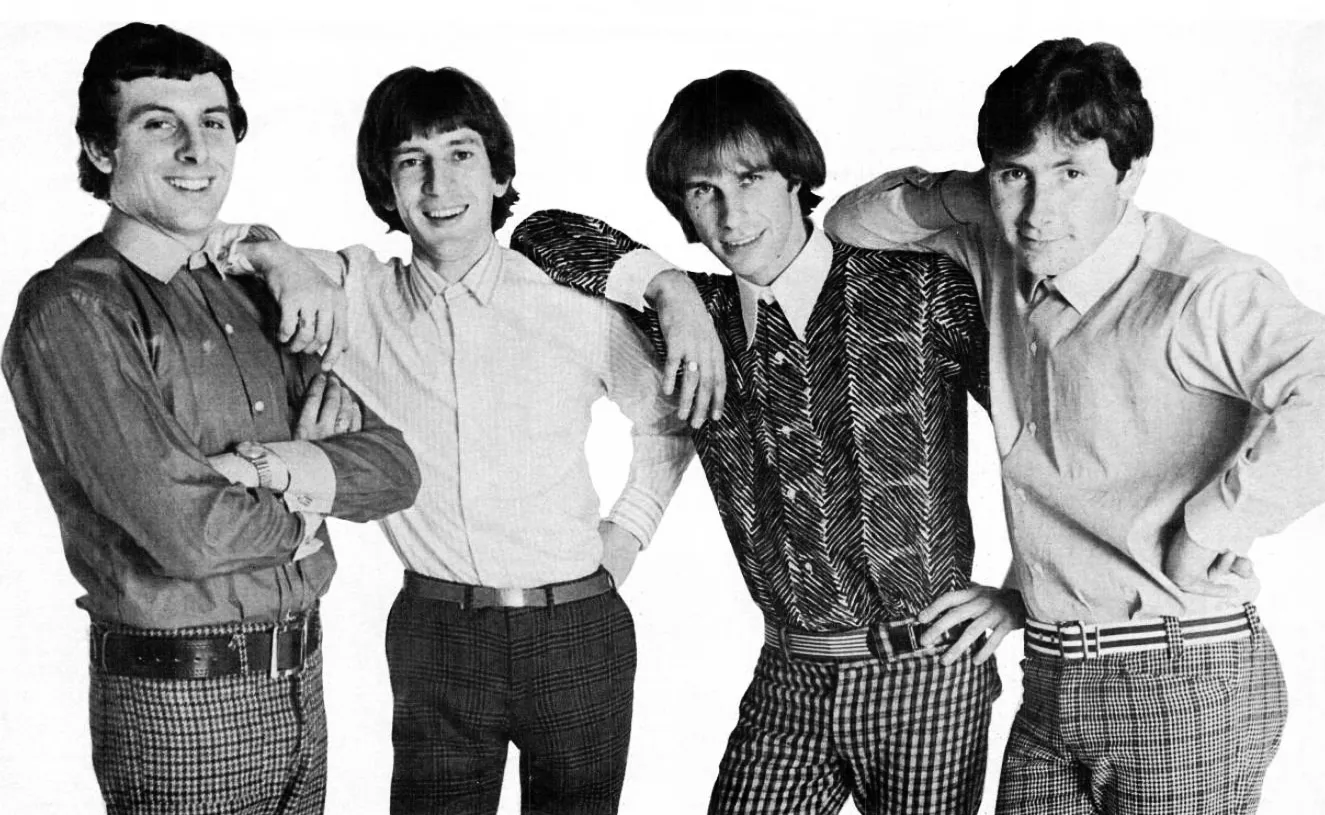
Photo by Fontana Records , licensed under Public domain · Wikimedia Commons
Rank #376
The Troggs
From Wikipedia
The Troggs are an English rock band formed in Andover, Hampshire, in May 1964. Their most famous songs include the US chart-topper "Wild Thing", "With a Girl Like You" and "Love Is All Around", all of which sold over 1 million copies and were awarded gold discs. "Wild Thing" is ranked No. 257 on the Rolling Stone magazine's list of The 500 Greatest Songs of All Time and was an influence on garage rock and punk rock.
Members
- Reg Presley
Discography & Previews
Browse through and click an album to open and play 30-second previews streamed from Apple Music.

From Nowhere
1966 · 16 tracks
- 1 Wild Thing ↗ 2:35
- 2 The Kitty Cat Song ↗ 2:14
- 3 Ride Your Pony ↗ 2:28
- 4 Hi Hi Hazel ↗ 2:46
- 5 I Just Sing ↗ 2:10
- 6 Evil ↗ 3:16
- 7 The Yella In Me ↗ 2:41
- 8 With A Girl Like You ↗ 2:08
- 9 Our Love Will Still Be There ↗ 3:13
- 10 Louie Louie ↗ 3:03
- 11 Jingle Jangle ↗ 2:29
- 12 When I'm With You ↗ 2:26
- 13 From Home ↗ 2:19
- 14 Jaguar And Thunderbird ↗ 2:02
- 15 I Can't Control Myself ↗ 3:05
- 16 Night Of The Long Grass ↗ 3:06


Trogglodynamite
1967 · 14 tracks
- 1 I Can Only Give You Everything ↗ 3:23
- 2 Last Summer ↗ 2:54
- 3 Meet Jaсqueline ↗ 2:15
- 4 Oh No ↗ 2:06
- 5 It's Too Late ↗ 2:10
- 6 No. 10 Downing Street ↗ 2:17
- 7 Mona (I Need You Baby) ↗ 5:09
- 8 I Want You To Come Into My Life ↗ 2:25
- 9 Let Me Tell You Babe ↗ 2:57
- 10 Little Queenie ↗ 2:53
- 11 Cousin Jane ↗ 2:23
- 12 You Can't Beat It ↗ 2:22
- 13 Baby Come Closer ↗ 2:33
- 14 It's Over ↗ 2:11

Cellophane
1967 · 24 tracks
- 1 Little Red Donkey ↗ 2:15
- 2 Too Much of a Good Thing ↗ 2:50
- 3 Butterflies and Bees ↗ 1:57
- 4 All of the Time ↗ 2:11
- 5 Seventeen ↗ 2:41
- 6 Somewhere My Girl Is Waiting ↗ 2:52
- 7 It’s Showing ↗ 2:57
- 8 Her Emotion ↗ 2:31
- 9 When Will the Rain Come ↗ 2:43
- 10 My Lady ↗ 3:01
- 11 Come the Day ↗ 1:56
- 12 Love Is All Around ↗ 3:02
- 13 That’s What You Get Girl ↗ 2:01
- 14 I Don’t Know Why ↗ 2:52
- 15 Easy Loving ↗ 3:00
- 16 Give Me Something ↗ 3:27
- 17 Lover ↗ 2:26
- 18 Come Now ↗ 2:20
- 19 The Raver ↗ 2:48
- 20 You ↗ 2:34
- 21 Carolyn ↗ 2:33
- 22 Anything for You ↗ 2:37
- 23 Lucinda Lee ↗ 3:07
- 24 Wichita Lineman ↗ 3:05

Mixed Bag
1968 · 12 tracks
- 1 Surprise, Surprise ↗ 2:49
- 2 You Can Cry, If You Want To ↗ 2:54
- 3 Say Darlin’ ↗ 2:47
- 4 Marbles and Some Gum ↗ 2:06
- 5 Purple Shades ↗ 2:25
- 6 Heads or Tails ↗ 3:44
- 7 Hip Hip Hooray ↗ 2:20
- 8 Little Girl ↗ 2:59
- 9 Maybe the Madman ↗ 2:14
- 10 Off the Record ↗ 3:45
- 11 We Waited for Someone ↗ 2:52
- 12 There’s Something About You ↗ 2:41

Love Is All Around
1968 · 1 track
- 1 Love Is All Around (Summer of Love Version) ↗ 2:51

The Trogg Tapes
1976 · 11 tracks

Black Bottom
1981 · 10 tracks
- 1 Black Bottom (1982 Version) ↗ 3:02
- 2 Strange Movies (1982 Version) ↗ 3:04
- 3 Bass For My Birthday (1982 Version) ↗ 3:33
- 4 Little Pretty Thing (1982 Version) ↗ 3:04
- 5 Last Night (1982 Version) ↗ 3:03
- 6 Hot Days (1982 Version) ↗ 2:59
- 7 I Don't (1982 Version) ↗ 3:38
- 8 Widge You (1982 Version) ↗ 4:03
- 9 Feels Like A Woman (1982 Version) ↗ 3:40
- 10 I Love You Baby (1982 Version) ↗ 4:26

Au
1989 · 10 tracks
- 1 There's Always Something There to Remind Me ↗ 2:53
- 2 Strange Movies ↗ 3:29
- 3 What You Doing Here ↗ 4:32
- 4 I Can't Control Myself ↗ 2:59
- 5 The Disco Kid Versus Sid Chicane ↗ 3:39
- 6 Wild Thing ↗ 4:00
- 7 Walking the Dog ↗ 3:21
- 8 Love Is All Around ↗ 3:24
- 9 With a Girl Like You ↗ 2:58
- 10 Maximum Overdrive ↗ 2:55

-
 From NowhereThe Troggs196616 tracks
 -
 Wild ThingThe Troggs19661 track
 -
 TrogglodynamiteThe Troggs196714 tracks
 -
 CellophaneThe Troggs196724 tracks
 -
 Mixed BagThe Troggs196812 tracks
 -
 Love Is All AroundThe Troggs19681 track
 -
 The Trogg TapesThe Troggs197611 tracks
 -
 Black BottomThe Troggs198110 tracks
 -
 AuThe Troggs198910 tracks
 -
 Athens AndoverThe Troggs199211 tracks
Deep Dive
Overview
The Troggs are an English rock band that emerged from Andover, Hampshire, in May 1964 at a moment when garage rock was beginning to crystallize across the Atlantic and the British Isles. Their catalog is anchored by three songs that transcended their era: “Wild Thing,” “With a Girl Like You,” and “Love Is All Around,” each of which achieved gold-disc status by selling over one million copies and charting globally. “Wild Thing” in particular secured lasting cultural weight, ranking at No. 257 on Rolling Stone’s list of The 500 Greatest Songs of All Time. The song became a touchstone for garage rock and punk rock aesthetics, its raw simplicity and primal energy outlasting most chart records from the 1960s.
Formation Story
The Troggs came together in Andover in the spring of 1964, emerging from a local rock and roll milieu that was crystallizing across southern England. The band coalesced around Reg Presley, who would become the public face and primary songwriter of the outfit. Like many groups of their era, they drew from a mixture of American rock and roll, rhythm and blues, and the growing wave of British Invasion sounds that had begun to saturate radio in the early 1960s. Andover’s distance from London did not insulate the group from broader trends; instead, it positioned them as part of a distributed network of garage bands working in relative isolation from major music industry infrastructure.
Breakthrough Moment
The Troggs achieved rapid and emphatic commercial breakthrough with the release of “Wild Thing” in 1966, which topped the US charts and became an international phenomenon. The song’s three-chord structure, deadpan vocal delivery, and distorted guitar riff created a template that proved irresistible to radio programmers and teenage audiences alike. That same year saw the release of two albums—From Nowhere and Wild Thing—which capitalized on the momentum of the single and established the band as more than a one-hit entity. The swift follow-up success of “With a Girl Like You” confirmed that their appeal extended beyond novelty; they had tapped into something deeper in the audience’s appetite for uncomplicated, emotionally direct rock and roll.
Peak Era
The Troggs’ commercial and creative peak ran through 1967 and into 1968, a period marked by prolific recording and consistent chart presence. Between 1966 and 1968, they released five studio albums—Trogglodynamite, T N.3, Cellophane, Mixed Bag, and Love Is All Around—demonstrating a capacity for sustained output even as the broader pop landscape grew more experimental and psychedelic. The 1967–68 period represented the high-water mark of their cultural penetration; their stripped-down approach to songwriting and recording stood in stark contrast to the studio elaboration that defined much of the late 1960s rock mainstream. Though the British Invasion had opened doors for acts like themselves, the Troggs remained rooted in a more primal vernacular, neither adopting the psychedelic affectations of their contemporaries nor retreating into pure nostalgia.
Musical Style
The Troggs’ sound was built on intentional simplicity: three or four chords, a driving rhythm section, and vocals delivered with minimal ornamentation or technical embellishment. This aesthetic ran counter to the prevailing wisdom of the era, which prized studio sophistication and harmonic complexity. Their guitar work emphasized distortion and sustain rather than fingerpicking virtuosity, and their rhythm section locked into straightforward, propulsive grooves that prioritized momentum over syncopation. Lyrically, they favored direct expressions of teenage desire and romantic frustration—themes that had animated rock and roll from its inception but that could feel almost subversive when stripped of contemporary production gloss. This unadorned approach proved extraordinarily influential on garage rock practitioners and would later resurface in the deliberately primitive aesthetics of punk rock, where the rejection of technical polish became a statement of artistic intent rather than a limitation.
Major Albums
Wild Thing (1966)
The debut album bearing the name of their signature hit, establishing the band’s commercial viability and introducing their core songwriting voice to a mass audience.
Trogglodynamite (1967)
Released during their most prolific period, this album consolidated the band’s formula and demonstrated their ability to mine variations on their garage-rock template across multiple tracks.
Love Is All Around (1968)
The album-length showcase for another of their gold-disc singles, capturing the band at their commercial peak and marking the end of their initial run of mainstream chart success.
Good Vibrations (1975)
A late-career studio album that represented the band’s return to recording after a period of reduced activity, signaling their continued existence beyond their 1960s heyday.
Signature Songs
- “Wild Thing” — A three-chord masterpiece that became a foundational text for garage rock and punk, its simplicity and swagger proving timeless.
- “With a Girl Like You” — A chart follow-up that proved the band could replicate their success with another direct, hook-driven composition about romantic desire.
- “Love Is All Around” — Another gold-disc earner that became the third pillar of their enduring legacy, balancing accessibility with emotional clarity.
Influence on Rock
The Troggs’ influence on rock music extended far beyond their own chart run, functioning as a bridge between 1950s rock and roll primitives and the deliberate anti-sophistication of punk rock. “Wild Thing” in particular became a reference point for bands seeking to strip away studio artifice and return to the emotional core of rock expression. Their refusal to chase psychedelia or adopt the studio techniques of their more ambitious contemporaries meant that their records aged differently than much 1960s rock: rather than sounding dated, they sounded archetypal. Garage-rock revivalists of the 1970s, 1980s, and beyond drew on their example as proof that minimalism and directness could withstand the passage of time. The song’s endurance in popular culture—appearing in films, television, and countless covers—reflects the durability of their central achievement.
Legacy
The Troggs have maintained an active presence in rock music for nearly six decades, with their status as living representatives of the 1960s garage-rock tradition. The band’s continued willingness to record and perform has meant their legacy remains connected to ongoing cultural conversation rather than sealed within a particular era. Their three gold-disc hits occupy a permanent place in rock’s historical record, and “Wild Thing” in particular has become a standard touchstone in discussions of the genre’s foundational aesthetics. The release of Athens Andover in 1992 and Hip Hip Hooray in 2004 demonstrated the band’s continued creative restlessness, even as their reputation increasingly rested on their 1960s catalog. Reissues and compilations have ensured steady availability of their work to new generations of listeners discovering garage rock through streaming platforms and retrospectives.
Fun Facts
- The Troggs released five studio albums in a single calendar year (1967), a testament to the prolific recording pace of the mid-1960s rock industry.
- “Wild Thing” was composed by Chip Taylor and Al Tartaglia before the Troggs recorded their definitive version, though the band’s interpretation became the definitive one.
- The band’s official website, http://www.my-generation.org.uk/Troggs/, reflects their long-term engagement with direct fan communication in the internet era.