
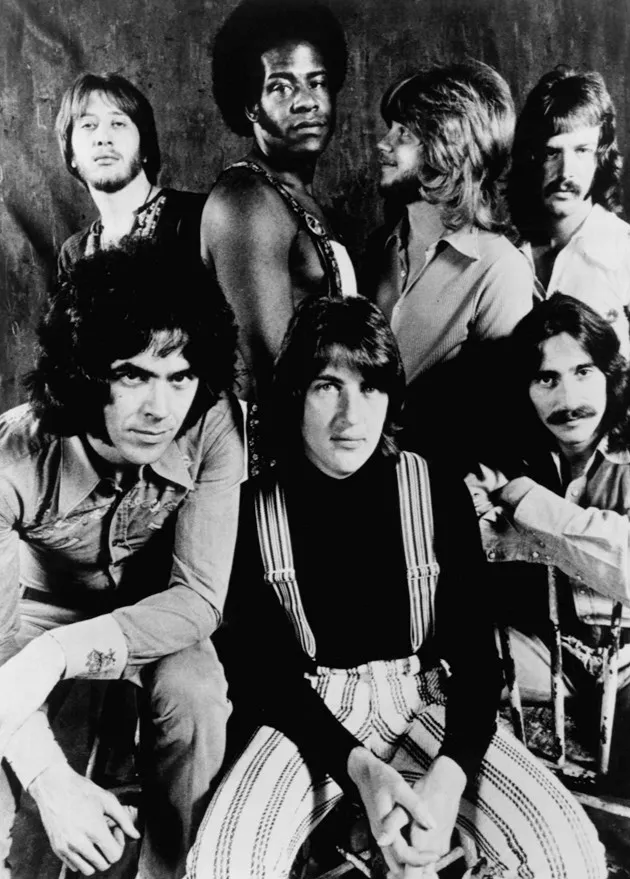
Photo by ABC Television , licensed under Public domain · Wikimedia Commons
Rank #390
Three Dog Night
From Wikipedia
Three Dog Night is an American rock band formed in Los Angeles in 1967, founded by vocalists Chuck Negron, Cory Wells, and Danny Hutton. This lineup was soon augmented by Jimmy Greenspoon (keyboards), Joe Schermie, Michael Allsup (guitar), and Floyd Sneed (drums). The band had 21 Billboard Hot 100 top 40 hits between 1969 and 1975, with three hitting number one. Three Dog Night recorded many songs written by outside songwriters, and they helped to introduce mainstream audiences to writers such as Harry Nilsson ("One"), Randy Newman, Paul Williams, Laura Nyro and Hoyt Axton.
Members
- Cory Wells (?–2015)
- Danny Hutton
- Jimmy Greenspoon (?–2015)
- Michael Allsup
Discography & Previews
Browse through and click an album to open and play 30-second previews streamed from Apple Music.

Three Dog Night
1968 · 11 tracks
- 1 One (Single Version) ↗ 3:06
- 2 Nobody (Single Version) ↗ 2:23
- 3 Heaven Is in Your Mind ↗ 3:01
- 4 It's for You (Single Version) ↗ 1:39
- 5 Let Me Go ↗ 2:31
- 6 Chest Fever ↗ 4:50
- 7 Find Someone to Love ↗ 2:03
- 8 Bet No One Ever Hurt This Bad ↗ 4:10
- 9 Don't Make Promises ↗ 2:53
- 10 The Loner ↗ 2:35
- 11 Try a Little Tenderness ↗ 4:07

Suitable for Framing
1969 · 10 tracks
- 1 Feeling Alright ↗ 3:41
- 2 Lady Samantha ↗ 2:55
- 3 Dreaming Isn't Good for You ↗ 2:17
- 4 A Change Is Gonna Come ↗ 3:12
- 5 Eli's Coming (Single Version) ↗ 2:42
- 6 Easy to Be Hard (Single Version) ↗ 3:12
- 7 Ain't That a Lotta Love ↗ 2:18
- 8 King Soloman's Mines ↗ 2:31
- 9 Circle for a Landing ↗ 2:22
- 10 Celebrate ↗ 3:15


Harmony
1971 · 10 tracks
- 1 Never Been to Spain ↗ 3:46
- 2 My Impersonal Life ↗ 4:27
- 3 An Old Fashioned Love Song ↗ 3:26
- 4 Never Dreamed You'd Leave In Summer ↗ 3:49
- 5 Jam ↗ 3:55
- 6 You ↗ 3:05
- 7 Night In the City ↗ 3:19
- 8 Murder In My Heart for the Judge ↗ 3:41
- 9 The Family of Man (Single Version) ↗ 3:35
- 10 Intro Poem: Mistakes and Illusions ↗ 3:11


Hard Labor
1974 · 9 tracks
- 1 Prelude ↗ 1:01
- 2 Sure As I'm Sittin' Here (Single Version) ↗ 4:46
- 3 Anytime Babe ↗ 3:23
- 4 Put Out the Light ↗ 3:07
- 5 Sitting In Limbo ↗ 4:57
- 6 I'd Be So Happy (Single Version) ↗ 5:06
- 7 Play Something Sweet (Brickyard Blues) [Single Version] ↗ 4:48
- 8 On the Way Back Home ↗ 4:15
- 9 The Show Must Go On ↗ 4:27

Coming Down Your Way
1975 · 10 tracks
- 1 'Til the World Ends (Single Version) ↗ 3:32
- 2 You Can Leave Your Hat On ↗ 4:14
- 3 Good Old Feeling ↗ 3:10
- 4 Mind Over Matter ↗ 2:57
- 5 Midnight Flyer (Eli Wheeler) ↗ 4:34
- 6 Kite Man ↗ 3:39
- 7 Coming Down Your Way ↗ 3:11
- 8 When It's Over ↗ 3:38
- 9 Lean Back, Hold Steady ↗ 3:47
- 10 Yo Te Quiero Hablar ↗ 3:11


Three Dog Night with the London Symphony Orchestra
2002 · 16 tracks
- 1 Overture (feat. London Symphony Orchestra) ↗ 5:52
- 2 Mama Told Me Not to Come (feat. London Symphony Orchestra) ↗ 3:24
- 3 Black and White (feat. London Symphony Orchestra) ↗ 2:26
- 4 Shambala (feat. London Symphony Orchestra) ↗ 3:37
- 5 Prelude to Liar (feat. London Symphony Orchestra) ↗ 2:56
- 6 Liar (feat. London Symphony Orchestra) ↗ 4:25
- 7 Easy to Be Hard (feat. London Symphony Orchestra) ↗ 3:32
- 8 Old Fashioned Love Song (feat. London Symphony Orchestra) ↗ 4:04
- 9 Never Been to Spain (feat. London Symphony Orchestra) ↗ 3:23
- 10 Prelude to One (feat. London Symphony Orchestra) ↗ 2:29
- 11 One (feat. London Symphony Orchestra) ↗ 3:27
- 12 Sault Ste. Marie (feat. London Symphony Orchestra) ↗ 3:33
- 13 Out in the Country (feat. London Symphony Orchestra) ↗ 4:00
- 14 Overground (feat. London Symphony Orchestra) ↗ 5:09
- 15 Celebrate (feat. London Symphony Orchestra) ↗ 2:42
- 16 Joy to the World (feat. London Symphony Orchestra) ↗ 3:04
-
 Three Dog NightThree Dog Night196811 tracks
 -
 Suitable for FramingThree Dog Night196910 tracks
 -
 NaturallyThree Dog Night197010 tracks
 -
 It Ain’t EasyThree Dog Night19709 tracks
 -
 HarmonyThree Dog Night197110 tracks
 -
 CyanThree Dog Night19739 tracks
 -
 Hard LaborThree Dog Night19749 tracks
 -
 Coming Down Your WayThree Dog Night197510 tracks
 -
 American PastimeThree Dog Night19769 tracks
 -
 Three Dog Night with the London Symphony OrchestraThree Dog Night200216 tracks
Deep Dive
Overview
Three Dog Night stands as one of the most commercially successful rock bands of the early 1970s, a Los Angeles-based ensemble that became a powerhouse on the Billboard charts with 21 Top 40 hits between 1969 and 1975. The band’s defining characteristic was not so much a unified songwriting voice as an ability to interpret material by accomplished outside writers, bringing songs by Harry Nilsson, Randy Newman, Paul Williams, Laura Nyro, and Hoyt Axton to mainstream audiences who might otherwise never have encountered them. This interpretive mission made Three Dog Night a crucial bridge between the singer-songwriter era and arena rock, and their sustained commercial dominance demonstrated the lasting appeal of pop-inflected rock in the early 1970s.
Formation Story
Three Dog Night took shape in Los Angeles in 1968, founded by three vocalists: Chuck Negron, Cory Wells, and Danny Hutton. This triple-vocal approach immediately distinguished the band from its peers, offering a richer harmonic palette and the flexibility to deploy different vocal textures across their catalog. The founding trio was joined by keyboardist Jimmy Greenspoon, bassist Joe Schermie, guitarist Michael Allsup, and drummer Floyd Sneed, assembling a unit with both the rock credibility of a live band and the musical sophistication necessary to execute complex arrangements of outside material. The Los Angeles of 1968 was fertile ground for such an ensemble: the city was home to both the AM radio infrastructure that would propel them to stardom and a thriving studio musician culture that would supply them with adept collaborators and producers.
Breakthrough Moment
Three Dog Night’s ascent to national prominence came swiftly. Their 1969 album Suitable for Framing marked their arrival as a hitmaking force, introducing their version of Harry Nilsson’s “One” to the American public and securing their place on the pop charts. The band’s willingness to interpret songs from contemporary songwriters gave them a unique advantage: they were not bound by a single songwriter’s vision or the pressure to generate hits from an in-house stable of composers. Instead, they could cherry-pick material tailored to their three-part vocal arrangements and their audience’s appetites. This formula proved devastatingly effective, and by 1970 they had become one of the most consistent hitmakers in rock, with three number-one singles to their credit across the early part of the decade.
Peak Era
The years 1970–1973 represented Three Dog Night’s commercial and creative zenith. Albums such as Naturally (1970), It Ain’t Easy (1970), Harmony (1971), Seven Separate Fools (1972), and Cyan (1973) arrived in rapid succession, each packed with crafted pop-rock songs designed for both AM radio and album-oriented rock radio. The band’s three-vocalist configuration allowed them to inject melodic urgency into material that might have sounded flat in other hands, and their backing musicians provided muscular, disciplined arrangements that balanced pop accessibility with rock credibility. During this period, Three Dog Night became a fixture on the Billboard Hot 100, racking up chart hits with a consistency that few rock bands have ever matched. Their ability to identify strong material from outside writers and execute it with professional polish made them the decade’s ultimate interpretive ensemble.
Musical Style
Three Dog Night’s sound centered on the interplay of their three lead vocalists, a device that allowed them to shift between solo passages, harmonized choruses, and call-and-response sections within a single song. Underpinning the vocals was a tightly organized rock formation: Allsup’s guitar work ranged from textured rhythm playing to melodic lead passages, Greenspoon’s keyboards (from organ to piano to synthesizer) added harmonic color and orchestral depth, and the Sneed-Schermie rhythm section locked in with the precision required of a band that spent its existence adapting to different songwriters’ visions. The band’s arrangements leaned toward the lush and melodic end of the rock spectrum—strings and horn sections frequently augmented their core sound, and their production typically emphasized clarity and separation of instruments rather than raw power. Vocally, the three singers brought distinct timbres to their work: this tonal variety became a signature trait, preventing any single song from relying on one voice’s charisma and distributing the interpretive burden across the trio.
Major Albums
Suitable for Framing (1969)
The album that launched Three Dog Night into the national consciousness, Suitable for Framing introduced the formula that would sustain them: carefully chosen material from outside writers, performed with the band’s full harmonic and instrumental resources. The success of “One” established them as hit-makers.
Naturally (1970)
Released in the band’s peak year, Naturally demonstrated their facility with a wide range of material and their ability to deliver consecutive albums of commercial and artistic merit. The album solidified their presence on both pop and rock radio.
It Ain’t Easy (1970)
Another 1970 release, It Ain’t Easy kept the momentum moving, showcasing the band’s adaptability and their core audience’s appetite for new material from the group.
Harmony (1971)
By Harmony, Three Dog Night had honed their approach to a science, blending intricate vocal arrangements with sophisticated musical accompaniment. The album represents the band operating at peak efficiency.
Seven Separate Fools (1972)
Seven Separate Fools maintained the band’s commercial viability during a period when their chart dominance was beginning to soften, though they remained a significant force on radio.
Signature Songs
- “One” — Harry Nilsson’s composition, performed with lush vocal harmonies, became one of the band’s signature hits and demonstrated their gift for interpreting outside material.
- “Mama Told Me Not to Come” — Randy Newman’s composition, executed with the band’s characteristic three-part vocals and rock-solid arrangement.
- “Joy to the World” — A showcase for their vocal prowess and their ability to turn melodic material into radio gold.
- “Black and White” — Showcased the band’s ability to handle socially conscious material while maintaining mainstream pop appeal.
- “The Family of Man” — A demonstration of the band’s harmonic sophistication and their capacity for earnest, multi-vocal balladry.
- “Never Been to Spain” — A country-influenced number that allowed the band to prove their versatility beyond pure pop-rock.
Influence on Rock
Three Dog Night’s impact on rock music was primarily one of accessibility and cross-pollination. By bringing songs from contemporary singer-songwriters into the mainstream rock and pop markets, they helped establish the idea that rock radio could accommodate diverse songwriting voices. Their success with material by Randy Newman, Paul Williams, and Laura Nyro exposed millions of radio listeners to writers who might otherwise have remained cult figures. The band’s commercial dominance also demonstrated that rock did not require a unified band identity or a singular songwriting voice—instead, a well-organized ensemble with strong musicianship and distinctive characteristics could thrive on interpretation and professional execution. In this sense, they paved a path for later rock bands that relied on material from outside writers rather than in-house compositions.
Legacy
Three Dog Night’s commercial peak faded by the mid-1970s as radio tastes shifted and the band’s interpretive model became less fashionable in an era that increasingly prized artist-written rock. However, their 21 Top 40 hits between 1969 and 1975 remain a testament to their era’s commercial muscle. The band has continued to perform, demonstrating the longevity of their catalogue and the enduring appeal of their arrangement of classic rock standards and pop songs. A 2002 collaboration with the London Symphony Orchestra showed the band willing to revisit their material with orchestral arrangements, honoring their original approach of adding sophisticated instrumentation to pop-rock songs. Their songs remain staples of classic rock radio and oldies formats, and their contribution to the mainstream acceptance of singer-songwriter material in the early 1970s has proven durable.
Fun Facts
- The band’s triple-vocalist configuration was highly unusual for rock bands of the era, inspired by the success of vocal groups from earlier decades and allowing them to tackle arrangements that would have been impossible for a single frontman.
- Three Dog Night recorded for multiple major labels throughout their career, including Epic Records, Columbia Records, and Dunhill, following the industry patterns of the era.
- Several key members, including Cory Wells and Jimmy Greenspoon, remained with the band well into the 2010s, giving the group remarkable stability across decades.
- The band became known for their ability to identify and record songs before or simultaneously with artists more closely associated with them, earning them credit as tastemakers as well as interpreters.