
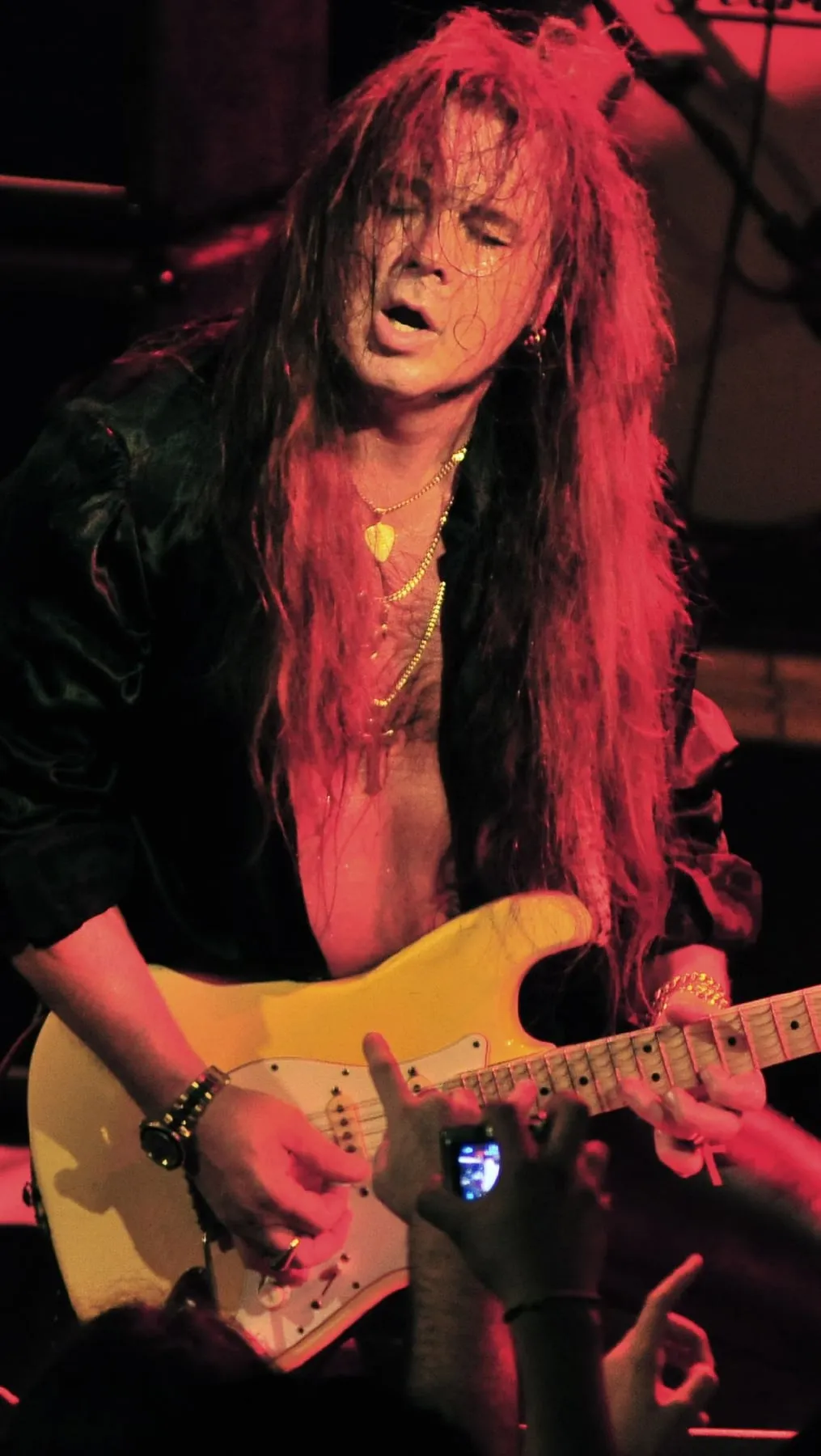
Photo by Alterna2 http://www.alterna2.com , licensed under CC BY 2.0 · Wikimedia Commons
Rank #341
Yngwie Malmsteen
From Wikipedia
Yngwie Johan Malmsteen is a Swedish-American guitarist. He first became known in the 1980s for his neoclassical playing style in heavy metal, and has released 22 studio albums in a career spanning over 40 years.
Discography & Previews
Browse through and click an album to open and play 30-second previews streamed from Apple Music.


Eclipse
1990 · 11 tracks

Fire & Ice
1992 · 14 tracks
- 1 Perpetual ↗ 4:14
- 2 Dragonfly ↗ 4:50
- 3 Teaser ↗ 3:29
- 4 How Many Miles to Babylon ↗ 6:11
- 5 Cry No More ↗ 5:17
- 6 No Mercy ↗ 5:33
- 7 C'est La Vie ↗ 5:19
- 8 Leviathan ↗ 4:26
- 9 Fire and Ice ↗ 4:31
- 10 Forever Is a Long Time ↗ 4:27
- 11 I'm My Own Enemy ↗ 6:10
- 12 All I Want Is Everything ↗ 4:02
- 13 Golden Dawn ↗ 1:30
- 14 Final Curtain ↗ 4:47


Facing the Animal
1997 · 13 tracks
- 1 Braveheart ↗ 5:18
- 2 Facing the Animal ↗ 4:37
- 3 Enemy ↗ 4:53
- 4 Sacrifice ↗ 4:17
- 5 Like an Angel – For April ↗ 5:48
- 6 My Resurrection ↗ 4:47
- 7 Another Time ↗ 5:03
- 8 Heathens from the North ↗ 3:38
- 9 Alone In Paradise ↗ 4:34
- 10 End of My Rope ↗ 4:23
- 11 Only the Strong ↗ 6:05
- 12 Poison In My Veins ↗ 4:21
- 13 Air On a Theme ↗ 1:44


Blue Lightning
2019 · 12 tracks
-
 TrilogyYngwie Malmsteen19869 tracks
 -
 EclipseYngwie Malmsteen199011 tracks
 -
 Fire & IceYngwie Malmsteen199214 tracks
 -
 The Seventh SignYngwie Malmsteen199412 tracks
 -
 Magnum OpusYngwie Malmsteen199512 tracks
 -
 InspirationYngwie Malmsteen199610 tracks
 -
 Facing the AnimalYngwie Malmsteen199713 tracks
 -
 Angels of LoveYngwie Malmsteen200910 tracks
 -
 World on FireYngwie Malmsteen201611 tracks
 -
 Blue LightningYngwie Malmsteen201912 tracks
 -
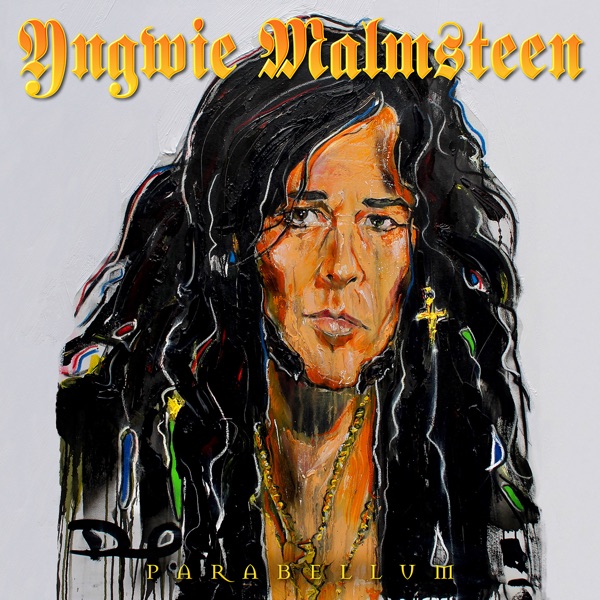
 ParabellumYngwie Malmsteen202110 tracks
Deep Dive
Overview
Yngwie Johan Malmsteen is a Swedish-American guitarist who emerged in the 1980s as one of the defining figures of neoclassical metal, a fusion of baroque and classical harmony with electric guitar virtuosity and heavy metal intensity. Over more than four decades of recording and performing, Malmsteen has released 22 studio albums that showcase an uncompromising commitment to technical mastery and compositional ambition. His influence on heavy metal guitar playing remains foundational: he demonstrated that the electric guitar could serve as a legitimate orchestral voice, capable of executing classical repertoire and original compositions of symphonic scope.
Formation Story
Born in Sweden in 1963, Malmsteen came of age during a period when rock guitar was dominated by blues-based soloing and three-chord progressions. His path diverged sharply from his contemporaries early on. Rather than apprenticing in American blues or British hard rock traditions, Malmsteen rooted his approach in European classical music—specifically the baroque and romantic periods. He absorbed the harmonic language and technical demands of composers like Paganini and Bach, then grafted that sensibility onto the power and distortion of the electric guitar. This fusion was neither a trendy pastiche nor a dilution of either idiom; it was a genuine synthesis that opened new possibilities for what rock and metal guitarists could attempt.
Breakthrough Moment
Malmsteen’s international breakthrough came with the release of his debut studio album, Trilogy, in 1986. The album introduced listeners to his signature sound in full force: shimmering, fast-picked arpeggios that climbed and descended with almost mathematical precision, layered over heavy metal arrangements and dramatic dynamic shifts. Trilogy established the template that would define his work: virtuoso instrumental passages interspersed with songs built on neoclassical themes, plus at least one large-scale orchestral composition. The album’s success in both the metal underground and mainstream rock radio showed that there was an audience hungry for technical guitar-driven music that refused to compromise on either complexity or heaviness. Where many guitar virtuosos in the 1980s were viewed as novelty acts, Malmsteen secured a sustained recording and touring career that would span decades.
Peak Era
The period from 1990 to 1998 represents Malmsteen’s most prolific and artistically expansive phase. Following Trilogy, he released Eclipse in 1990, Fire & Ice in 1992, and The Seventh Sign in 1994, each album deepening his exploration of neoclassical metal while experimenting with different vocal partnerships and production styles. Magnum Opus (1995) and Inspiration (1996) continued this trajectory of ambitious, guitar-centric songwriting. The release of Concerto Suite for Electric Guitar and Orchestra in E-flat minor, op. 1 in 1998 marked a career pinnacle—a full orchestral concerto showcasing the electric guitar as a concert instrument, a formal statement of Malmsteen’s lifelong artistic goal. This album stands as one of the few rock-metal recordings to seriously engage with classical concert music on its own terms rather than as a novelty crossover.
Musical Style
Malmsteen’s sound is immediately recognizable and rooted in three technical pillars: rapid alternate picking, neo-baroque melodic phrasing, and harmonic minor modal interchange. His right hand executes tremolo picking—rapid, continuous strikes of the pick across single strings or entire arpeggios—at speeds that were remarkable when he emerged in the 1980s and remain impressive today. His left hand navigates classical-derived sequences: cascading sixteenth-note arpeggios, wide intervallic leaps, and chromatic passing tones borrowed from Bach and Paganini. Harmonically, he favors the harmonic and melodic minor scales, diminished chords, and neo-baroque chord progressions that avoid the blues pentatonic simplicity of mainstream rock. Vocally, his albums have featured multiple singers, but production-wise, the guitar remains the dominant voice; songs are built as vehicles for instrumental exposition rather than around three-minute pop structures.
Over his career, Malmsteen’s approach has remained fundamentally consistent—he has not pursued genre experimentation or radical stylistic reinvention. Instead, his evolution has been one of increasing confidence and sophistication within his established idiom. Later albums such as World on Fire (2016), Blue Lightning (2019), and Parabellum (2021) demonstrate that his core vision has endured intact across four decades, even as production technologies and recording practices evolved around him.
Major Albums
Trilogy (1986)
Malmsteen’s debut and statement of purpose, Trilogy introduced neoclassical metal as a fully realized sound and established all the elements—virtuoso instrumental passages, dramatic arrangement, orchestral pretension—that would define his subsequent work.
Eclipse (1990)
A commercial and artistic peak, Eclipse refined the formula of Trilogy while deepening both the technical difficulty of compositions and the sophistication of their melodic content, confirming Malmsteen’s staying power beyond a debut novelty.
The Seventh Sign (1994)
Malmsteen’s third major album consolidated his position as the undisputed master of neoclassical metal, featuring some of his most memorable compositions and sustained technical writing.
Concerto Suite for Electric Guitar and Orchestra in E-flat minor, op. 1 (1998)
A career landmark: a full orchestral concerto that positioned the electric guitar as a legitimate orchestral soloist, validating Malmsteen’s long-stated ambition to reconcile classical music and rock on equal terms.
Relentless (2010)
After a long hiatus in studio releases, Relentless demonstrated that Malmsteen’s technical abilities and compositional voice remained undiminished, reinvigorating his recording output for the final phase of his career.
Signature Songs
- Fire and Ice — A showcase of Malmsteen’s ability to write memorable melodic themes within a neoclassical framework, balancing technical passages with genuine hooks.
- Concerto Suite — The orchestral centerpiece of his 1998 concerto album, demonstrating the electric guitar’s capacity to function as a concert instrument.
- Far Beyond the Sun — A signature instrumental of rapid arpeggio work and baroque-derived phrasing that became a staple of his live performances.
- Rising Force — An early instrumental that helped define the neoclassical metal sound and established Malmsteen’s technical credentials with audiences and musicians alike.
Influence on Rock
Malmsteen’s impact on rock and metal guitar playing has been profound and multifaceted. He proved that technical mastery and compositional ambition were not obstacles to commercial viability in rock music; instead, they could define an entire subgenre. The neoclassical metal movement that emerged in the 1980s—a wave that included musicians who studied or absorbed Malmsteen’s approach—fundamentally altered what audiences expected from metal guitarists. Shredding, the practice of playing at extreme speed with technical precision, became a valued skill rather than a novelty. His insistence on classical harmony and baroque structures within heavy metal compositions opened ears to the possibility of fusion between traditionally separate musical worlds. Subsequent generations of progressive metal and metal musicians working in the 21st century trace a lineage through Malmsteen’s work; his example made it acceptable for rock musicians to embrace formal orchestral composition, complex time signatures, and harmonic sophistication without sacrificing the genre’s power and aggression.
Moreover, Malmsteen’s career demonstrated the viability of the guitar virtuoso as a solo artist and bandleader, rather than merely as a session player or sideman. He maintained artistic control over his output, released albums on a regular basis (particularly from 1986 to 1998), and built a fanbase that followed his compositional evolution rather than demanding repetition of early hits.
Legacy
Malmsteen’s career spans more than 40 years and 22 studio albums, an output that places him among the most prolific instrumentalists in rock and metal history. His neoclassical metal sound has not fallen out of favor; instead, it has been absorbed into the broader vocabulary of progressive and technical metal subgenres. Young guitarists discovering metal in the 21st century continue to encounter Malmsteen’s recordings as foundational texts, and his albums remain widely available on streaming platforms, ensuring that successive generations have access to his work. His insistence on merging classical music and rock, far from being a 1980s novelty, has proven to be a durable artistic vision that stands the test of time.
The release of Parabellum in 2021, more than 35 years after his debut, confirms that Malmsteen has not abandoned his core artistic mission. He remains active as a recording artist and performer, touring internationally and maintaining a presence on his official website and social media. His influence can be traced through countless metal and rock musicians who cite his technical facility and compositional ambition as inspirational.
Fun Facts
- Malmsteen recorded a full concerto for electric guitar and orchestra in 1998, formally titling it Concerto Suite for Electric Guitar and Orchestra in E-flat minor, op. 1—a gesture toward the classical canon that underscores his lifelong mission to legitimize the electric guitar within concert music.
- His early success in the 1980s made him one of the first major recording artists to emerge from the Swedish metal scene, predating the broader Scandinavian metal boom of the 1990s.
- Despite his virtuosity and technical perfectionism, Malmsteen has remained based largely in the United States, building his career through American record labels like Polydor and American touring circuits rather than primarily European venues.