
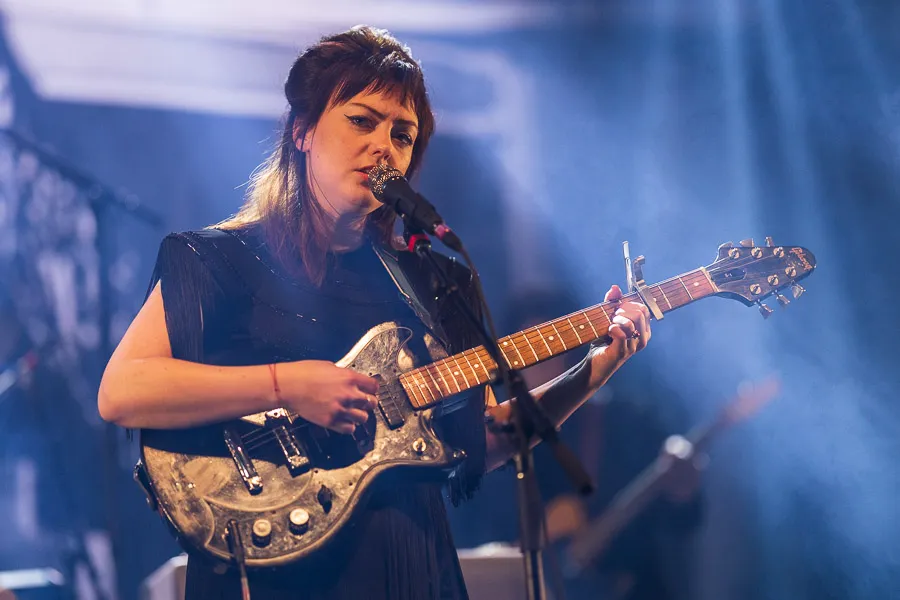
Photo by Stian Schløsser Møller , licensed under CC BY-SA 4.0 · Wikimedia Commons
Rank #102
Angel Olsen
From Wikipedia
Angel Olsen is an American singer-songwriter from St. Louis, Missouri who lives in Asheville, North Carolina.
Discography & Previews
Browse through and click an album to open and play 30-second previews streamed from Apple Music.

Half Way Home
2012 · 11 tracks


Whole New Mess
2020 · 11 tracks
- 1 Whole New Mess ↗ 3:43
- 2 Too Easy (Bigger Than Us) ↗ 2:32
- 3 (New Love) Cassette ↗ 2:50
- 4 (We Are All Mirrors) ↗ 2:37
- 5 (Summer Song) ↗ 4:10
- 6 Waving, Smiling ↗ 3:52
- 7 Tonight (Without You) ↗ 4:01
- 8 Lark Song ↗ 6:31
- 9 Impasse (Workin' for the Name) ↗ 3:48
- 10 Chance (Forever Love) ↗ 5:29
- 11 What It Is (What It Is) ↗ 2:36

-
 Half Way HomeAngel Olsen201211 tracks
 -
 Burn Your Fire for No WitnessAngel Olsen201411 tracks
 -
 MY WOMANAngel Olsen201610 tracks
 -
 All MirrorsAngel Olsen201911 tracks
 -
 Whole New MessAngel Olsen202011 tracks
 -
 Big TimeAngel Olsen202210 tracks
 -
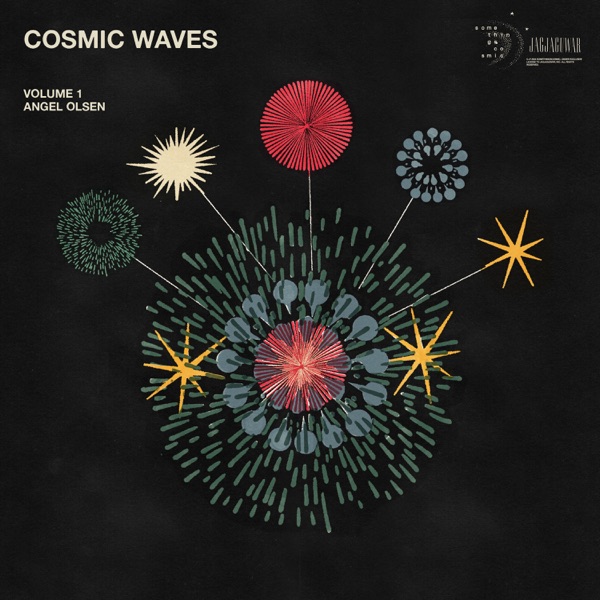
 Cosmic Waves, Volume 1Angel Olsen202410 tracks
Deep Dive
Overview
Angel Olsen is an American singer-songwriter and instrumentalist whose work spans pop rock and traditional folk idioms. Born in St. Louis, Missouri in 1987, Olsen emerged in the early 2010s as a distinctive voice in contemporary alternative music, eventually becoming one of the most acclaimed pop-rock artists of her generation. Her career trajectory—from bedroom recordings to festival headliner—reflects a broader shift in how singer-songwriters could build devoted audiences outside traditional industry gatekeeping structures.
Formation Story
Angel Olsen grew up in St. Louis, a city with deep roots in American popular music spanning blues, ragtime, and soul. Her musical education drew from both traditional folk songwriting and the DIY ethos that had animated underground rock for decades. In the late 2000s and early 2010s, as digital distribution and social media began reshaping how artists could reach listeners, Olsen began recording and releasing her own material. She signed to the independent label Jagjaguwar, a decision that aligned her with a lineage of art-rock and experimental pop practitioners. By 2012, she was positioned within the broader singer-songwriter revival that characterized the early 2010s, though her approach to arrangement and production would gradually distinguish her from contemporaries.
Breakthrough Moment
Olsen’s early albums, Half Way Home (2012) and Burn Your Fire for No Witness (2014), established her reputation among indie-music listeners and critics. However, her breakthrough to wider recognition came with MY WOMAN (2016), a landmark album that found her fully realized as a producer and arranger of her own vision. The album demonstrated a command of studio dynamics, layered orchestration, and emotional directness that elevated her beyond the minimal-instrumentation singer-songwriter template. MY WOMAN announced that Olsen had matured into an artist capable of working at album-length with conceptual and sonic ambition.
Peak Era
The period from 2016 through 2022 constituted Olsen’s sustained creative peak. All Mirrors (2019) deepened her exploration of orchestral pop, marking her most expansive and dramatically arranged work to date. The album pushed toward lush string arrangements and dramatic dynamics while maintaining the melodic clarity and emotional vulnerability that defined her songwriting. In 2020, she released Whole New Mess, a companion work that documented alternative takes and sonic approaches to material from the All Mirrors era, expanding the conceptual scope of that creative moment. Big Time (2022) continued her evolution, demonstrating her willingness to revisit and reimagine her own material and aesthetic foundations. Throughout this period, Olsen established herself as a festival fixture and a major touring artist, performing at leading venues and events worldwide.
Musical Style
Angel Olsen’s sound is built on a foundation of pop-rock songwriting informed by traditional folk sensibilities. Her voice—warm, precise, and capable of both whisper-thin vulnerability and full-bodied projection—functions as a primary instrument, often doubled or layered within her arrangements. Early in her career, her work operated in relatively sparse arrangements, allowing the melodic and lyrical content to dominate. Over time, particularly from MY WOMAN onward, she expanded her instrumental palette to include orchestral strings, synthesizers, and more complex production textures. Her songwriting gravitates toward emotional directness paired with oblique or impressionistic lyrical imagery. The production choices across her albums reflect a growing comfort with studio layering and spatial arrangement, placing her within a lineage of singer-songwriters like Joni Mitchell who understood the studio as an instrument in itself. Her work bridges the gap between intimate confessional songwriting and pop-influenced melodicism.
Major Albums
Half Way Home (2012)
Olsen’s debut album for Jagjaguwar, establishing her fundamental approach to folk-influenced pop songwriting with minimal production.
Burn Your Fire for No Witness (2014)
A more assured second album that deepened her compositional voice and began experimenting with subtle textural additions beyond sparse instrumentation.
MY WOMAN (2016)
A watershed moment in which Olsen fully embraced orchestral arrangement and studio production as central to her vision, marking her emergence as a complete artist-producer.
All Mirrors (2019)
Her most expansive work, using lush string arrangements and dramatic dynamic shifts while maintaining melodic clarity and emotional directness.
Whole New Mess (2020)
A companion work offering alternative versions and perspectives on the All Mirrors era, expanding the conceptual scope of that creative period.
Big Time (2022)
A continued evolution demonstrating her ongoing willingness to reimagine her material and refine her aesthetic approach.
Signature Songs
- “Sister” — A showcase for Olsen’s layered vocal arrangements and emotional intensity within the pop-rock framework.
- “Intern” — A prime example of her ability to pair melodic accessibility with complex production textures.
- “Lark” — Demonstrates her gift for folk-influenced melody combined with orchestral arrangement.
- “Shut Up Kiss Me” — Highlights her pop sensibility and ability to write hooks within art-pop contexts.
Influence on Rock
Angel Olsen arrived at a moment when the singer-songwriter tradition was being substantially reimagined by artists embracing studio production and genre-crossing aesthetics. Her work contributed to a broader 2010s shift in which pop-rock could accommodate both emotional vulnerability and sophisticated arrangement without contradiction. By demonstrating that folk-influenced songwriting could expand into orchestral and electronic textures without losing intimacy, she helped expand what was considered possible within independent pop-rock. Her approach to self-production and album-making influenced younger artists working within similar DIY and indie-label contexts who understood the studio as creative tool rather than mere documentation space.
Legacy
By 2024, Angel Olsen had established herself as a significant figure in contemporary rock and pop music. The release of Cosmic Waves, Volume 1 in 2024 indicated her continued artistic activity and evolution. Her discography demonstrates a musician committed to sustained artistic development across more than a decade, moving through distinct phases while maintaining core compositional and emotional integrity. Her career is emblematic of how independent artists working outside major-label systems could, through talent and consistent creative output, build substantial cultural presence and critical regard. Her influence continues to be felt in contemporary singer-songwriter and art-pop contexts.
Fun Facts
- Angel Olsen maintains an official presence at angelolsen.com, directly connecting with her audience outside traditional media gatekeeping.
- She relocated from Missouri to Asheville, North Carolina, positioning herself within a contemporary music community that has become increasingly significant in American indie and alternative music.
- The album Tim Kinsella Sings the Songs of Marvin Tate by Leroy Bach (2013) demonstrates her collaborative and experimental impulses outside her primary solo discography.
- Her continued touring and festival presence from 2016 onward established her as a major live performer, with her performances becoming known for their emotional intensity and sonic sophistication.