
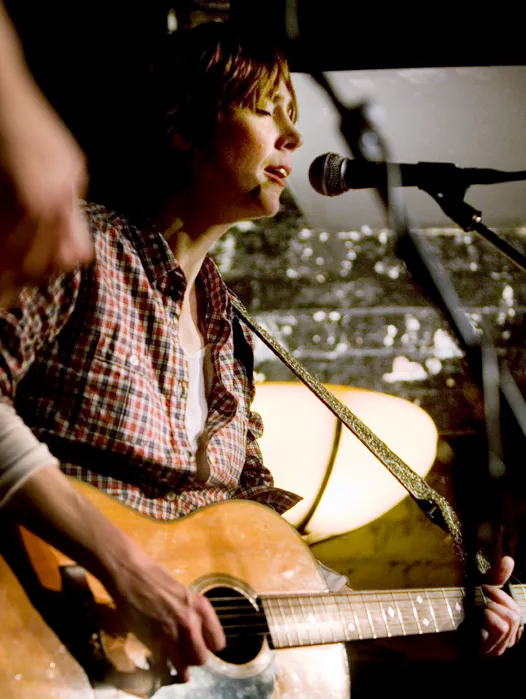
Photo by Simon Fernandez , licensed under CC BY 2.0 · Wikimedia Commons
Rank #283
Beth Orton
From Wikipedia
Elizabeth Caroline Orton is an English musician. Known for her "folktronica" sound, which mixes elements of folk and electronica, she was initially recognised for her collaborations with William Orbit, Andrew Weatherall, Red Snapper and the Chemical Brothers in the mid-1990s. Her UK/US first solo album, Trailer Park, received much critical acclaim in 1996. Orton developed a devoted audience with the release of the BRIT Award-winning album Central Reservation (1999) and the 2002 UK top 10 album, Daybreaker. Her 2006 album, Comfort of Strangers, was followed by a break during which Orton gave birth to her daughter and collaborated with the British guitarist Bert Jansch. Orton returned with Sugaring Season in 2012, which moved towards a purer acoustic sound, followed by a return to electronic music with Kidsticks, released in 2016.
Discography & Previews
Browse through and click an album to open and play 30-second previews streamed from Apple Music.
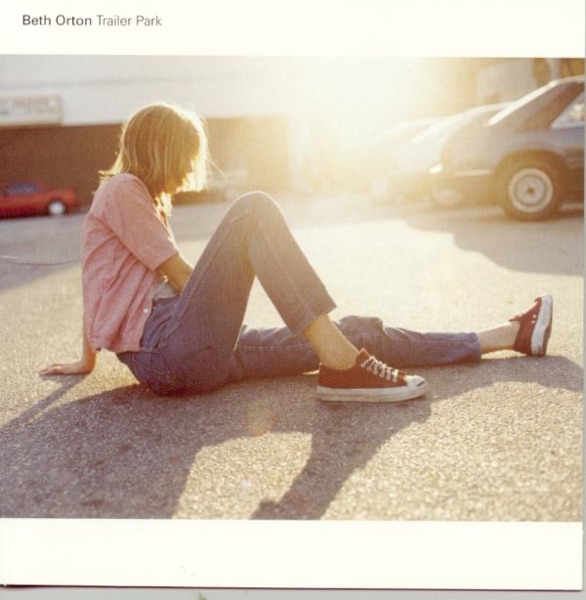
Trailer Park
1996 · 11 tracks
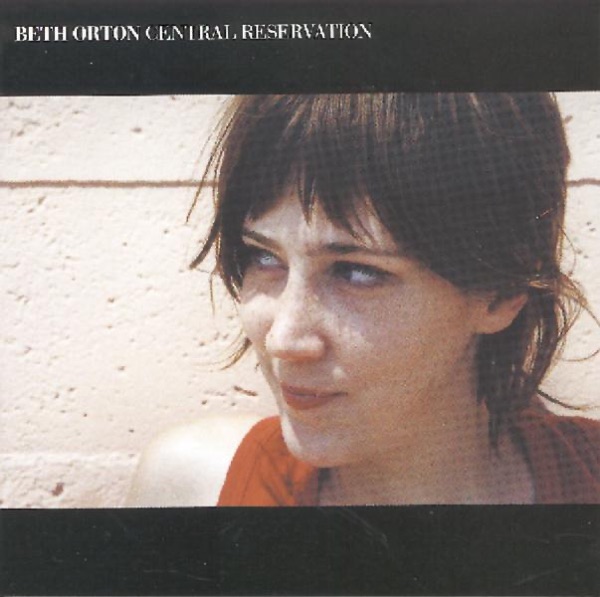
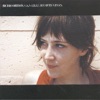
Central Reservation
1998 · 12 tracks
- 1 Stolen Car ↗ 5:26
- 2 Sweetest Decline ↗ 5:39
- 3 Couldn't Cause Me Harm ↗ 4:48
- 4 So Much More ↗ 5:42
- 5 Pass In Time ↗ 7:18
- 6 Central Reservation ↗ 4:51
- 7 Stars All Seem to Weep ↗ 4:40
- 8 Love Like Laughter ↗ 3:07
- 9 Blood Red River ↗ 4:16
- 10 Devil Song ↗ 5:05
- 11 Feel to Believe ↗ 4:03
- 12 Central Reservation (The Then Again Version) ↗ 4:04


Heart Of Soul
2005 · 2 tracks

Comfort of Strangers
2006 · 14 tracks
- 1 Worms ↗ 2:04
- 2 Countenance ↗ 2:23
- 3 Heartland Truckstop ↗ 2:48
- 4 Rectify ↗ 2:27
- 5 Comfort of Strangers ↗ 3:19
- 6 Shadow of a Doubt ↗ 3:58
- 7 Conceived ↗ 3:28
- 8 Absinthe ↗ 4:02
- 9 A Place Aside ↗ 2:19
- 10 Safe In Your Arms ↗ 4:28
- 11 Shopping Trolley ↗ 2:52
- 12 Feral Children ↗ 3:35
- 13 Heart of Soul ↗ 3:51
- 14 Pieces of Sky ↗ 3:09

Sugaring Season
2012 · 13 tracks
- 1 Magpie ↗ 4:32
- 2 Dawn Chorus ↗ 3:24
- 3 Candles ↗ 3:45
- 4 Something More Beautiful ↗ 3:28
- 5 Call Me the Breeze ↗ 3:52
- 6 Poison Tree ↗ 4:06
- 7 See Through Blue ↗ 1:54
- 8 Last Leaves of Autumn ↗ 4:01
- 9 State of Grace ↗ 4:15
- 10 Mystery ↗ 4:08
- 11 That Summer Feeling ↗ 4:40
- 12 I Wasn't Born to Follow ↗ 4:00
- 13 Goin' Back ↗ 4:04


-
 Trailer ParkBeth Orton199611 tracks
 -
 Central ReservationBeth Orton199812 tracks
 -
 DaybreakerBeth Orton200210 tracks
 -
 Heart Of SoulBeth Orton20052 tracks
 -
 Comfort of StrangersBeth Orton200614 tracks
 -
 Sugaring SeasonBeth Orton201213 tracks
 -
 KidsticksBeth Orton201610 tracks
 -
 Weather AliveBeth Orton20228 tracks
 -
 The Ground AboveBeth Orton20268 tracks
Deep Dive
Overview
Beth Orton is an English musician born in 1970 who became one of the defining figures of 1990s folktronica—a hybrid genre that braids together traditional folk songwriting with electronic and ambient production. Her career began not as a solo act but through high-profile collaborations with electronic producers and DJs, a path that led to her landmark solo debut, Trailer Park (1996). Over three decades, Orton has navigated between electronic experimentation and acoustic purity, building a devoted international following while maintaining artistic credibility across multiple musical territories.
Orton’s significance lies in her refusal to remain fixed. Rather than choosing between folk authenticity and electronic innovation, she proved both could coexist, influencing subsequent generations of artists who similarly moved between acoustic and digital realms. Her career arc—from collaborator to headliner, through motherhood and sabbatical, back to recording—reflects a broader shift in how contemporary musicians balance creative ambition with personal life.
Formation Story
Beth Orton grew up in England during the 1970s and 1980s, absorbing both traditional folk influences and the emerging electronic music culture of the era. Rather than emerging from a particular band or collective, she entered the music industry through producer and collaborator relationships that would define her early identity. In the mid-1990s, working with William Orbit, Andrew Weatherall, the British electronic group Red Snapper, and the Chemical Brothers, Orton’s unmistakable vocal presence and songwriting clarity became a focal point within the electronica and trip-hop scenes—genres where female singer-songwriters remained comparatively rare.
These collaborations were not mere features; they were a form of apprenticeship. Orton learned how to preserve melodic and lyrical integrity while working within the production vocabularies of electronic music, a skill that would become central to her solo identity. By the mid-1990s, she had accumulated enough credibility and material to launch as a solo artist.
Breakthrough Moment
Orton’s debut solo album, Trailer Park, released in 1996, became an immediate critical success in both the UK and US markets. The album synthesized everything she had learned through her collaborative work: it placed her plainspoken, emotionally direct vocal style against textured, often minimal electronic backdrops and acoustic instrumentation. Rather than choosing between folk and electronic, Trailer Park demonstrated that a single song, even a single moment, could hold both. The album’s reception established Orton as more than a featured vocalist—she was a songwriter and artist in her own right, capable of carrying an album with vision and consistency.
Peak Era
Orton’s most commercially successful and creatively focused period spanned the late 1990s and early 2000s. Her second solo album, Central Reservation (1998), deepened the folktronica template and earned her a BRIT Award, confirming her trajectory beyond debut success. The 2002 album Daybreaker reached the UK top 10, representing her highest chart performance and indicating that audiences had fully embraced her hybrid aesthetic. These years saw her consolidate the sound and audience she had sketched on Trailer Park, producing work that balanced accessibility with artistic uncompromise.
Musical Style
Orton’s sound can be described as folktronica—a term that captures her central artistic gesture but does not fully contain it. At its core, her music rests on clear, fingerpicked acoustic guitar and direct vocal delivery rooted in folk and singer-songwriter traditions. Over this foundation, she layers electronic textures: ambient pads, subtle drum machines, samples, and production techniques borrowed from trip-hop and electronica. The effect is neither fully acoustic nor fully electronic, but rather a productive tension between the two. Her vocals remain the constant; whether accompanied by orchestral arrangements or minimal beats, her phrasing and emotional directness anchor the work.
As her career progressed, this balance shifted. Sugaring Season (2012) marked a deliberate move toward purer acoustic sound, stripping away much of the electronic apparatus that had defined her earlier work. Conversely, Kidsticks (2016) returned to electronic music, suggesting that Orton views these poles not as a contradiction but as different facets of a continuous artistic investigation. Her voice—conversational in tone, precise in intonation, never melismatic—remains the consistent element, whether set against minimal instrumentation or rich production.
Major Albums
Trailer Park (1996)
Orton’s debut solo album established the folktronica template and received widespread critical acclaim, positioning her as a significant new voice in both indie and electronic music circles.
Central Reservation (1998)
Winner of a BRIT Award, this album deepened her fusion of folk songwriting and electronic production, solidifying her artistic vision and expanding her audience across the UK and US.
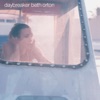
Daybreaker (2002)
Reaching the UK top 10, Daybreaker became Orton’s commercial peak, proving that her hybrid aesthetic had crossed over to mainstream listeners while maintaining critical respect.
Sugaring Season (2012)
Following a break and the birth of her daughter, Orton returned with an album that deliberately moved toward acoustic purity, demonstrating her willingness to reinvent her sound after a hiatus.
Kidsticks (2016)
This album signaled a return to electronic music, showing that Orton’s artistic vocabulary remained expansive and that acoustic and electronic approaches were equally valid expressions of her artistry.
Signature Songs
- “She Cries Your Name” — A signature collaboration that exemplified her early work with electronic producers, blending her introspective vocal with minimal production.
- “Stolen Car” — A standout from Trailer Park that became one of her most enduring songs, showcasing her ability to convey emotional vulnerability over understated arrangements.
- “Central Reservation” — The title track from her BRIT Award-winning album, representing her at peak commercial and creative confidence.
- “Daybreaker” — Lead single from her 2002 album, demonstrating how her sound had evolved toward greater accessibility without sacrificing depth.
Influence on Rock
Orton’s impact on rock and adjacent genres lies in her demonstration that folk authenticity and electronic experimentation were not mutually exclusive. Before her emergence, these territories were often kept separate; the folk-rock establishment dismissed electronica as inauthentic, while electronic musicians viewed acoustic instruments as retro. Orton’s sustained success across both territories influenced subsequent artists who similarly refused rigid genre categorization. Her work helped legitimize folktronica as a sustainable artistic approach and demonstrated that female singer-songwriters could be central figures in electronic and experimental music, not merely featured guests.
Her collaborations with William Orbit, Andrew Weatherall, and others established a model of how established electronic producers could work with songwriter-singers without subordinating the vocal or songwriting to production novelty. This partnership model influenced how electronic music and traditional songwriting have been integrated in the decades since.
Legacy
Beth Orton remains an active recording artist well into the 2020s, with Weather Alive released in 2022 and further work forthcoming, demonstrating sustained creative engagement over three decades. Her influence on folktronica and hybrid acoustic-electronic music is secured; artists working in similar territory acknowledge her pioneering role. The durability of her catalogue—particularly Trailer Park and Central Reservation—across streaming platforms and continued radio play indicates that her work has become part of the standard repertoire of 1990s and 2000s indie and alternative music.
Orton’s career also carries significance beyond music, as an example of an artist who prioritized motherhood without abandoning her creative identity, taking a sabbatical when necessary and returning on her own terms. In the context of the music industry’s historical treatment of women artists, this balance is notable. Her later albums, characterized by varied sonic approaches, suggest an artist who has moved beyond proving herself and instead follows genuine creative impulse, whether that leads toward acoustic simplicity or electronic complexity.
Fun Facts
- Orton collaborated with British guitarist Bert Jansch during the period surrounding the release of Comfort of Strangers (2006), one of several partnerships that enriched her artistic trajectory beyond her solo work.
- Her 1993 release Superpinkymandy predates her better-known debut Trailer Park by three years, showing early experimentation before she achieved wider recognition.
- The term “folktronica,” now associated with Orton’s work, emerged partly through critical efforts to categorize her hybrid sound—a classification she helped popularize through sustained practice rather than explicit manifesto.