
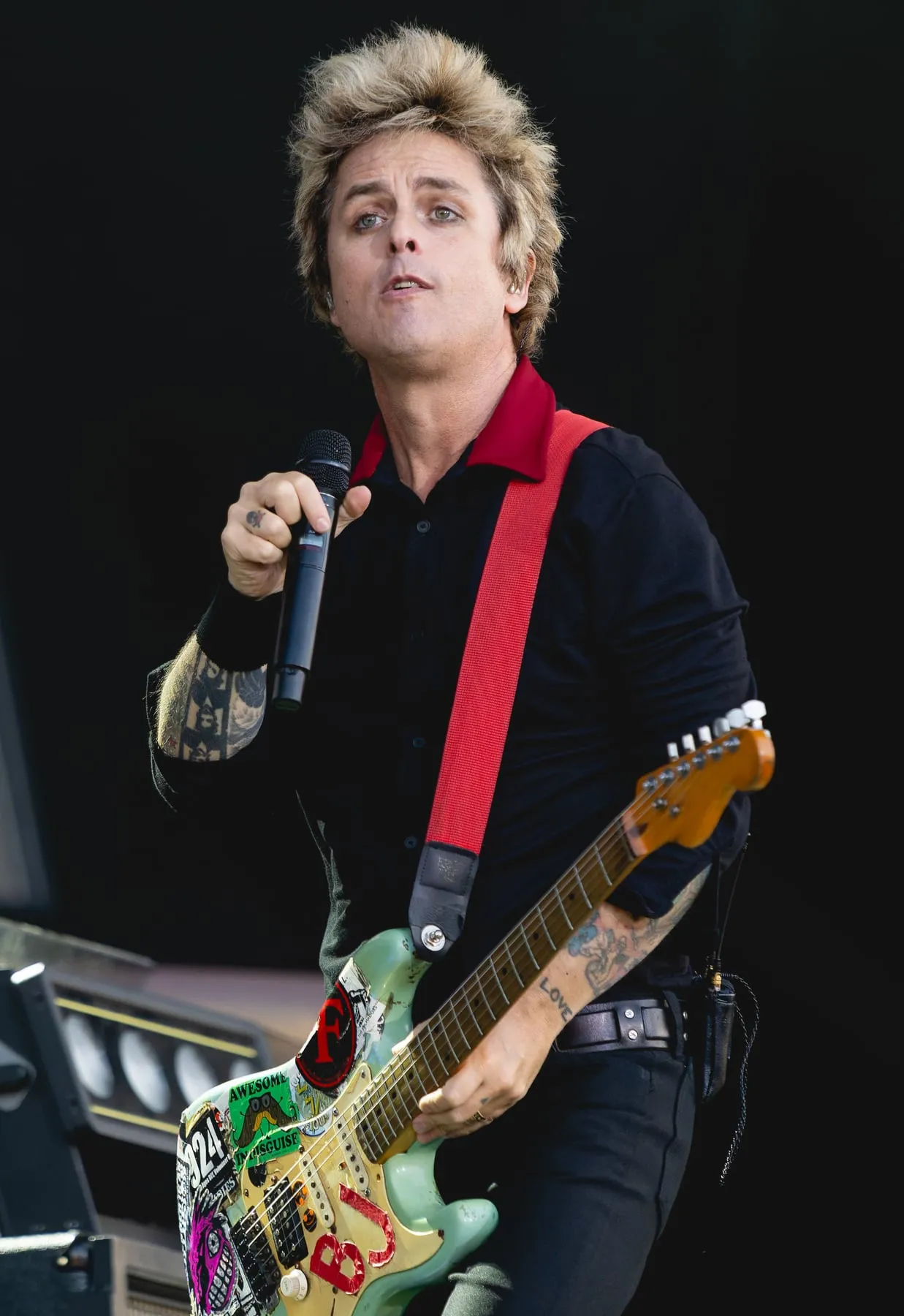
Photo by Raph_PH , licensed under CC BY 2.0 · Wikimedia Commons
Rank #369
Billie Joe Armstrong
From Wikipedia
Billie Joe Armstrong is an American musician and actor. He is best known for being the lead vocalist, guitarist, and primary songwriter of the rock band Green Day, which he co-founded with Mike Dirnt in 1987. He is also a guitarist and vocalist for the punk rock band Pinhead Gunpowder, and provides lead vocals for Green Day's side projects Foxboro Hot Tubs, the Network, the Longshot and the Coverups. Armstrong has been considered by critics as one of the greatest punk rock guitarists of all time, as well as one of the greatest punk rock singers of all time.
Discography & Previews
Browse through and click an album to open and play 30-second previews streamed from Apple Music.

Foreverly
2013 · 12 tracks
- 1 Roving Gambler ↗ 4:09
- 2 Long Time Gone ↗ 3:28
- 3 Lightning Express ↗ 5:01
- 4 Silver Haired Daddy of Mine ↗ 3:15
- 5 Down In the Willow Garden ↗ 4:32
- 6 Who's Gonna Shoe Your Pretty Little Feet? ↗ 2:56
- 7 Oh So Many Years ↗ 3:04
- 8 Barbara Allen ↗ 4:49
- 9 Rockin' Alone (In an Old Rockin' Chair) ↗ 3:01
- 10 I'm Here To Get My Baby Out of Jail ↗ 4:20
- 11 Kentucky ↗ 3:26
- 12 Put My Little Shoes Away ↗ 3:28
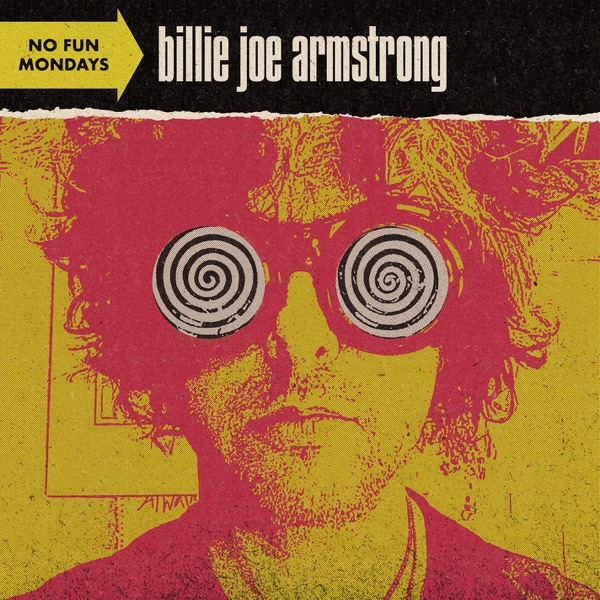
No Fun Mondays
2020 · 14 tracks
- 1 I Think We're Alone Now ↗ 2:15
- 2 War Stories ↗ 2:42
- 3 Manic Monday ↗ 3:07
- 4 Corpus Christi ↗ 3:24
- 5 That Thing You Do! ↗ 2:49
- 6 Amico ↗ 2:28
- 7 You Can't Put Your Arms Round a Memory ↗ 3:31
- 8 Kids in America ↗ 3:09
- 9 Not That Way Anymore ↗ 2:53
- 10 That's Rock 'n' Roll ↗ 2:59
- 11 Gimme Some Truth ↗ 2:48
- 12 Whole Wide World ↗ 3:19
- 13 Police on My Back ↗ 3:11
- 14 A New England ↗ 2:09
-
 ForeverlyBillie Joe Armstrong201312 tracks
 -
 No Fun MondaysBillie Joe Armstrong202014 tracks
Deep Dive
Overview
Billie Joe Armstrong stands as one of the defining figures in late-twentieth-century rock music, a guitarist and vocalist whose songwriting and performance have shaped punk rock and its adjacent genres for over three decades. Best known as the co-founder, lead vocalist, guitarist, and primary songwriter of Green Day, Armstrong has been recognized by critics as among the greatest punk rock guitarists and singers of his generation. His work spans punk, power pop, new wave, and alternative rock—a range that speaks to both his technical command and his refusal to be confined by genre boundaries.
Armstrong’s career encompasses not only Green Day’s massive output but also extensive work in side projects and collaborations, demonstrating a restless creative energy that has kept him relevant and productive from the late 1980s onward. His influence extends beyond the records he has made to include his approach to songwriting—economical, emotionally direct, and built on strong melodic foundations beneath distorted guitars.
Formation Story
Billie Joe Armstrong was born in 1972 in the United States, arriving at musical consciousness during the punk and new wave explosion of the mid-to-late 1970s and early 1980s. These genres—punk’s three-chord urgency and new wave’s electronic experimentation and art-school sensibility—formed the bedrock of his musical identity. Like many musicians of his cohort, Armstrong came to rock through listening to the records that dominated that era, absorbing both punk’s DIY ethos and power pop’s gift for melody. His early years were spent learning guitar and developing a songwriter’s instinct in the American rock underground, where garage bands and small clubs served as the apprenticeship for anyone serious about the instrument.
Breakthrough Moment
The breakthrough that would define Armstrong’s career came in 1987 when he co-founded Green Day with bassist Mike Dirnt. The formation of Green Day marked the moment when Armstrong transitioned from aspiring musician to professional bandleader and songwriter. Although Armstrong has maintained involvement in other projects—most notably the punk rock band Pinhead Gunpowder, alongside various side endeavors—it is Green Day that catapulted him to international prominence and allowed him to develop his craft on an increasingly large stage. The band’s emergence from the San Francisco Bay Area punk scene positioned Armstrong at the center of a movement that would reshape popular music in the 1990s and beyond.
Peak Era
Armstrong’s most visible and creatively fertile period spans from Green Day’s formation in 1987 through the following decades of touring, recording, and songwriting. His role as Green Day’s primary songwriter meant that his evolution as a composer directly paralleled the band’s rise and the shifting landscape of rock radio, MTV, and concert venues. Through the 1990s and 2000s, Armstrong established himself not only as a performer but as a craftsman capable of writing songs that balanced punk’s edge with pop sensibility—a balance that would become his signature approach. His continued productivity in songwriting and his willingness to explore different sounds through various side projects ensured that his creative energy remained high even as Green Day achieved stadium-level success.
Musical Style
Billie Joe Armstrong’s playing and singing style combines punk rock’s raw energy with power pop’s melodic sophistication. His guitar work is characterized by economical but effective use of distortion, a strong sense of rhythm, and the ability to craft riffs that are both memorable and driving. As a vocalist, Armstrong employs a tenor voice that can convey both vulnerability and aggression, often pushing it to the edge of his range for emotional effect. His songwriting gravitates toward direct emotional expression—themes of alienation, relationships, desire, and social observation—delivered through song structures that favor strong hooks and clear narrative or emotional arcs.
Genre-wise, Armstrong’s work sits at the intersection of power pop, punk rock, new wave, and alternative rock. Power pop’s emphasis on strong melodies and guitar-driven arrangements forms the harmonic foundation of much of his work, while punk rock’s attitude and production aesthetic provide the surface texture. New wave’s art-school approach to arrangement and production appears in his willingness to experiment with texture and studio technique. This synthesis results in music that is accessible to mainstream audiences yet retains enough edge and specificity to satisfy rock purists—a feat that few musicians have managed as consistently as Armstrong has.
Major Albums
Foreverly (2013)
Armstrong’s 2013 solo album Foreverly represents a significant statement of his approach to songwriting outside the Green Day context. The record showcases his ability to work in an intimate, sometimes acoustic setting, revealing the craftsmanship beneath the distortion and volume of his primary band.
No Fun Mondays (2020)
Released in 2020, No Fun Mondays continues Armstrong’s exploration of solo material, demonstrating his ongoing commitment to creating new work independent of Green Day’s schedule and commercial demands. The album reflects a mature songwriter still engaged with contemporary recording practices and sonic experimentation.
Signature Songs
- Armstrong’s work as Green Day’s primary songwriter has produced numerous songs that define punk rock’s mainstream presence in the late twentieth and early twenty-first centuries.
- His compositions balance lyrical specificity with universal themes, making them resonate across different audiences and generations of listeners.
- His vocal delivery often carries emotional intensity that distinguishes his performances from other punk vocalists of his era.
- His guitar parts, while often simple in construction, serve the song’s emotional arc rather than serving as a showcase for technical virtuosity.
Influence on Rock
Billie Joe Armstrong’s influence on rock music extends through multiple channels. As Green Day’s architect, he helped bring punk rock into the mainstream during the 1990s, proving that punk need not be a marginal genre if the songs were strong enough and the presentation was compelling. His songwriting approach—melodic, emotionally direct, guitar-driven—has been absorbed and imitated by countless bands working in punk, pop-punk, and alternative rock. His approach to the electric guitar as both a rhythmic and textural instrument, combined with his use of distortion as an emotional signifier rather than mere aggression, influenced how subsequent generations of rock musicians conceived of the instrument.
Furthermore, Armstrong’s willingness to engage in side projects and collaborations expanded the conversation around what punk rock could encompass. His work in Pinhead Gunpowder, as well as his involvement in various other ensembles under names like Foxboro Hot Tubs, the Network, the Longshot, and the Coverups, demonstrated that a punk rock artist could work across stylistic boundaries while maintaining artistic credibility. This approach helped legitimize genre-crossing in rock music during an era when strict genre adherence was often expected.
Legacy
Billie Joe Armstrong’s legacy is fundamentally tied to the transformation of punk rock from a marginal, underground phenomenon into a commercially viable and culturally significant form of popular music. His career—now spanning more than three decades from Green Day’s 1987 formation to the present—demonstrates unusual longevity for a rock musician. His influence on subsequent generations of punk and alternative rock musicians remains substantial, with his songwriting approach and guitar style referenced explicitly and implicitly in the work of countless bands that emerged in his wake.
Armstrong’s continued productivity, both through Green Day and through solo and side projects, ensures that his work remains part of the active rock music conversation rather than becoming historical artifact. His presence on streaming platforms, his ongoing tour schedule, and his continued recording activity all testify to a career that has endured beyond the typical life span of most rock acts. The combination of commercial success, critical respect, and ongoing creative engagement places Armstrong among the most significant rock musicians of his era.
Fun Facts
- Armstrong was born in 1972, arriving at musical adulthood during the punk and new wave movement of the late 1970s and early 1980s.
- Beyond Green Day, Armstrong has maintained an active involvement in the punk rock band Pinhead Gunpowder throughout his career.
- Armstrong’s work spans multiple side projects with distinct names, including Foxboro Hot Tubs, the Network, the Longshot, and the Coverups, allowing him to explore different musical directions.
- His career demonstrates the viability of punk rock as a long-term professional pursuit, spanning from 1987 to the present without significant career interruptions.