
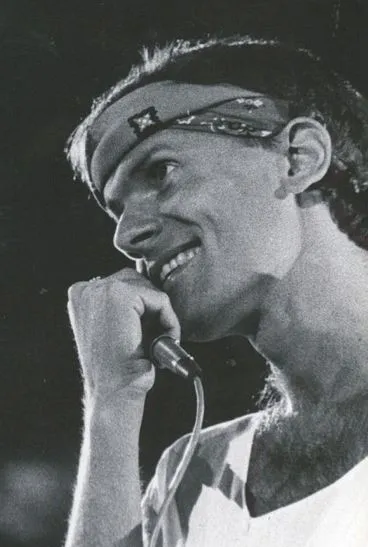
Photo by CAFé Simone Pedaços (original version) , licensed under CC BY-SA 4.0 · Wikimedia Commons
Rank #434
Cazuza
From Wikipedia
Agenor de Miranda Araújo Neto, better known as Cazuza, was a Brazilian singer-songwriter, born in Rio de Janeiro. Along with Raul Seixas, Renato Russo and Os Mutantes, Cazuza, both while fronting Barão Vermelho and at solo career, is considered one of the best exponents of Brazilian rock music. In his 9-year career, he sold more than 5 million albums and achieved 11 number one singles and 18 Top 10 singles in Brazil.
Discography & Previews
Browse through and click an album to open and play 30-second previews streamed from Apple Music.


-
 ExageradoCazuza198510 tracks
 -
 IdeologiaCazuza19881 track
 - ExageradoCazuza199810 tracks
Deep Dive
Overview
Cazuza—born Agenor de Miranda Araújo Neto—stands as one of the defining voices of Brazilian rock music. Active from the mid-1980s until his death in 1990, he left an outsized imprint on the country’s musical landscape despite a career spanning only nine years. His solo work, alongside his tenure fronting the band Barão Vermelho, positioned him among the era’s most vital rock interpreters, a peer to Raul Seixas, Renato Russo, and Os Mutantes in shaping the sound and spirit of Brazilian rock.
Formation Story
Cazuza was born in Rio de Janeiro in 1958, emerging from a city that had long incubated Brazil’s most experimental and commercially savvy musical movements. The Rio rock scene of the late 1970s and early 1980s was marked by tension between punk’s raw urgency, the country’s indigenous samba and bossa nova traditions, and the international rock idioms flooding in from North America and Europe. Cazuza arrived at rock as both a natural outlet for that cross-cultural ferment and as a personal vehicle for his songwriting talents. His path to prominence came through fronting Barão Vermelho, a vehicle that brought him national recognition, before he pivoted to a parallel solo career that would ultimately define his legacy.
Breakthrough Moment
Cazuza’s solo debut, Exagerado, arrived in 1985 and announced him as a force independent of his band identity. The album’s commercial and critical success established him as a solo artist of commercial consequence; it became a landmark in Brazilian rock, proving that he possessed both the songwriting depth and vocal charisma to carry records on his own terms. The title track and the album’s broader sonic palette—rooted in blues rock but inflected with Brazilian harmonic sensibilities and contemporary rock production—resonated across Brazilian radio and audiences. The album’s success led to sustained chart dominance: across his solo career, Cazuza achieved 11 number-one singles and 18 Top 10 hits in Brazil, and sold more than 5 million albums overall.
Peak Era
The period from 1985 to 1989 marked Cazuza’s most creatively fertile and commercially dominant stretch. Following Exagerado, he released Só se for a 2 in 1987, maintaining momentum and deepening his songwriting range. Ideologia (1988) and Burguesia (1989) continued his output during this window, each release demonstrating his ability to evolve his sound while remaining rooted in the blues-rock foundation that defined his appeal. These years coincided with the peak of his fame in Brazil, when Cazuza was not merely a recording artist but a cultural figure whose music reflected and articulated the social and political anxieties of his generation.
Musical Style
Cazuza’s music fused blues rock with Brazilian musical idioms and the experimental edge of 1980s alternative rock. His vocals—a rough, emotionally direct instrument—cut through arrangements that typically featured electric guitars, bass, and drums in the Anglo-American rock tradition, but shaped by the harmonic sophistication and rhythmic flexibility of Brazilian music. He worked primarily with Philips Records, which gave him the production resources to craft densely arranged, polished recordings that balanced rock’s aggressive immediacy with the melodic and harmonic complexity that his songwriting demanded. His style was neither a straightforward translation of North American blues rock nor a regression into Brazil’s pop or samba traditions, but rather a synthesis that acknowledged his debts to both while forging a distinct voice. The influence of punk and post-punk was present in his directness and emotional intensity, while his instrumentation and arrangements drew from the broader rock canon.
Major Albums
Exagerado (1985)
Cazuza’s solo debut announced him as a fully realized artist with a distinctive voice and songwriting vision. The album established his commercial and critical foundation, becoming a cornerstone of mid-1980s Brazilian rock.
Só se for a 2 (1987)
His second solo effort deepened the artistic trajectory initiated by Exagerado, demonstrating sustained songwriting quality and growing confidence in his solo identity distinct from his band work.
Ideologia (1988)
Released at the height of his popularity, Ideologia showcased a maturing artist engaging with social and personal themes through increasingly sophisticated arrangements and lyrical depth.
Burguesia (1989)
Cazuza’s final album released during his lifetime, Burguesia represented the culmination of his artistic evolution and commercial dominance in the Brazilian market.
Signature Songs
- “Exagerado” — The title track from his debut, this song became his calling card and one of the most recognizable Brazilian rock songs of the 1980s.
- “O Tempo Não Para” — A signature composition that captured the anxieties and momentum of his generation, becoming emblematic of his songwriting vision.
- “Ideologia” — The title track from his 1988 album, directly engaging with social and political questions that animated his lyrical work.
Influence on Rock
Cazuza’s impact on Brazilian rock was immediate and lasting. He demonstrated that a rock musician working in Portuguese, drawing on Brazilian traditions while embracing international rock idioms, could achieve massive commercial success without diluting artistic integrity. His work influenced subsequent generations of Brazilian rock artists and helped establish rock as a legitimate and vital component of Brazil’s musical landscape alongside samba, bossa nova, and tropicália. The synthesis he modeled—of blues rock with Brazilian harmonic and rhythmic sensibilities—became a template for later artists navigating similar cross-cultural musical territories. His peer status with figures like Renato Russo and Raul Seixas helped establish Brazilian rock as a genre with its own history and weight, not merely an imitation of Anglo-American forms.
Legacy
Cazuza’s career was cut short by his death in 1990 at age 32, but his nine-year run had already secured his place as one of the most commercially successful and artistically significant Brazilian rock artists. His sales figures—5 million albums, 11 number-one singles, 18 Top 10 hits—remain remarkable and speak to his broad appeal and cultural resonance. Posthumous releases like Por aí (1991) and compilations such as Coleção obras-primas (1995) have kept his music in circulation and allowed later audiences to encounter his work. In the decades since his death, Cazuza has remained a reference point for Brazilian rock history, referenced alongside Barão Vermelho’s collective legacy and studied as part of the broader 1980s rock movement in Brazil. His music continues to stream and circulate internationally as interest in Brazilian rock has grown beyond the country’s borders.
Fun Facts
- Cazuza’s birth name, Agenor de Miranda Araújo Neto, reflected his family’s Portuguese heritage; “Cazuza” emerged as his stage moniker and became inseparable from his public identity.
- His simultaneous involvement with Barão Vermelho and his solo career meant he was often juggling two creative identities during the 1980s, a demanding dual role that few Brazilian rock artists have managed as successfully.
- His official website, cazuza.com.br, has served as a digital archive and fan hub, reflecting the sustained interest in his legacy in the digital age.
- The span from his debut album to his final album released in his lifetime—Exagerado in 1985 to Burguesia in 1989—compressed an extraordinary amount of creative and commercial activity into just four years, a pace few artists sustain at such a high level.