
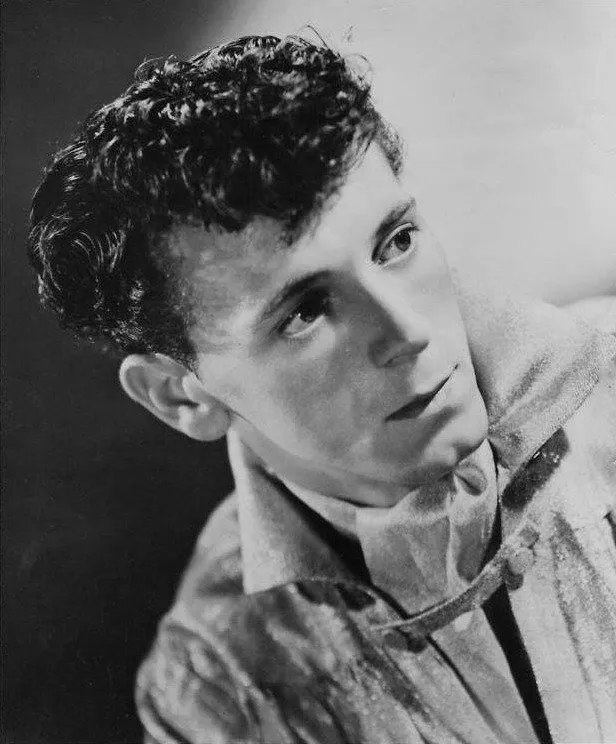
Photo by Capitol Records , licensed under Public domain · Wikimedia Commons
Rank #389
Gene Vincent
From Wikipedia
Vincent Eugene Craddock, known as Gene Vincent, was an American rock and roll musician who pioneered the style of rockabilly. His 1956 top ten hit with his backing band the Blue Caps, "Be-Bop-a-Lula", is considered a significant early example of rockabilly. His chart career was brief, especially in his home country of the US, where he notched three top 40 hits in 1956 and 1957, and never charted in the top 100 again. In the UK, he was a somewhat bigger star, racking up eight top 40 hits from 1956 to 1961.
Discography & Previews
Browse through and click an album to open and play 30-second previews streamed from Apple Music.

Sounds Like Gene Vincent
1959 · 12 tracks
- 1 My Baby Don't 'Low ↗ 2:36
- 2 I Can't Believe You Want To Leave ↗ 2:46
- 3 I Might Have Known ↗ 2:14
- 4 In Love Again ↗ 2:31
- 5 You Are the One For Me ↗ 2:20
- 6 Ready Teddy ↗ 1:58
- 7 I Got To Get To You Yet ↗ 2:10
- 8 Vincent's Blues ↗ 2:21
- 9 Maybe ↗ 2:22
- 10 Now Is the Hour ↗ 2:59
- 11 My Heart ↗ 2:28
- 12 Maybelline ↗ 2:27

Crazy Times
1960 · 12 tracks
- 1 Crazy Times (Mono Version) ↗ 2:12
- 2 She She Little Sheila (Mono Version) ↗ 2:28
- 3 Darlene (Mono Version) ↗ 2:46
- 4 Everybody's Got a Date But Me (Mono Version) ↗ 2:08
- 5 Why Don't You People Learn To Drive (Mono Version) ↗ 2:00
- 6 Green Back Dollar (Mono Version) ↗ 2:22
- 7 Big Fat Saturday Night (Mono Version) ↗ 2:01
- 8 Mitchiko From Tokyo (Mono Version) ↗ 2:14
- 9 Hot Dollar (Mono Version) ↗ 2:24
- 10 Accentuate the Positive (Mono Version) ↗ 2:01
- 11 Blue Eyes Crying In the Rain (Mono Version) ↗ 2:15
- 12 Pretty Pearly (Mono Version) ↗ 2:25

Shakin’ Up a Storm
1964 · 14 tracks
- 1 Hey Hey Hey ↗ 2:11
- 2 Lavender Blue ↗ 3:23
- 3 Private Detective ↗ 2:43
- 4 Shimmy Shammy Shingle ↗ 2:10
- 5 Someday (You'll Want Me to Want You) ↗ 2:26
- 6 Another Saturday Night ↗ 1:46
- 7 Slippin' and Slidin' ↗ 2:32
- 8 Long Tall Sally ↗ 2:02
- 9 Send Me Some Lovin' ↗ 2:32
- 10 Love Love Love ↗ 2:15
- 11 Good Golly, Miss Molly ↗ 2:21
- 12 Baby Blue ↗ 2:37
- 13 Susie Q ↗ 2:04
- 14 You Are My Sunshine ↗ 3:33

I'm Back and I'm Proud
1969 · 12 tracks
- 1 Rockin' Robin ↗ 2:27
- 2 In the Pines ↗ 4:01
- 3 Be-Bop-A-Lula ↗ 2:38
- 4 Rainbow at Midnight ↗ 2:39
- 5 Black Letter ↗ 2:39
- 6 White Lightning ↗ 2:43
- 7 Sexy Ways ↗ 2:37
- 8 Ruby Baby ↗ 2:50
- 9 Lotta Lovin' ↗ 3:07
- 10 Circle Never Broken ↗ 2:58
- 11 I Heard That Lonesome Whistle ↗ 2:28
- 12 Scarlet Ribbons (For Her Hair) ↗ 3:14


The Day the World Turned Blue
1970 · 11 tracks
- 1 How I Love Them Old Songs ↗ 3:05
- 2 High On Life ↗ 2:53
- 3 North Carolina Line ↗ 3:08
- 4 You Can Make It If You Try ↗ 2:52
- 5 Our Souls ↗ 2:51
- 6 There Is Something On Your Mind ↗ 4:29
- 7 The Day The World Turned Blue ↗ 2:04
- 8 Boppin' The Blues ↗ 2:42
- 9 Looking Back ↗ 2:28
- 10 Oh Lonesome Me ↗ 2:25
- 11 The Woman In Black ↗ 3:22

The Crazy Beat Of Gene Vincent
2015 · 12 tracks
- 1 Crazy Beat ↗ 2:06
- 2 Important Words (feat. The Blue Caps) ↗ 2:40
- 3 It's Been Nice ↗ 1:56
- 4 Lonesome Boy ↗ 2:51
- 5 Good Lovin' ↗ 2:04
- 6 I'm Gonna Catch Me a Rat ↗ 2:04
- 7 Rip It Up ↗ 2:05
- 8 High Blood Pressure (Take 10) ↗ 2:46
- 9 That's the Trouble With Love ↗ 2:09
- 10 Weeping Willow ↗ 2:39
- 11 Tear Drops ↗ 2:29
- 12 Gone, Gone, Gone ↗ 2:08
-
 Sounds Like Gene VincentGene Vincent195912 tracks
 -
 Crazy TimesGene Vincent196012 tracks
 -
 Shakin’ Up a StormGene Vincent196414 tracks
 -
 I'm Back and I'm ProudGene Vincent196912 tracks
 -
 Gene VincentGene Vincent197010 tracks
 -
 The Day the World Turned BlueGene Vincent197011 tracks
 -
 The Crazy Beat Of Gene VincentGene Vincent201512 tracks
Deep Dive
Overview
Gene Vincent, born Vincent Eugene Craddock, stands as one of the foundational figures in early rockabilly and rock and roll. Though his chart success in the United States proved fleeting—three top 40 hits in 1956 and 1957 marked the apex of his domestic commercial run—his influence on the emerging rock aesthetic proved far more durable than sales figures suggest. His 1956 recording of “Be-Bop-a-Lula” with his backing band the Blue Caps remains a touchstone of early rockabilly, a style he helped pioneer during rock and roll’s first creative explosion.
Formation Story
Vincent grew up in Norfolk, Virginia, in the American South during the Depression and war years. The region’s proximity to military bases and its rich tradition of country, blues, and rhythm and blues confluences shaped his early musical instincts. He began performing in his teenage years, absorbing the country music tradition of his region while remaining alert to the rhythm and blues sounds radiating from nearby cities. By the mid-1950s, as rock and roll began crystallizing as a distinct musical form, Vincent positioned himself at the intersection of country twang and rhythm and blues energy—the exact soil from which rockabilly would grow.
Breakthrough Moment
Vincent’s breakthrough arrived in 1956 with “Be-Bop-a-Lula,” recorded with his supporting ensemble the Blue Caps. The single became a top ten hit and proved an immediate touchstone for the nascent rockabilly sound. Released during the same year Elvis Presley achieved national dominance and country musicians began crossing into rock and roll territory, “Be-Bop-a-Lula” offered an alternative pole of the emerging style—rawer, more explicitly country in its instrumental attack, yet deeply rhythmic and charged with rock and roll urgency. The song’s success propelled Vincent into the charts in both the US and UK, establishing him as a significant early figure in the new music.
Peak Era
Vincent’s most commercially successful period occurred between 1956 and 1957, when he achieved his three US top 40 placements. However, his cultural and artistic relevance extended considerably beyond those two years. In the UK, where his appeal proved more enduring, he accumulated eight top 40 hits between 1956 and 1961, demonstrating that his rockabilly approach retained potency overseas long after American chart success had dried up. This transatlantic divide—early dominance in the US market followed by sustained popularity in Britain—became a pattern for several rockabilly artists of the era, suggesting that his style found a more receptive long-term audience in the UK rock and roll audience.
Musical Style
Vincent’s sound epitomized rockabilly at its most raucous and unpolished. His vocals carried a raw, sometimes strained quality that contrasted sharply with the polished crooning of mainstream pop singers; he shouted, hiccupped, and bent notes with an intensity that conveyed teenage rebellion and working-class urgency. The Blue Caps provided stripped-down, guitar-driven accompaniment heavy on slap bass, snare crackle, and twangy lead guitar—the sonic architecture of country music repurposed for rock and roll tempo and attitude. There was little string arrangement, little orchestral sweetening; instead, the music relied on direct, almost crude instrumental vigor. His recordings from the late 1950s embodied rockabilly’s core aesthetic: country instrumentation and sensibility allied with rhythm and blues swing and rock and roll’s emerging rebellious identity.
Major Albums
Sounds Like Gene Vincent (1959)
Vincent’s first studio album, capturing him in the immediate aftermath of his initial chart success and establishing the sonic template of his recorded work.
Crazy Times (1960)
Recorded as his initial chart dominance faded, the album demonstrated Vincent’s continued commitment to the rockabilly sound even as his commercial fortunes declined in the US market.
Shakin’ Up a Storm (1964)
Released well into a period of minimal chart activity, this album showed Vincent persisting in his musical approach, continuing to record for various labels throughout the 1960s.
Born to Be a Rolling Stone (1967)
Recorded during the latter portion of the 1960s, as rock music itself had undergone significant evolution away from the rockabilly template Vincent had helped establish.
I’m Back and I’m Proud (1969)
Vincent’s late-career assertion of continuity, recorded as he maintained an active recording presence despite remaining far outside the contemporary rock mainstream.
Signature Songs
- Be-Bop-a-Lula — The definitive rockabilly anthem and Vincent’s most enduring legacy, a 1956 single that crystallized the early rock and roll sound.
- Race with the Devil — A high-energy rockabilly workout that showcased his shouted vocal delivery and the Blue Caps’ instrumental ferocity.
- Lotta Lovin’ — A 1957 release that demonstrated his command of rhythm and blues-inflected rockabilly material during his commercial peak.
- Blue Jean Bop — A raw, guitar-driven recording that exemplified the stripped-down aesthetic of early rockabilly.
Influence on Rock
Gene Vincent’s significance lies not in sustained chart dominance but in his pioneering role in establishing rockabilly as a distinct musical language within early rock and roll. He demonstrated that country musicians could embrace rock and roll’s rhythmic and attitudinal innovations without abandoning their instrumental roots—a template that countless rockabilly and country-rock artists would follow. His raw, almost crude vocal approach and the Blue Caps’ minimal, guitar-centered production offered an alternative to the more polished, orchestra-augmented rock and roll of early competitors. Though he never achieved the sustained fame of Elvis Presley, his influence filtered through subsequent generations of rock musicians, particularly those interested in rockabilly’s authentic, regional character.
Legacy
Vincent’s legacy remains substantial in rockabilly and rock and roll historiography despite his modest long-term chart presence. “Be-Bop-a-Lula” has been covered, sampled, and referenced repeatedly in rock music and popular culture, ensuring his signature achievement remains accessible across generations. His continued recording activity through the 1960s and into the early 1970s, despite commercial obscurity, underscored his commitment to the rockabilly idiom at a time when most industry attention had moved toward other styles. Subsequent rockabilly revivals, particularly in the 1970s and 1980s, restored Vincent to a more prominent place in rock history, with collectors and enthusiasts recognizing his contributions to the music’s foundational vocabulary. His death in 1971 marked the end of an era, but reissues and compilations have ensured that “Be-Bop-a-Lula” and his broader catalog remain audible to contemporary audiences interested in rock and roll’s origins.
Fun Facts
- Vincent recorded for multiple independent and major labels throughout his career, including Apex, Challenge Records, Capitol Records, and Dandelion, reflecting both his mobility across the music industry and the rapid fragmentation of the rock and roll market in its early years.
- His greater success in the United Kingdom than in the United States mirrored a broader pattern among American rockabilly artists, suggesting that British audiences maintained a longer-term appetite for the style even as American radio moved toward other sounds.
- Vincent maintained an active recording presence into the early 1970s, cutting albums well after commercial radio had largely abandoned rockabilly, demonstrating an unusual degree of commitment to his musical vision.