
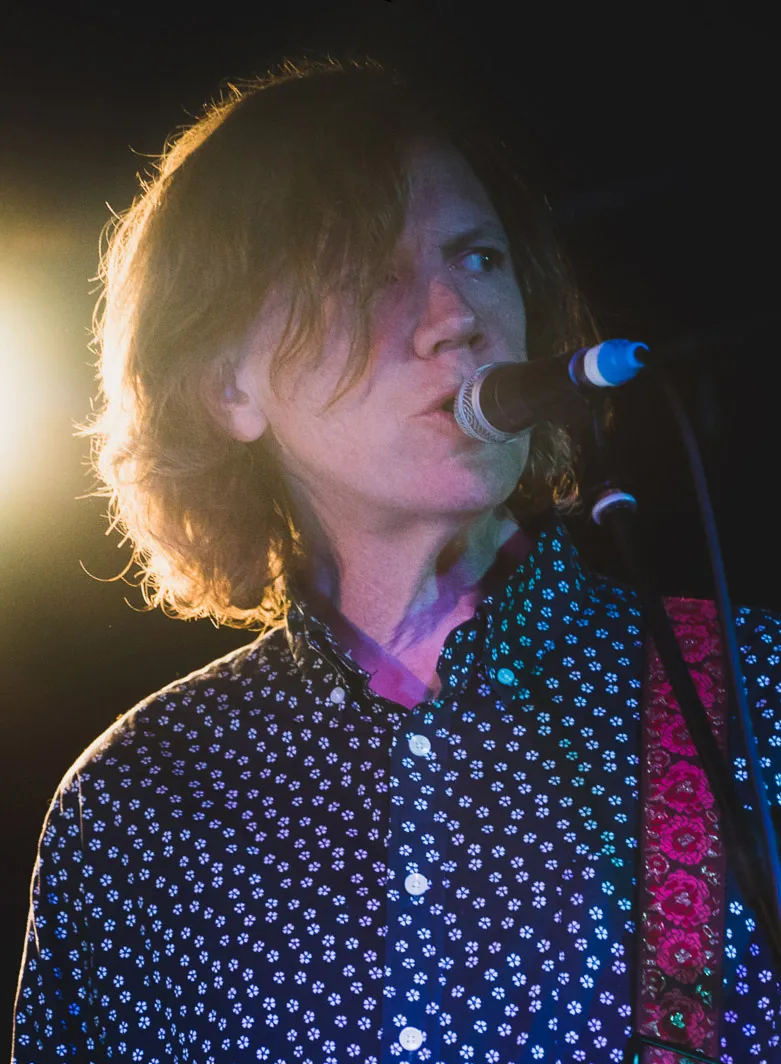
Photo by Paul Hudson from United Kingdom , licensed under CC BY 2.0 · Wikimedia Commons
Rank #405
Thurston Moore
From Wikipedia
Thurston Joseph Moore is an American musician, singer and songwriter best known as the lead guitarist and vocalist of alternative rock band Sonic Youth. He has participated in many solo and group collaborations outside Sonic Youth, as well as running the Ecstatic Peace! record label. Moore was ranked 34th in Rolling Stone's 2004 edition of the "100 Greatest Guitarists of All Time".
Discography & Previews
Browse through and click an album to open and play 30-second previews streamed from Apple Music.
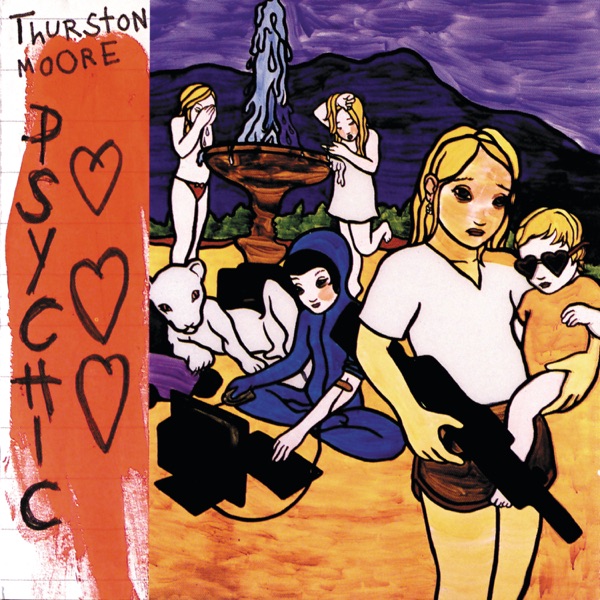
Psychic Hearts
1995 · 15 tracks
- 1 Queen Bee and Her Pals ↗ 2:57
- 2 Ono Soul ↗ 3:26
- 3 Psychic Hearts ↗ 3:58
- 4 Pretty Bad ↗ 3:58
- 5 Patti Smith Math Scratch ↗ 2:41
- 6 Blues from Beyond the Grave ↗ 4:34
- 7 See-Through Playmate ↗ 2:17
- 8 Hang Out ↗ 4:11
- 9 Feathers ↗ 2:20
- 10 Tranquilizer ↗ 2:04
- 11 Staring Status ↗ 2:33
- 12 Cindy (Rotten Tanx) ↗ 3:47
- 13 Cherry's Blues ↗ 2:06
- 14 Female Cop ↗ 5:22
- 15 Elegy for All the Dead Rock Stars ↗ 19:47
Piece for Jetsun Dolma
1996 · 2 tracks
Trees Outside the Academy
2007 · 12 tracks
- 1 Frozen Gtr ↗ 4:07
- 2 The Shape Is In a Trance ↗ 4:40
- 3 Honest James ↗ 3:50
- 4 Silver>Blue ↗ 5:50
- 5 Fri/End ↗ 3:31
- 6 American Coffin ↗ 3:57
- 7 Wonderful Witches + Language Meanies ↗ 2:25
- 8 Off Work ↗ 4:12
- 9 Never Day ↗ 4:01
- 10 Free Noise Among Friends ↗ 0:37
- 11 Trees Outside the Academy ↗ 6:06
- 12 Thurston @ 13 ↗ 2:39
Sensitive / Lethal
2008 · 3 tracks

Senso
2009 · 2 tracks
Suicide Notes for Acoustic Guitar
2010 · 4 tracks


Vi är alla Guds slavar
2013 · 2 tracks


Tiny People Having a Meeting
2015 · 8 tracks
- 1 Let ↗ 0:47
- 2 Synoptic Microcosmos ↗ 8:44
- 3 The Very Idea (feat. Devin Waldman) ↗ 6:59
- 4 High Street ↗ 0:40
- 5 Free Leaks ↗ 12:43
- 6 & The Tea Will Seem Golden (feat. Devin Waldman, Ambrose Bye & Max Davies) ↗ 4:29
- 7 Unpopular Message ↗ 3:01
- 8 Making It Glow (feat. Devin Waldman & Ambrose Bye) ↗ 13:57


Heretics
2016 · 11 tracks
- 1 Tout ce que je sais ↗ 6:41
- 2 Clair obscur ↗ 5:14
- 3 Érétik ↗ 4:44
- 4 Casino Rabelaisien ↗ 5:36
- 5 Dull Jack ↗ 7:13
- 6 The Things That Belong to William ↗ 7:53
- 7 Heidsecks Chords ↗ 4:21
- 8 Coquins coquettes et cocus ↗ 6:51
- 9 Poetry Must Be Made by All ↗ 6:09
- 10 Le songe de Ludwig ↗ 5:28
- 11 Concoctions ↗ 6:52
Dunia
2017 · 3 tracks

Spirit Counsel
2019 · 3 tracks


-
 Psychic HeartsThurston Moore199515 tracks
 -
 Piece for Jetsun DolmaThurston Moore19962 tracks
 -
 The PromiseThurston Moore19997 tracks
 -
 Three Incredible IdeasThurston Moore20013 tracks
 -
 Trees Outside the AcademyThurston Moore200712 tracks
 -
 Sensitive / LethalThurston Moore20083 tracks
 -
 SensoThurston Moore20092 tracks
 -
 Suicide Notes for Acoustic GuitarThurston Moore20104 tracks
 -
 Demolished ThoughtsThurston Moore201110 tracks
 -
 YOKOKIMTHURSTONThurston Moore20126 tracks
 -
 Vi är alla Guds slavarThurston Moore20132 tracks
 -
 The Best DayThurston Moore20148 tracks
 -
 Tiny People Having a MeetingThurston Moore20158 tracks
 -
 Full BleedThurston Moore20159 tracks
 -
 HereticsThurston Moore201611 tracks
 -
 DuniaThurston Moore20173 tracks
 -
 Rock n Roll ConsciousnessThurston Moore20175 tracks
 -
 Spirit CounselThurston Moore20193 tracks
 -
 By the FireThurston Moore20209 tracks
 -
 Screen TimeThurston Moore202110 tracks
 -
 Comes Through in the Call HoldThurston Moore20237 tracks
 -
 Flow Critical LucidityThurston Moore20247 tracks
Deep Dive
Overview
Thurston Joseph Moore is an American musician best known as the lead guitarist and vocalist of alternative rock band Sonic Youth, the art-rock ensemble that redefined guitar noise and structural experimentation for the post-punk era. Beyond his foundational role in one of rock’s most influential acts, Moore has maintained a prolific parallel solo and collaborative career spanning experimental rock, no wave, noise music, and avant-garde composition. Ranked 34th in Rolling Stone’s 2004 edition of the “100 Greatest Guitarists of All Time,” Moore’s fingerprints are felt not only through Sonic Youth’s catalog but through his own restless artistic practice and his stewardship of the Ecstatic Peace! record label.
Moore’s significance lies in his refusal to be bound by a single project or aesthetic. His solo discography—which began in earnest in 1988 and has continued into the 2020s—documents an artist for whom experimentation is not a phase but a permanent condition. His work straddles composition and improvisation, acoustic introspection and electric abstraction, and demonstrates how a guitarist schooled in noise and indeterminacy can explore territories as varied as meditative soundscaping and rhythm-based composition.
Formation Story
Thurston Moore was born in 1958 and came of age during the post-punk and No Wave ferment of New York City in the late 1970s and early 1980s. The city’s underground music scene—centered in clubs, lofts, and art galleries downtown—shaped his understanding of rock as a vehicle for experimental practice rather than commercial formula. Rather than arriving at music through conventional rock apprenticeship, Moore’s formation was inseparable from the broader art world: the visual arts, performance, and conceptual thinking informed his approach to the guitar from the outset.
It was within this context of New York’s avant-garde and No Wave scenes that Moore would eventually co-found Sonic Youth with guitarist Lee Ranaldo, and subsequently form the classic lineup with bassist Kim Gordon and drummer Steve Shelley. While Sonic Youth became his primary vehicle, Moore’s artistic personality—restless, curious, and committed to pushing boundaries—ensured that he would pursue work outside the band almost from the beginning. His early solo ventures, beginning with The Crumb in 1988, emerged from the same ethos that drove Sonic Youth: the belief that rock music could be a laboratory for sound exploration.
Breakthrough Moment
Moore’s breakthrough as a solo artist came with Psychic Hearts (1995), a work that demonstrated his ability to craft sustained, album-length statements independent of Sonic Youth. The mid-1990s saw Moore simultaneously at the peak of Sonic Youth’s critical and commercial visibility—the band was touring internationally and releasing albums to major-label backing—and increasingly productive as a solo artist. Psychic Hearts and the albums surrounding it in the mid-to-late 1990s (Shamballa in 1994, Pillow Wand in 1997, Hurricane Floyd in 1999) showed Moore developing a distinctive solo voice that could shift between electric turbulence and quieter, more introspective passages.
The year 1995 proved particularly prolific, with both Psychic Hearts and Klangfarbenmelodie… And the Colorist Strikes Primitiv released, signaling Moore’s ability to sustain multiple creative projects simultaneously. By the early 2000s, his solo work had earned sufficient standing that albums like From the Earth to the Spheres, Volume 1 (2004) and Trees Outside the Academy (2007) were received as significant statements in their own right, not merely adjuncts to his band work.
Peak Era
Moore’s peak creative period as a solo artist spans from the mid-2000s through the early 2010s. During this stretch, he released Trees Outside the Academy (2007), Built for Lovin’ (2008), Senso (2009), Demolished Thoughts (2011), and Fundamental Sunshine (2012). These albums represent Moore at his most focused, exploring the intersection of melody, drone, and rhythmic experimentation with a maturity that came from two decades of solo work alongside Sonic Youth’s ongoing evolution.
Demolished Thoughts (2011) stands as a particularly notable achievement in this period, marking a moment where Moore seemed to synthesize his various modes—the guitar manipulator, the melodist, the experimentalist—into a coherent artistic statement. The years 2007 through 2012 also demonstrated Moore’s commitment to collaborative work and varied record labels, working with Virgin Music and continuing to release material through Ecstatic Peace!, his own imprint. This era also shows Moore extending beyond traditional guitar-based work into electronic composition and unconventional recording formats.
Musical Style
Moore’s solo work is characterized by a restless eclecticism rooted in the fundamental commitment to exploring what the guitar—and sound in general—can express beyond conventional rock forms. His style has always involved extensive use of tuning manipulation, feedback, and harmonic experimentation inherited from his work in Sonic Youth, but his solo catalog demonstrates a wider range of approaches. Some albums embrace minimalism and meditative repetition, others shift toward structured songwriting with vocal prominence, and still others venture into pure abstraction and sound collage.
Throughout his discography, Moore demonstrates facility with both electric and acoustic guitar, and later in his career, with electronic instrumentation. His approach to composition ranges from highly structured pieces to frameworks for improvisation, reflecting his engagement with avant-garde music, jazz, and contemporary classical traditions. Genres that define his work include noise rock, experimental rock, no wave, indie rock, and avant-garde music. Moore’s voice, when present, functions more as another textural element than as a vehicle for narrative or emotional projection in the conventional sense. The sheer volume of his output—over 40 albums from 1988 to 2024—reflects an artist for whom the creative act itself is the primary driver, not commercial calculation or periodic renewal.
Major Albums
Psychic Hearts (1995)
Moore’s most accessible and structured solo album, Psychic Hearts demonstrated his ability to balance guitar-based experimentation with memorable melodic shapes and a cohesive album arc.
Demolished Thoughts (2011)
A landmark late-career statement that synthesizes Moore’s various approaches—it integrates structured songwriting, experimental guitar work, and refined production into a focused artistic vision.
Senso (2009)
An exploration of tone and texture, Senso showcases Moore’s continued evolution in sound design and his capacity to sustain extended pieces without conventional song structures.
Trees Outside the Academy (2007)
This album represents Moore’s engagement with more abstract and meditative sound exploration, marking a shift toward exploratory instrumental work.
Rock n Roll Consciousness (2017)
A late-period return to more straightforward rock and roll references, demonstrating Moore’s ongoing ability to engage with rock’s foundational forms while maintaining experimental rigor.
Signature Songs
- “Piece for Jetsun Dolma” (1996) — An instrumental exploration of guitar tone and spatial manipulation, exemplifying Moore’s compositional approach to solo work.
- “Suicide Notes for Acoustic Guitar” (2010) — A stark, intimate piece demonstrating Moore’s ability to convey emotional content through minimalist acoustic means.
- “New York – Ystad” (2000) — A crosscultural collaboration piece reflecting Moore’s engagement with global music and place-based inspiration.
- “Demolished Thoughts” (2011) — The title track showcases Moore’s synthesis of melody, production sophistication, and emotional directness.
Influence on Rock
Thurston Moore’s influence extends across multiple dimensions of contemporary music. As Sonic Youth’s lead guitarist, he helped establish a template for how noise, feedback, and unconventional tuning could serve avant-garde and rock contexts simultaneously. His solo work has influenced generations of guitarists and experimentalists working at the intersection of noise, composition, and improvisation. Moore’s establishment of Ecstatic Peace! as a record label created an institutional framework for releasing experimental and unconventional work, providing a counterweight to mainstream music industry structures.
More broadly, Moore’s career demonstrates a model of artistic practice in which a musician can maintain meaningful engagement with a primary band while simultaneously exploring disparate artistic directions. His work has influenced both the no wave and noise rock traditions that trace through contemporary experimental music, and his collaborative approach has helped establish cross-disciplinary exchange between musicians, visual artists, and conceptual thinkers as a norm rather than an exception.
Legacy
Thurston Moore’s legacy as a solo artist rests on his consistent commitment to experimentation and refusal to calcify around a single sound or approach. His output from the 1990s onward has documented an artist in continuous dialogue with evolving technologies, musical traditions, and conceptual frameworks. The sheer productivity of his solo catalog—with albums continuing to appear regularly through 2024 and beyond—testifies to an undiminished creative drive that shows no signs of settling into retrospection or repetition.
Moore’s work also reflects the broader ecosystem of experimental and independent music that developed outside major-label structures. His association with Ecstatic Peace! and his frequent collaborations with other experimental musicians have cemented his role not just as an artist but as a facilitator and enabler of experimental practice. The continued circulation and streaming of his work, alongside Sonic Youth’s ongoing cultural presence, ensures that Moore’s contributions to both alternative rock and experimental music remain accessible to successive generations of musicians and listeners.
Fun Facts
- Moore has released material across multiple record labels including Virgin Music and his own Ecstatic Peace! imprint, reflecting his dual engagement with mainstream and independent music infrastructure.
- His 1997 album Legend of the Blood Yeti exemplifies the playful, conceptually driven approach to naming and theming that characterizes much of his solo work.
- Moore’s prolific output includes numerous collaborative releases, such as YOKOKIMTHURSTON (2012) and various duo and ensemble pieces, demonstrating his commitment to collective creative practice.
- His later solo albums increasingly embrace electronic music and compositional approaches extending beyond traditional rock instrumentation, as evidenced by works like Electronic Music for Piano (2018).