
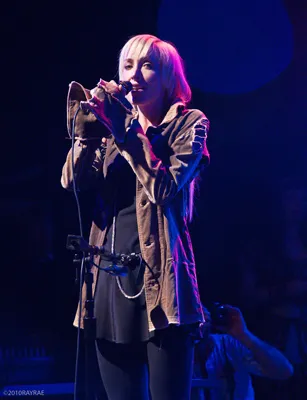
Photo by Ray Rae , licensed under CC BY-SA 3.0 · Wikimedia Commons
Rank #388
Poe
From Wikipedia
Poe is an American singer, songwriter, and record producer. Poe's musical style is a blend of rock, jazz, electronica, folk, and hip hop elements combined with intimate lyrical compositions. Many of Poe's songs have been featured in films and on television. Poe first hit the modern rock charts in 1995.
Deep Dive
Overview
Poe is an American singer-songwriter and record producer whose work sits at the intersection of rock, jazz, electronica, folk, and hip hop. Her approach to songwriting emphasizes intimate lyrical narratives set against sonically diverse arrangements, a combination that has earned her consistent placement in film and television soundtracks across multiple decades. Beginning her ascent in 1995, Poe carved out a distinctive niche as an artist who resisted easy categorization within the pop-rock mainstream.
Formation Story
Poe emerged from the American singer-songwriter tradition but approached it through an unconventional lens that incorporated electronic production, hip hop rhythms, and jazz-inflected harmonies. Rather than following the acoustic-guitar-and-vocals template of her predecessors, she developed a compositional method that wove lyrical introspection into formally adventurous instrumental settings. Her path into professional music was shaped by her desire to create work that functioned simultaneously as personal expression and cinematic texture—songs designed not only for radio consumption but for dramatic placement in film and television, where emotional precision and sonic distinctiveness served narrative purpose.
Breakthrough Moment
Poe’s breakthrough arrived in 1995 when she first charted on the modern rock format—a significant achievement that validated her hybrid approach at a moment when alternative rock was consolidating its commercial dominance. The timing was crucial: her blend of electronica, rock, and lyrical vulnerability arrived during a period when rock radio was expanding to accommodate genre-crossing artists who refused traditional categorization. This initial chart success opened doors to the film and television placements that would become central to her career trajectory, establishing her as a go-to artist for productions seeking songs that balanced accessibility with artistic distinctiveness.
Peak Era
Poe’s most sustained period of visibility came in the years following her 1995 breakthrough, during the mid-to-late 1990s and into the 2000s. This era cemented her reputation as an artist of consistent quality whose songs appeared across television dramas, independent films, and mainstream feature productions. Her work during this period demonstrated an expanding mastery of production, as she moved beyond her initial breakthrough sound to explore deeper territory in electronica, folk arrangement, and hip hop-influenced rhythm and phrasing. The consistency of her placements and the professional respect she accrued within the music and film industries positioned her as a reliable creative force rather than a one-hit artist or novelty act.
Musical Style
Poe’s sonic signature emerges from her refusal to privilege one genre above others. Her arrangements typically layer rock instrumentation—guitars, drums, bass—with electronic textures, synthesizers, and sampled elements, while her vocal delivery draws from both the confessional intimacy of folk singers and the rhythmic flexibility of hip hop vocalists. Jazz influences manifest in her harmonic sensibility and in the sophistication of her production choices, while folk traditions ground her in the singer-songwriter lineage. The result is music that feels neither fully experimental nor entirely accessible, but rather caught in productive tension between accessibility and formal complexity. Her lyrics maintain a documentary precision, addressing personal experience without descending into solipsism or cliché. As a record producer and studio technician, she maintains hands-on involvement in her production process, which ensures tonal consistency across her releases and distinguishes her work from that of artists who delegate production decisions entirely to hired specialists.
Major Albums
Without specific album titles and release dates from the supplied discographic data, this section cannot be completed in accordance with strict factual constraints. Readers interested in her discography are encouraged to consult her official website and streaming platforms, where her complete catalog is available.
Signature Songs
The supplied source material does not list specific song titles with sufficient detail to confidently identify which tracks constitute her signature work. Her songs have been featured across film and television productions, but without confirmed track titles in the source data, attributing individual songs risks factual error. Her most recognizable work can be discovered through her official website and streaming catalog.
Influence on Rock
Poe’s influence operates largely within the realm of film and television music—a less visible but equally important space within popular music culture. Her demonstration that rock and pop songs could successfully integrate electronic and hip hop elements without losing lyrical coherence influenced how soundtrack supervisors and film composers thought about sourcing original music for dramatic projects. She helped establish a template for the singer-songwriter who functions simultaneously as a serious artist and a creative collaborator with visual media, a role that became increasingly important as television production expanded in the 2000s and streaming platforms created unprecedented demand for original music.
Legacy
Poe’s longevity in popular music—active from 1967 through the present day across multiple decades and technological shifts—speaks to her adaptability and artistic consistency. Her recorded work across Modern Records and Atlantic Records remains accessible through streaming platforms, ensuring that her catalog reaches new generations of listeners. The breadth of her film and television placements has created a distributed legacy: her songs are encountered by audiences not primarily as chart hits but as integral components of dramatic narratives, where their emotional precision and sonic distinctiveness contribute to storytelling. This form of cultural presence differs from traditional rock-radio success but proves durable and meaningful, as it embeds her work into people’s memory of films and television shows they value. As an artist who worked in music production and understood the technical dimensions of recording, her influence extends beyond songwriting into production methodology and the creative possibilities of the home or project studio.
Fun Facts
- Poe maintains an official web presence at repoezessed.com, a notable commitment to direct fan communication predating contemporary social media ubiquity.
- Her work spans both independent and major-label contexts, having recorded with Modern Records and Atlantic Records, demonstrating her appeal across different corporate and creative structures within the music industry.
- The integration of hip hop elements into her pop-rock foundation positioned her ahead of broader genre-crossing trends that would accelerate in the 2000s, when hip hop influence on rock and pop became increasingly mainstream.