
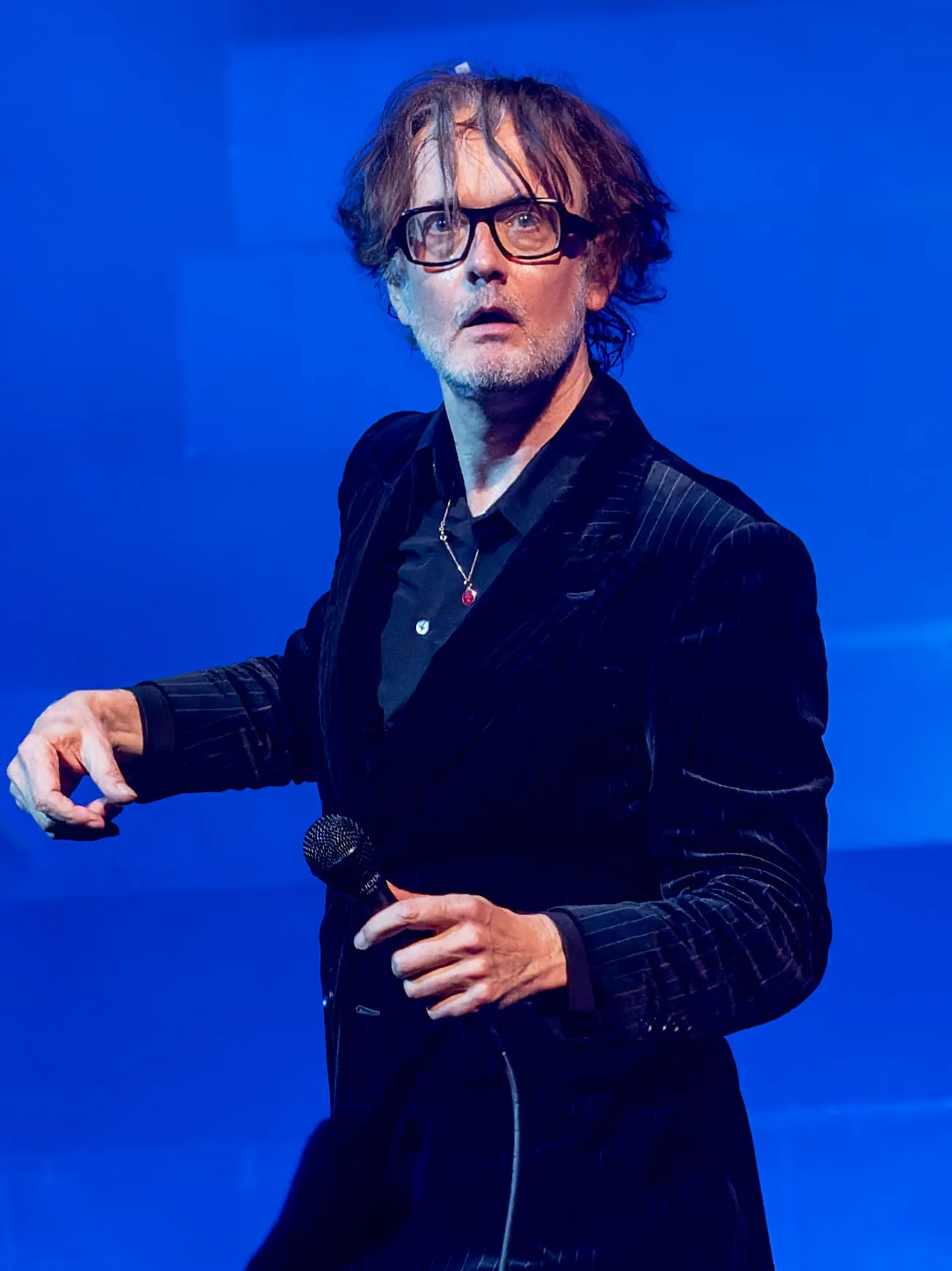
Photo by Raph_PH , licensed under CC BY 2.0 · Wikimedia Commons
Rank #291
Jarvis Cocker
From Wikipedia
Jarvis Branson Cocker is an English singer and musician. As the founder, frontman, lyricist and only consistent member of the band Pulp, he became a reluctant figurehead of the Britpop genre of the mid-1990s. Cocker has also pursued a solo career, and for seven years he presented the BBC Radio 6 Music show Jarvis Cocker's Sunday Service.
Discography & Previews
Browse through and click an album to open and play 30-second previews streamed from Apple Music.

“Further Complications.”
2009 · 11 tracks

Room 29
2017 · 16 tracks
- 1 Room 29 ↗ 3:35
- 2 Marmont Overture ↗ 2:42
- 3 Tearjerker ↗ 3:04
- 4 Interlude 1 - Hotel Stationery ↗ 1:22
- 5 Clara ↗ 2:59
- 6 Bombshell ↗ 4:36
- 7 Belle Boy ↗ 3:03
- 8 Howard Hughes Under the Microscope ↗ 3:20
- 9 Salomé ↗ 2:55
- 10 Interlude 2 - 5 Hours a Day ↗ 1:14
- 11 Daddy, You're Not Watching Me ↗ 2:10
- 12 The Other Side ↗ 3:44
- 13 The Tearjerker Returns ↗ 3:33
- 14 A Trick of the Light ↗ 7:22
- 15 Room 29 (Reprise) ↗ 2:11
- 16 Ice Cream As Main Course ↗ 2:51
-
 “Further Complications.”Jarvis Cocker200911 tracks
 -
 Room 29Jarvis Cocker201716 tracks
Deep Dive
Overview
Jarvis Branson Cocker is an English singer and musician best known as the founder, frontman, and lyricist of Pulp, the band that became synonymous with Britpop in the mid-1990s. As a solo artist, Cocker has pursued a parallel creative path separate from his primary band, releasing a series of albums that reflect his restless artistic evolution and his position as one of Britain’s most distinctive rock vocalists. Beyond recording, he has maintained a presence in broadcast media, presenting BBC Radio 6 Music’s Jarvis Cocker’s Sunday Service for seven years, solidifying his role as both creator and cultural commentator.
Formation Story
Born in 1963, Jarvis Cocker emerged from the post-punk and new wave landscape of British rock in the late 1970s and early 1980s. His entry into rock music came through the formation of Pulp in the mid-1980s, which would occupy the majority of his artistic attention through the 1990s and beyond. The solo work that followed came later in his career, after Pulp had established itself as a major force in British alternative rock. Cocker’s solo output represents a deliberate expansion of his artistic voice, undertaken while his primary band remained active, and reflects his willingness to experiment with different production approaches and sonic textures outside the Pulp framework.
Breakthrough Moment
Cocker’s breakthrough as a solo artist came with the release of The Jarvis Cocker Record in 2006 on Island Records. This debut solo album marked his first sustained effort as a recording artist working independently from Pulp’s established sound and process. The album signaled his intent to explore new creative territory while maintaining the lyrical acuity and melodic sensibility that had defined his work with the band. This initial solo venture established the groundwork for what would become an ongoing parallel career, proving that Cocker’s songwriting and vocal presence could sustain projects beyond the band context.
Peak Era
Cocker’s most concentrated period of solo activity spans from 2006 through 2017, encompassing three studio albums across more than a decade. Following The Jarvis Cocker Record, he released Further Complications in 2009, continuing his exploration of alternative rock and pop forms. The decade between his second and third solo albums saw Cocker balancing his broadcasting work with intermittent recording activity. His third album, Room 29 (2017), represented a return to the recording studio and demonstrated his continued engagement with the solo project format. This extended timeline reveals a pattern of careful, deliberate releases rather than prolific output, reflecting Cocker’s approach to his solo work as a complement to rather than replacement for his role in Pulp.
Musical Style
As a solo artist, Jarvis Cocker operates within the broader terrain of alternative rock and pop music, genres that define much of his output both with and without Pulp. His solo recordings showcase the same lyrical precision and vocal idiosyncrasy that characterize his band work, while allowing for different instrumental arrangements and production sensibilities. His baritone, slightly nasal singing voice remains consistent across his output, instantly recognizable and distinctly British in character. The solo albums reflect a willingness to work with different producers and session musicians, creating sonic variety while maintaining a core identity rooted in post-punk and new wave influences filtered through contemporary alternative rock practice. His approach emphasizes songwriting clarity and melodic development, avoiding both extreme experimentation and commercial pastiche.
Major Albums
The Jarvis Cocker Record (2006)
Cocker’s inaugural solo album introduced his voice and songwriting in a new context, establishing the template for his independent work while drawing on his extensive experience as Pulp’s primary creative force.
Further Complications (2009)
Released three years after his debut, this second album continued his solo exploration with different production approaches and reinforced his commitment to recording outside the Pulp structure.
Room 29 (2017)
Cocker’s third solo album marked a significant return to recording after a prolonged gap, demonstrating his sustained engagement with the solo format and his ability to remain creatively active across multiple projects.
Signature Songs
While Jarvis Cocker’s solo discography is considerably smaller than his Pulp catalog, the songs from his three albums represent important moments in his independent work. His solo recordings emphasize the same attention to lyrical detail and melodic construction found throughout his career. The relative scarcity of major hit singles from his solo work reflects his positioning as a band frontman first, with his independent recordings serving a different function within his overall artistic output.
Influence on Rock
Jarvis Cocker’s influence on rock music stems primarily from his work with Pulp, though his solo career reinforces his status as a significant voice in alternative rock. As a frontman, he helped define the Britpop aesthetic through his distinctive vocal delivery, sharp observational lyrics, and uncompromising approach to songwriting. His presence in British rock extended beyond recording and touring; his work as a broadcaster on BBC Radio 6 Music positioned him as a tastemaker and cultural arbiter, influencing how contemporary listeners engage with rock music and music history. His solo releases, while less commercially dominant than Pulp’s output, contribute to a broader legacy of artists who successfully balance primary band commitments with independent creative projects.
Legacy
Jarvis Cocker’s legacy encompasses his central role in Britpop as Pulp’s principal creative force and his sustained presence in British cultural life as both musician and broadcaster. His willingness to pursue solo recordings alongside his band work demonstrates an artist committed to creative autonomy and experimentation across multiple formats. The solo albums, though not achieving the commercial impact of Pulp’s major releases, represent an important part of his artistic trajectory and showcase his refusal to be confined by commercial expectation or generic categorization. His long career—spanning from the early 1980s through the present day—positions him as a significant figure in post-punk and alternative rock history, one whose influence extends through multiple generations of British musicians.
Fun Facts
- Jarvis Cocker presented BBC Radio 6 Music’s Jarvis Cocker’s Sunday Service for seven years, establishing himself as a cultural broadcaster beyond his role as a recording artist.
- His solo albums were released on Island Records, a major label with a storied history in alternative and rock music.
- The gap between his second solo album (2009) and third (2017) reflects his focus on Pulp during that period, as the band remained his primary creative outlet.