
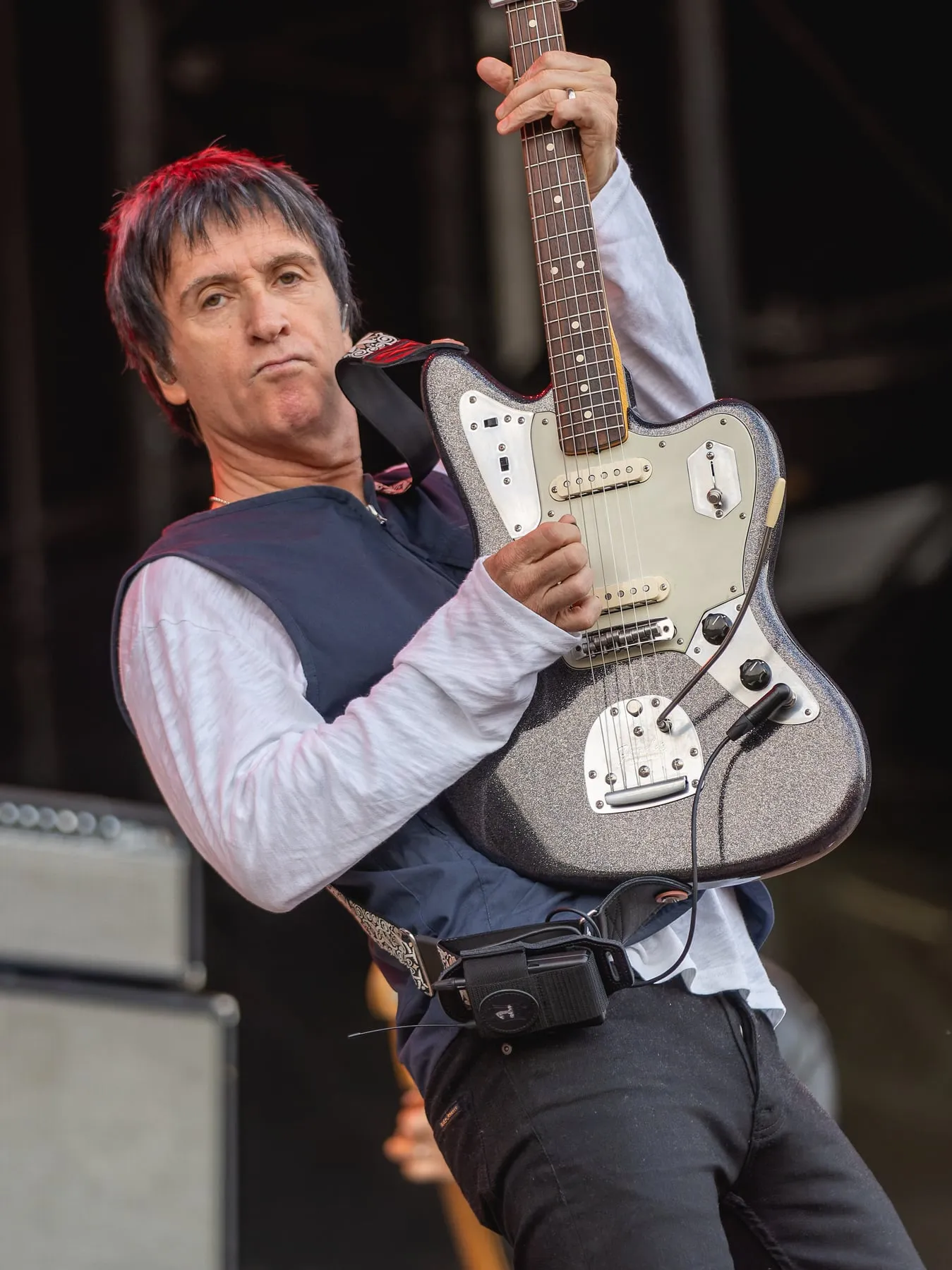
Photo by Raph_PH , licensed under CC BY 2.0 · Wikimedia Commons
Rank #128
Johnny Marr
From Wikipedia
John Martin Marr is an English-born Irish musician, singer and songwriter. He first achieved fame as the guitarist and co-songwriter of the Smiths, who were active from 1982 to 1987. He has since performed with numerous other bands and embarked on a solo career.
Discography & Previews
Browse through and click an album to open and play 30-second previews streamed from Apple Music.

The Messenger
2013 · 12 tracks


Fever Dreams Pts. 1-4
2022 · 16 tracks
- 1 Spirit Power and Soul ↗ 4:39
- 2 Receiver ↗ 5:18
- 3 All These Days ↗ 4:55
- 4 Ariel ↗ 4:52
- 5 Lightning People ↗ 4:39
- 6 Hideaway Girl ↗ 3:25
- 7 Sensory Street ↗ 5:18
- 8 Tenement Time ↗ 4:19
- 9 The Speed of Love ↗ 5:44
- 10 Night and Day ↗ 4:55
- 11 Counter Clock World ↗ 4:07
- 12 Rubicon ↗ 4:15
- 13 God's Gift ↗ 4:06
- 14 Ghoster ↗ 4:10
- 15 The Whirl ↗ 3:44
- 16 Human ↗ 4:23
-
 The MessengerJohnny Marr201312 tracks
 -
 PlaylandJohnny Marr201411 tracks
 -
 Call the CometJohnny Marr201812 tracks
 -
 Fever Dreams Pts. 1-4Johnny Marr202216 tracks
Deep Dive
Overview
Johnny Marr stands as one of rock music’s most distinctive and restless guitarists. An English-born Irish musician born in 1963, Marr first achieved international prominence as the guitarist and co-songwriter of The Smiths, the Manchester-based band that operated from 1982 to 1987 and fundamentally reshaped British indie rock. Following The Smiths’ dissolution, Marr embarked on a prolific solo career spanning decades, while also collaborating with an extensive roster of artists across rock, electronic, and alternative music. His work sits at the intersection of jangle pop, indie rock, and alternative dance—a musician whose restless approach to songwriting and production has kept him continuously active in rock’s creative margins.
Formation Story
Johnny Marr’s journey into music began in an era when rock’s geography was being redrawn. Born in 1963 in England, he came of age during the post-punk upheaval of the late 1970s and early 1980s, when Manchester emerged as a second major creative hub in British rock after London. His early musical identity coalesced around the intersection of indie sensibility, pop craftsmanship, and the guitar-driven sound that bands like Jangly pop and post-punk acts were developing. Before achieving his signature prominence, Marr honed his approach to arrangement, tone, and songwriting, developing an immediately recognizable guitar language that would become his defining trademark.
Breakthrough Moment
Johnny Marr’s breakthrough came through The Smiths, the partnership that would define the first half of his career. The band, formed in 1982, paired Marr’s intricate, melodically sophisticated guitar work with Morrissey’s distinctive vocals and lyrical sensibility. Across five studio albums released between 1984 and 1987, The Smiths became one of the most influential British acts of the 1980s, moving indie rock toward a more pop-conscious, emotionally direct aesthetic. The Smiths’ impact on British and American alternative music proved immediate and lasting, establishing Marr as a guitarist of unusual intelligence and melodic invention. Their dissolution in 1987 marked not an ending but a pivot point: Marr would spend the next two decades proving his versatility and depth as a musician operating beyond any single band context.
Peak Era
Following The Smiths’ end, Johnny Marr moved into a remarkably varied peak period defined by exploration and restlessness. Rather than retiring or attempting to recreate his most famous band, Marr collaborated with Electronic, Modest Mouse, and numerous other artists, appearing as a session and touring guitarist across multiple projects. His decision to record a solo album came in 2013 with The Messenger, released on Rough Trade—the independent label that had hosted The Smiths’ early work. The Messenger announced a shift toward solo authorship: Marr as vocalist, bandleader, and conceptual force rather than sole guitarist. The album was followed in 2014 by Playland, demonstrating that solo recording was not a one-off but a sustained creative commitment. Throughout this era, Marr balanced touring, recording, and collaborative work, sustaining relevance across indie rock and alternative music without relying on nostalgia or reunion tours.
Musical Style
Johnny Marr’s guitar style emerged from jangle pop and indie rock traditions but transformed them through precision, harmonic sophistication, and an almost classical attention to arrangement. His tone favors clarity and melodic definition over distortion or effects excess; where other 1980s guitarists pursued density, Marr pursued architecture. His approach to songwriting emphasizes memorable melodic hooks, unexpected chord movements, and a pop sensibility that never slides into sentimentality. As a solo artist and vocalist, Marr’s singing sits in a middle register, clear and conversational, supporting rather than dominating arrangements. His production choices reflect influences across alternative dance, indie pop, and electronic music—a willingness to experiment with texture and rhythm that moves beyond traditional rock instrumentation. The genres he inhabits—alternative rock, indie rock, alternative dance, jangle pop—all describe different facets of the same impulse: a musician equally interested in pop catchiness, textural innovation, and emotional directness.
Major Albums
The Messenger (2013)
Marr’s solo debut announced an artist working across electronic production, pop melody, and rock instrumentation, establishing him as a complete musician rather than a guitarist seeking a new backing band.
Playland (2014)
Released a year after The Messenger, Playland consolidated Marr’s solo approach, deepening his engagement with electronic elements and production-forward songwriting.
Call the Comet (2018)
After a four-year gap, Marr returned with Call the Comet, demonstrating his continued evolution and commitment to exploring alternative rock and electronic music boundaries.
Fever Dreams Pts. 1-4 (2022)
Marr’s fourth solo album arrived as a double album in four installments, marking his most ambitious solo work and confirming his status as an active, evolving artist well into his sixth decade.
Signature Songs
- “How Soon Is Now?” — The Smiths’ signature ballad, showcasing Marr’s ability to build emotional weight through guitar architecture and melodic phrasing.
- “There Is a Light That Never Goes Out” — A The Smiths epic that became one of British rock’s most enduring anthems through Marr’s patient, building arrangement.
- “This Charmed Life” — Demonstrates The Smiths’ command of pop structure and Marr’s gift for memorable, intricate guitar hooks.
- “The Boy with the Thorn in His Side” — A defining track that balances pop accessibility with subtle harmonic sophistication.
Influence on Rock
Johnny Marr’s influence on rock music operates across two distinct but overlapping domains. Through The Smiths, he helped establish indie rock as a viable mainstream alternative in the 1980s, moving the genre toward pop melodicism and emotional vulnerability while maintaining artistic credibility. His guitar approach—melodic, arranged, clearly audible—became a template for countless indie and alternative acts that followed, from 1990s British pop-punk to contemporary indie rock. As a solo artist and collaborator, Marr has continued expanding the vocabulary of alternative rock and electronic music, demonstrating that a musician’s creative arc need not follow a single trajectory. His willingness to work across genres, collaborate extensively, and evolve his sound has made him a model for alternative rock musicians navigating longevity without predictability.
Legacy
Johnny Marr’s legacy divides between his work with The Smiths—one of the most influential British bands of the 1980s—and his sustained solo career as an active, evolving artist. The Smiths’ cultural footprint remains enormous: their albums remain in print and widely streamed, their influence evident across British indie pop, American alternative rock, and contemporary guitar music. As a solo artist, Marr has proven that creative vitality does not depend on recreating past success; his solo albums demonstrate an artist willing to experiment with electronic production, alternative dance, and pop songwriting conventions. He has maintained a presence in contemporary alternative rock not through nostalgia but through active engagement with current production techniques and genre evolution. His recording history from 1963 to the present confirms him as a working musician rather than a heritage act.
Fun Facts
- Johnny Marr has collaborated with an unusually diverse array of artists across rock, electronic, and alternative music, expanding the possible contexts for his guitar playing and songwriting.
- His decision to pursue solo recording came relatively late in his career, after decades of session and collaborative work, suggesting a deliberate choice to establish his own artistic voice distinct from his most famous partnership.
- Marr has remained aligned with independent record labels throughout his solo career, maintaining creative autonomy rather than pursuing major label distribution.