
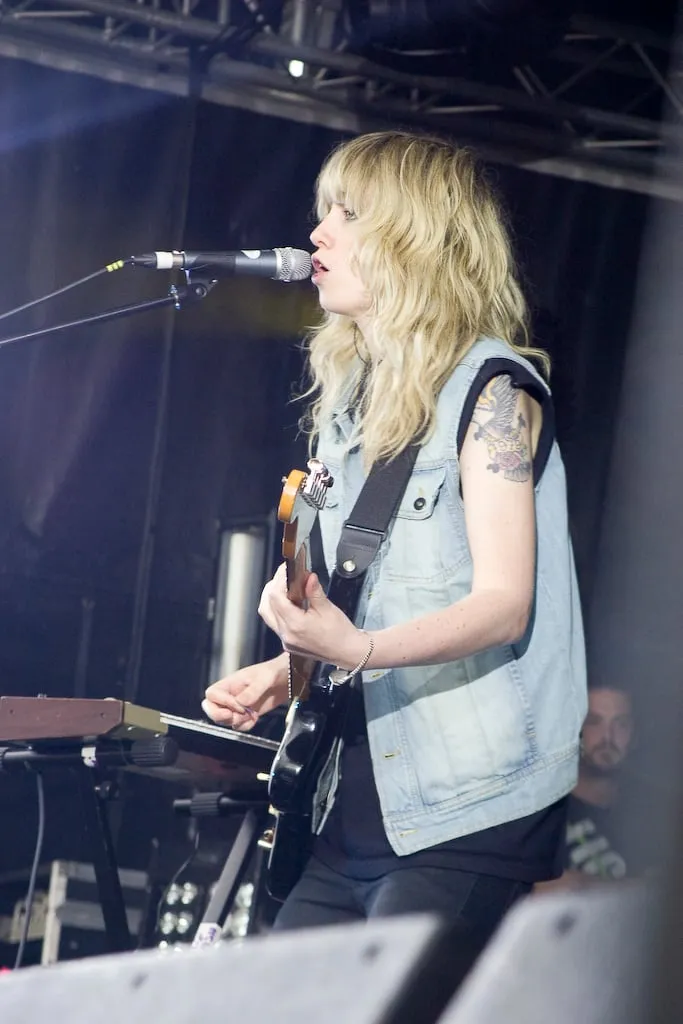
Photo by Matt Dinnery from Sunderland, United Kingdom , licensed under CC BY 2.0 · Wikimedia Commons
Rank #448
Ladyhawke
From Wikipedia
Phillipa Margaret "Pip" Brown, better known by her stage name Ladyhawke, is a New Zealand singer-songwriter and multi-instrumentalist. She took her stage name from Richard Donner's 1985 film Ladyhawke.
Discography & Previews
Browse through and click an album to open and play 30-second previews streamed from Apple Music.

Ladyhawke
2008 · 12 tracks


-
 LadyhawkeLadyhawke200812 tracks
 -
 AnxietyLadyhawke201211 tracks
 -
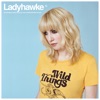 Wild ThingsLadyhawke201611 tracks
 -
 Time FliesLadyhawke202111 tracks
Deep Dive
Overview
Ladyhawke, the stage name of Phillipa Margaret “Pip” Brown, is a New Zealand singer-songwriter and multi-instrumentalist who emerged from the 2000s indie and new wave revival. Working primarily across new wave and pop idioms, Brown has crafted a distinctive sound rooted in synth-driven arrangements, precise songwriting, and her characteristic vocal delivery. Since her debut in 2008, she has sustained a recording career across multiple albums, establishing herself as a notable figure in contemporary alternative pop.
Formation Story
Phillipa Margaret Brown was born in 1979 in New Zealand, coming of age during the 1990s when alternative rock and indie pop were establishing themselves globally. She adopted the stage name Ladyhawke from Richard Donner’s 1985 fantasy film Ladyhawke, a reference that hints at her engagement with cinematic and atmospheric sensibilities. Brown developed as a multi-instrumentalist in the New Zealand music scene, drawing on her country’s tradition of independent artists operating outside major cultural centers. Her formation as a solo artist occurred during a period when digital distribution and independent record labels were reshaping how musicians could reach audiences without traditional major-label machinery.
Breakthrough Moment
Brown’s formal debut came in 2008 with the self-titled album Ladyhawke, released through Modular Recordings. The album introduced her distinctive synthesis of 1980s new wave production—sharp synth lines, precise drums, and detached yet emotionally precise vocals—applied to contemporary songwriting. The record marked her transition from local New Zealand artist to an act with international reach, establishing her presence on the global indie and alternative pop landscape. The debut’s success set the template for her subsequent work and positioned her within the broader 2000s indie pop movement that drew from post-punk and new wave precedents.
Peak Era
Brown’s most creatively consistent and commercially visible period spanned from 2008 through the mid-2010s. Her first two albums, Ladyhawke (2008) and Anxiety (2012), established her core sound and demonstrated her capacity to evolve incrementally while maintaining stylistic coherence. During this era she worked extensively with Modular Recordings and later Island Records, securing distribution that allowed her music to circulate beyond New Zealand. The period between her debut and Wild Things (2016) saw her refine her production approach, experiment with texture and arrangement, and develop a loyal international following among listeners invested in new wave and indie pop.
Musical Style
Ladyhawke’s sound is fundamentally rooted in new wave and pop, with particular emphasis on synthesizer-based arrangements and rhythmic precision. Her production approach favors clean, often minimal instrumentation—prominent keyboard lines, tight drum programming, and vocals that sit with clarity and detachment in the mix. The influence of 1980s new wave figures is audible in her structural choices and her preference for economy over excess, though her songwriting sensibility is distinctly contemporary. Her vocal delivery trades in understatement and emotional restraint; she sings with control and clarity rather than power or overt expressiveness, allowing the precision of her melodies and arrangements to carry the weight. Across her albums, she has demonstrated an evolving relationship with texture, moving from the relatively spare debut toward more layered and atmospheric production on later records like Wild Things (2016) and Time Flies (2021).
Major Albums
Ladyhawke (2008)
Brown’s self-titled debut introduced her synth-driven new wave aesthetic and established the clean, rhythmically precise production that would define her work. The album announced her arrival as a distinctive voice in contemporary pop.
Anxiety (2012)
Her second album deepened and developed the template established by the debut, exploring themes of tension and unease through her characteristic restrained vocal approach and sharp instrumental arrangements.
Wild Things (2016)
Released four years after Anxiety, this album saw Brown experiment with expanded arrangements and atmospheric production while maintaining her new wave foundation, demonstrating continued artistic growth and refinement.
Time Flies (2021)
Brown’s most recent studio album extended her exploration of production texture and songwriting depth, affirming her sustained presence as a working artist in the alternative pop landscape.
Signature Songs
- “Magic” — A highlight from her debut, showcasing her ability to craft infectious melodic hooks within minimalist arrangements.
- “Blue Eyes” — Demonstrates her gift for emotionally restrained yet memorable pop songwriting.
- “Seventeen” — Representative of her work on Anxiety, balancing pop accessibility with new wave severity.
- “About You” — A track that exemplifies her precise vocal delivery and synth-forward instrumentation.
Influence on Rock
Ladyhawke’s work exists within the broader contemporary reappraisal of 1980s new wave and post-punk that accelerated in the 2000s. While she does not represent a singular generative moment for rock music, her sustained career as a new wave and pop artist contributed to the mainstreaming of synth-driven indie pop during the 2000s and 2010s. Her multi-instrumental approach and her synthesis of electronic production with contemporary songwriting offered a model for solo artists operating at the intersection of indie rock, new wave revival, and pop sensibility. Her work has circulated among listeners interested in new wave lineage and contemporary alternative pop, situating her within a continuum rather than as a radical innovator.
Legacy
Ladyhawke’s legacy rests on her sustained career as a working musician across multiple decades and her consistent engagement with new wave and pop forms. From 2008 onward, she has remained active in recording and performance, avoiding the boom-and-bust pattern that characterizes many indie artists. Her output demonstrates that new wave as a production and songwriting approach remained viable and generative well into the 21st century, particularly for artists willing to synthesize past aesthetic approaches with contemporary songwriting sensibility. Her presence on streaming platforms and her ongoing recording activity affirm her status as an enduring figure in contemporary alternative pop, even if she has not achieved the crossover fame of some peers. For listeners engaged with new wave aesthetics and electronic pop, her catalog remains central to understanding how those forms evolved in the post-2000s era.
Fun Facts
- Brown chose her stage name from the 1985 fantasy film Ladyhawke directed by Richard Donner, a detail that reflects her engagement with cinematic reference and mythology.
- She is a multi-instrumentalist capable of playing multiple instruments across her recordings, contributing to the hands-on character of her production approach.
- Her career has been anchored by independent and mid-level labels including Modular Recordings and Island Records, allowing her to operate outside major-label infrastructure while maintaining professional distribution and support.