
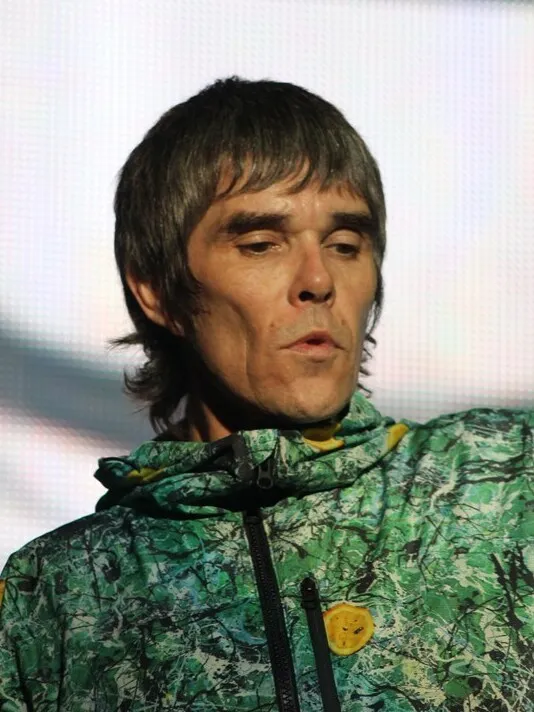
Photo by Sean Reynolds from Liverpool, United Kingdom , licensed under CC BY 2.0 · Wikimedia Commons
Rank #222
Ian Brown
From Wikipedia
Ian George Brown is an English musician. He was the lead singer and the only continuous member of the alternative rock band the Stone Roses from their formation in 1983. Following the band's initial split in 1996, he began a solo career, releasing seven studio albums, a greatest hits compilation, a remix album, an 11-disc box set titled Collection, and 19 singles. He returned to singing for the Stone Roses between 2011 and 2017.
Discography & Previews
Browse through and click an album to open and play 30-second previews streamed from Apple Music.
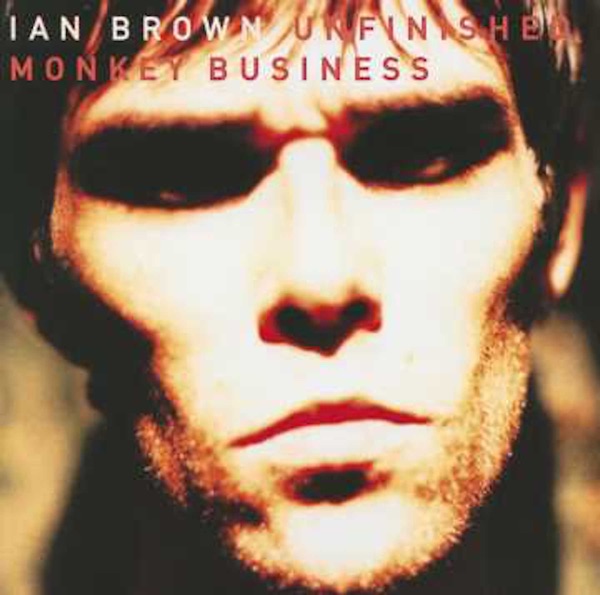
Unfinished Monkey Business
1998 · 12 tracks
- 1 Intro Under the Paving Stones: The Beach ↗ 1:50
- 2 My Star ↗ 5:14
- 3 Can't See Me ↗ 4:54
- 4 Ice Cold Cube ↗ 6:27
- 5 Sunshine ↗ 3:58
- 6 Lions ↗ 6:53
- 7 Corpses in Their Mouths ↗ 4:09
- 8 What Happened to Ya Part 1 ↗ 3:15
- 9 What Happend to Ya Part 2 ↗ 5:39
- 10 Nah Nah ↗ 3:55
- 11 Deep Pile Dreams ↗ 3:39
- 12 Unfinished Monkey Business ↗ 3:12


Solarized
2004 · 11 tracks
- 1 Longsight M13 ↗ 3:12
- 2 Time Is My Everything ↗ 3:52
- 3 Destiny or Circumstance ↗ 2:35
- 4 Upside Down ↗ 3:12
- 5 Solarized ↗ 3:47
- 6 The Sweet Fantastic ↗ 3:52
- 7 Keep What Ya Got ↗ 4:28
- 8 Home Is Where the Heart Is ↗ 3:07
- 9 One Way Ticket to Paradise ↗ 4:16
- 10 Kiss Ya Lips (No I.D.) ↗ 3:57
- 11 Happy Ever After (Uk Bonus Track) ↗ 2:47

The World Is Yours
2007 · 12 tracks
- 1 The World Is Yours ↗ 4:32
- 2 On Track ↗ 4:21
- 3 Sister Rose ↗ 3:52
- 4 Save Us ↗ 4:58
- 5 Eternal Flame ↗ 4:16
- 6 The Feeding of The 5000 ↗ 3:58
- 7 Street Children ↗ 3:52
- 8 Some Folks Are Hollow ↗ 3:49
- 9 Goodbye to the Broken ↗ 3:53
- 10 Me and Your Forever ↗ 4:11
- 11 Illegal Attacks ↗ 5:28
- 12 The World Is Yours (Reprise) ↗ 1:26

My Way
2009 · 12 tracks

Ripples
2019 · 10 tracks
- 1 First World Problems ↗ 5:58
- 2 Black Roses ↗ 2:38
- 3 Breathe and Breathe Easy (The Everness of Now) ↗ 3:27
- 4 The Dream and the Dreamer ↗ 5:38
- 5 From Chaos to Harmony ↗ 4:02
- 6 It's Raining Diamonds ↗ 3:10
- 7 Ripples ↗ 3:44
- 8 Blue Sky Day ↗ 5:10
- 9 Soul Satisfaction ↗ 4:08
- 10 Break Down the Walls (Warm up Jam) ↗ 4:53
-
 Unfinished Monkey BusinessIan Brown199812 tracks
 -
 Golden GreatsIan Brown199910 tracks
 -
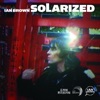 SolarizedIan Brown200411 tracks
 -
 The World Is YoursIan Brown200712 tracks
 -
 My WayIan Brown200912 tracks
 -
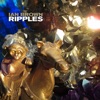 RipplesIan Brown201910 tracks
Deep Dive
Overview
Ian Brown stands as one of British rock’s most distinctive frontmen, commanding the stage with a vocal presence that became synonymous with the Madchester sound and the broader Britpop movement. Born in 1963, he emerged as the lead singer and sole continuous member of the Stone Roses, the Manchester alternative rock band that defined a generation’s musical and cultural sensibility. Following the Roses’ initial split in 1996, Brown embarked on a solo career spanning three decades, releasing seven studio albums while maintaining the band’s spirit—a blend of funk-inflected rhythms, psychedelic textures, and working-class British conviction.
Formation Story
Ian George Brown grew up in Manchester during the 1970s and early 1980s, a city whose industrial heritage and emerging club culture would shape his artistic sensibility. He came of age as punk and post-punk were redefining rock’s boundaries, but it was the nascent electronic and funk influences percolating through the city’s nightclubs and live venues that captured his imagination. In 1983, Brown co-founded the Stone Roses with guitarist John Squire, bassist Mani, and drummer Alan Wren, emerging from Manchester’s thriving alternative scene at a moment when the city was beginning to rival London as a creative epicenter. The band’s formation marked the convergence of punk’s directness, funk’s physicality, and electronic music’s rhythmic precision—a sound that would eventually define Madchester and influence British rock for decades.
Breakthrough Moment
The Stone Roses’ early 1990s ascendancy, driven by the release of their eponymous 1989 debut album and cemented by the sprawling second album “The Second Coming” (1994), made Brown one of the era’s most recognizable voices. Their blend of baggy textures, dub-influenced production, and Brown’s distinctive vocal delivery—neither conventionally trained nor aggressively punk, but possessed of a particular swagger and emotional directness—resonated across the United Kingdom and beyond. The band’s split in 1996 left a void in British rock, prompting Brown to test his solo capabilities. His debut solo album, Unfinished Monkey Business (1998), announced that he could sustain a career beyond the Roses’ framework, blending the funk and psychedelic tendencies he had explored in the band with a more introspective sensibility.
Peak Era
Brown’s solo work from 1998 through the early 2000s represents his most artistically fertile period outside the Roses. Unfinished Monkey Business (1998) and Music of the Spheres (2001) established him as a capable solo artist willing to pursue ambitious arrangements and conceptual depth. The release of Solarized (2004) and The World Is Yours (2007) further solidified his reputation, showcasing his ability to evolve without abandoning the core sensibility that had made the Roses essential. Throughout this decade, Brown maintained an independent trajectory even as the broader Britpop movement that had sustained him underwent various reinterpretations and revivals. When the Stone Roses reunited between 2011 and 2017, Brown balanced both projects, demonstrating his enduring importance to the band’s legacy while continuing to develop his solo work.
Musical Style
Brown’s vocal approach defines much of his work—a delivery that hovers between sung melody and rhythmic utterance, influenced by funk and soul traditions but filtered through a distinctly British sensibility. His phrasing favors space and groove over technical virtuosity, allowing lyrics and atmospheric production to breathe within the song’s architecture. In the Roses’ context, he shared songwriting duties with Squire and contributed to the band’s evolution from late-1980s post-punk toward the funk-and-dance-inflected sound that made them vital forces in the Madchester scene. His solo albums have embraced a broader palette: the Unfinished Monkey Business era drew on contemporary funk and dub influences, while Music of the Spheres (2001) explored more experimental and psychedelic textures. The production values expanded across records released through Polydor and later labels, reflecting a willingness to work with different collaborators and sonic approaches. Throughout, his work remains rooted in the Madchester and Britpop contexts that defined his emergence—genres themselves characterized by the synthesis of dance, electronic, and rock elements.
Major Albums
Unfinished Monkey Business (1998)
Brown’s solo debut announced his capacity to sustain a career beyond the Roses, blending funk grooves, psychedelic production, and his distinctive vocal presence into a set of tracks that proved his songwriting and interpretive skills remained sharp.
Music of the Spheres (2001)
Released three years later, this album deepened Brown’s exploration of psychedelic and experimental textures while maintaining the funk-and-rock synthesis that had defined his earlier work, showcasing increased sonic ambition and thematic cohesion.
Solarized (2004)
This record continued his solo trajectory with further refinement of his arrangements and production approach, balancing accessibility with the kind of experimental impulses that had made the Roses’ later work divisive but compelling.
The World Is Yours (2007)
Approaching this mid-career statement, Brown demonstrated his staying power and ability to evolve, crafting songs that honored his Madchester and Britpop roots while incorporating contemporary production sensibilities.
Ripples (2019)
After a decade-long gap since his previous solo release and following the Stone Roses’ final reunion shows, Brown returned with Ripples, proving his relevance and creative vitality in the streaming era, with production reflecting contemporary indie rock and electronic influences.
Signature Songs
- Love Like a Fountain — A demonstration of Brown’s ability to craft introspective, melodically strong solo material that expanded on themes explored with the Roses.
- Dolphins Were Monkeys — Showcases the experimental and playful side of his solo work, blending quirky production with his distinctive vocal character.
- Corpses in Their Mouths — Represents Brown’s willingness to engage darker, more provocative lyrical territory in his solo output.
- Golden Greats — The title track and opening salvo from his second album, establishing the ambitious scope of his continued solo ambitions.
Influence on Rock
Ian Brown’s influence flows through two distinct but interconnected channels: his role as frontman of the Stone Roses, and his subsequent solo career. The Roses’ Madchester sound—a fusion of punk directness, funk physicality, and electronic production—shaped alternative rock’s trajectory in the 1990s, influencing everything from British Britpop to American alternative acts drawing on similar wellsprings. Brown’s distinctive vocal presence and physical swagger became a template for frontmen seeking alternatives to grunge’s angst or British shoegaze’s ethereality. His solo career, meanwhile, has preserved and extended the experimental and funk-informed sensibilities of the Roses into subsequent decades, ensuring that the Madchester sound remained part of contemporary indie rock’s vocabulary rather than a relic of the 1980s. His willingness to pursue introspective and conceptually ambitious work outside the band framework demonstrated that his contributions to the Roses extended beyond performance into the realm of artistic vision.
Legacy
Ian Brown remains one of British rock’s most recognizable and enduring figures, his status secured by three decades of consistent work across his Stone Roses years and his expansive solo output. The Stone Roses’ reunion between 2011 and 2017 introduced their music to new generations while confirming Brown’s irreplaceable role in the band’s identity—no substitute vocalist could replicate the particular combination of swagger, restraint, and emotional conviction that defines his performances. His seven studio albums and extensive singles catalogue, released through Polydor, Interscope, and other labels, have ensured a steady stream of new material across changing musical landscapes and industry formats. The existence of compilation materials, including a greatest hits compilation and the comprehensive Collection box set, underscores his status within the broader canon of British alternative rock. Brown’s presence on streaming platforms and continued touring activity keep both his Roses legacy and solo work accessible to listeners ranging from longtime devotees to those discovering Madchester and Britpop through contemporary retrospectives.
Fun Facts
- Brown was the sole continuous member of the Stone Roses across their formation in 1983, their initial dissolution in 1996, and their reunions in later years, making him the band’s anchor point across nearly four decades.
- His solo career has encompassed seven studio albums, a greatest hits compilation, a remix album, and an 11-disc box set titled Collection, demonstrating the prolific nature of his output beyond the Roses.
- The gap between The World Is Yours (2007) and Ripples (2019) spanned twelve years, during which Brown maintained touring activity and continued to participate in Stone Roses reunion shows, suggesting a deliberate editorial approach to his solo releases.
- Brown maintained an official website at ianbrown.co.uk, ensuring direct connection with fans outside traditional industry promotional channels.