
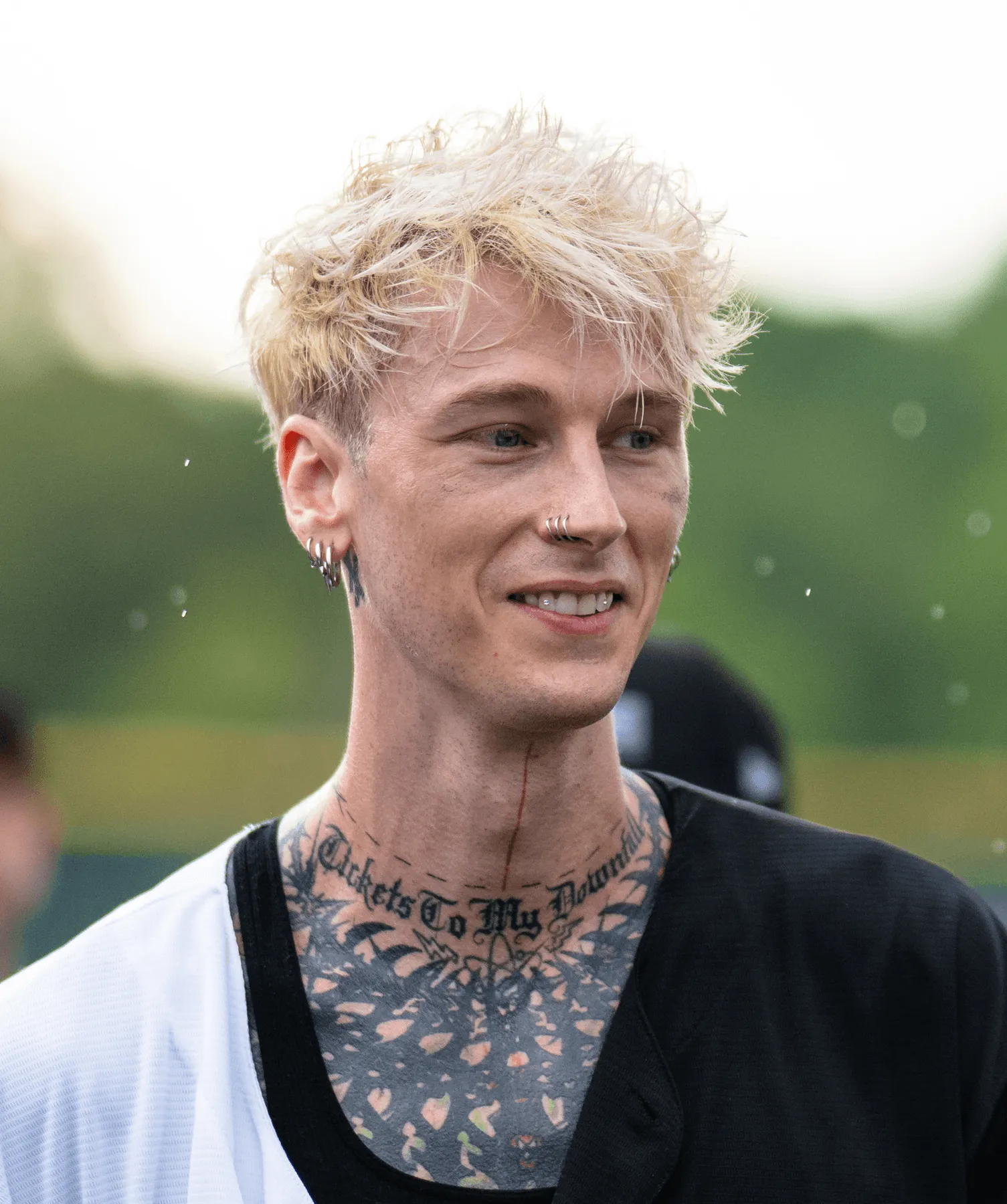
Photo by Erik Drost , licensed under CC BY 2.0 · Wikimedia Commons
Rank #140
Machine Gun Kelly
From Wikipedia
Colson Baker, known professionally as MGK and formerly Machine Gun Kelly, is an American rapper, singer, songwriter, producer and actor. His original stage name "Machine Gun Kelly" was derived from the nickname of Prohibition-era gangster George Kelly Barnes.
Discography & Previews
Browse through and click an album to open and play 30-second previews streamed from Apple Music.
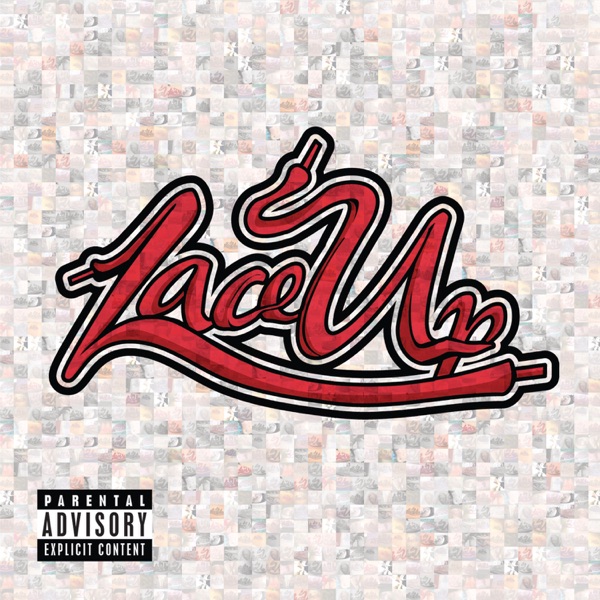
Lace Up
2010 · 13 tracks
- 1 Save Me (feat. M. Shadows & Synyster Gates) ↗ 3:13
- 2 What I Do (feat. Bun B & Dub-O) ↗ 4:33
- 3 Wild Boy (feat. Waka Flocka Flame) ↗ 3:51
- 4 Lace Up (feat. Lil Jon) ↗ 3:02
- 5 Stereo (feat. Fitts of the Kickdrums) ↗ 3:54
- 6 All We Have (feat. Anna Yvette) ↗ 3:27
- 7 See My Tears ↗ 4:10
- 8 D3MONS (feat. DMX) ↗ 4:21
- 9 Edge of Destruction (feat. Tech N9ne & Twista) ↗ 5:08
- 10 Runnin' (feat. Planet VI) ↗ 2:48
- 11 Invincible (feat. Ester Dean) ↗ 3:06
- 12 On My Way ↗ 4:11
- 13 End of the Road (feat. Blackbear) ↗ 4:04
Lace Up
2012 · 13 tracks
- 1 Save Me (feat. M. Shadows & Synyster Gates) ↗ 3:13
- 2 What I Do (feat. Bun B & Dub-O) ↗ 4:33
- 3 Wild Boy (feat. Waka Flocka Flame) ↗ 3:51
- 4 Lace Up (feat. Lil Jon) ↗ 3:02
- 5 Stereo (feat. Fitts of the Kickdrums) ↗ 3:54
- 6 All We Have (feat. Anna Yvette) ↗ 3:27
- 7 See My Tears ↗ 4:10
- 8 D3MONS (feat. DMX) ↗ 4:21
- 9 Edge of Destruction (feat. Tech N9ne & Twista) ↗ 5:08
- 10 Runnin' (feat. Planet VI) ↗ 2:48
- 11 Invincible (feat. Ester Dean) ↗ 3:06
- 12 On My Way ↗ 4:11
- 13 End of the Road (feat. Blackbear) ↗ 4:04

General Admission
2015 · 13 tracks
- 1 Spotlight (feat. Lzzy Hale) ↗ 5:05
- 2 Alpha Omega ↗ 3:33
- 3 Till I Die ↗ 3:33
- 4 Eddie Cane ↗ 3:07
- 5 Bad Mother F*cker (feat. Kid Rock) ↗ 3:34
- 6 World Series ↗ 3:35
- 7 Oz. ↗ 2:59
- 8 Everyday ↗ 4:02
- 9 Gone (feat. Leroy Sanchez) ↗ 4:01
- 10 Story of the Stairs ↗ 3:10
- 11 Merry Go Round ↗ 4:06
- 12 A Little More (feat. Victoria Monet) ↗ 3:58
- 13 All Night Long ↗ 7:03

bloom
2017 · 13 tracks
- 1 The Gunner ↗ 3:38
- 2 Wake + Bake ↗ 3:04
- 3 Go For Broke (feat. James Arthur) ↗ 3:31
- 4 At My Best (feat. Hailee Steinfeld) ↗ 3:20
- 5 Kiss the Sky ↗ 3:07
- 6 Golden God ↗ 3:19
- 7 Trap Paris (feat. Quavo & Ty Dolla $ign) ↗ 3:23
- 8 Moonwalkers (feat. DubXX) ↗ 3:06
- 9 Can’t Walk ↗ 3:06
- 10 Bad Things ↗ 3:59
- 11 Rehab ↗ 4:26
- 12 Let You Go ↗ 3:05
- 13 27 ↗ 4:58
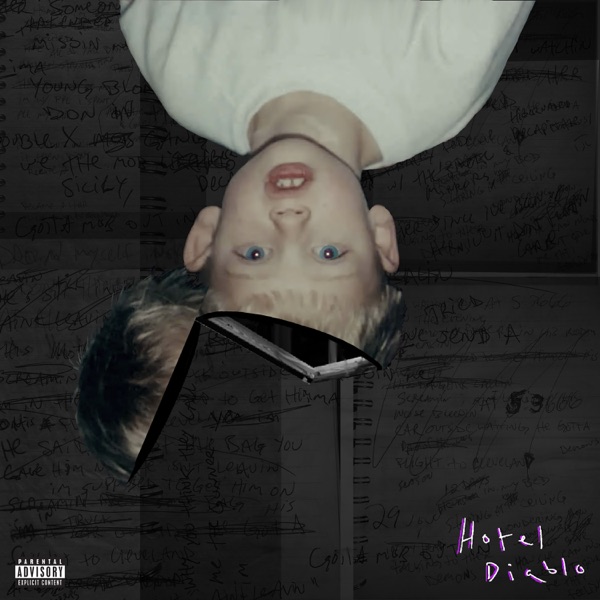
Hotel Diablo
2019 · 14 tracks
- 1 Sex Drive ↗ 2:03
- 2 el Diablo ↗ 2:26
- 3 Hollywood Whore ↗ 3:23
- 4 Glass House (feat. Naomi Wild) ↗ 3:22
- 5 Burning Memories (feat. Lil Skies) ↗ 3:36
- 6 A Message from the Count ↗ 0:37
- 7 Floor 13 ↗ 3:15
- 8 Roulette ↗ 3:03
- 9 Truck Norris Interlude ↗ 0:53
- 10 Death in My Pocket ↗ 3:00
- 11 Candy (feat. Trippie Redd) ↗ 2:37
- 12 Waste Love (feat. Madison Love) ↗ 3:16
- 13 5:3666 (feat. Phem) ↗ 3:15
- 14 I Think I'm OKAY ↗ 2:49
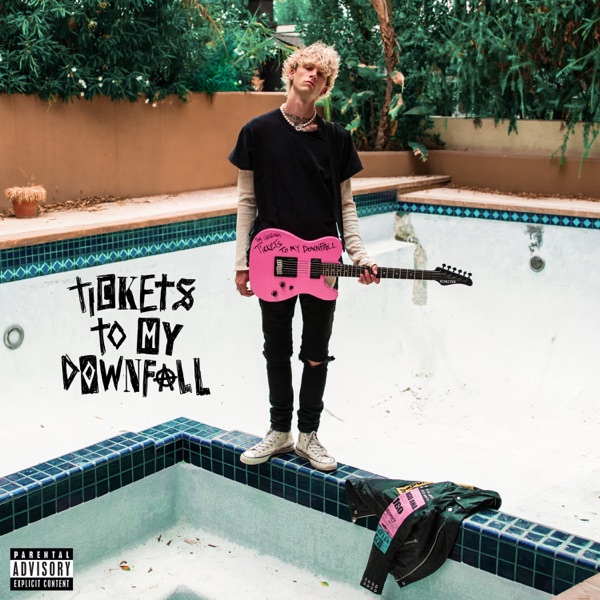
Tickets to My Downfall
2020 · 15 tracks
- 1 title track ↗ 2:46
- 2 kiss kiss ↗ 2:18
- 3 drunk face ↗ 2:24
- 4 bloody valentine ↗ 3:25
- 5 forget me too ↗ 2:52
- 6 all I know (feat. Trippie Redd) ↗ 2:09
- 7 lonely ↗ 3:10
- 8 WWIII ↗ 1:00
- 9 kevin and barracuda (interlude) ↗ 1:23
- 10 concert for aliens ↗ 2:40
- 11 my ex's best friend ↗ 2:19
- 12 jawbreaker ↗ 1:58
- 13 nothing inside (feat. iann dior) ↗ 2:52
- 14 banyan tree (interlude) ↗ 1:31
- 15 play this when i'm gone ↗ 3:22

MAINSTREAM SELLOUT
2022 · 16 tracks
- 1 born with horns ↗ 2:28
- 2 god save me ↗ 3:00
- 3 maybe ↗ 2:50
- 4 drug dealer (feat. Lil Wayne) ↗ 2:52
- 5 wall of fame (interlude) ↗ 0:33
- 6 mainstream sellout ↗ 1:48
- 7 make up sex ↗ 2:03
- 8 emo girl ↗ 2:39
- 9 5150 ↗ 2:55
- 10 papercuts (album edit) ↗ 3:01
- 11 WW4 ↗ 1:13
- 12 ay! ↗ 2:04
- 13 fake love don’t last ↗ 2:23
- 14 die in california (feat. Gunna, Young Thug & Landon Barker) ↗ 3:27
- 15 sid & nancy ↗ 3:10
- 16 twin flame ↗ 3:59
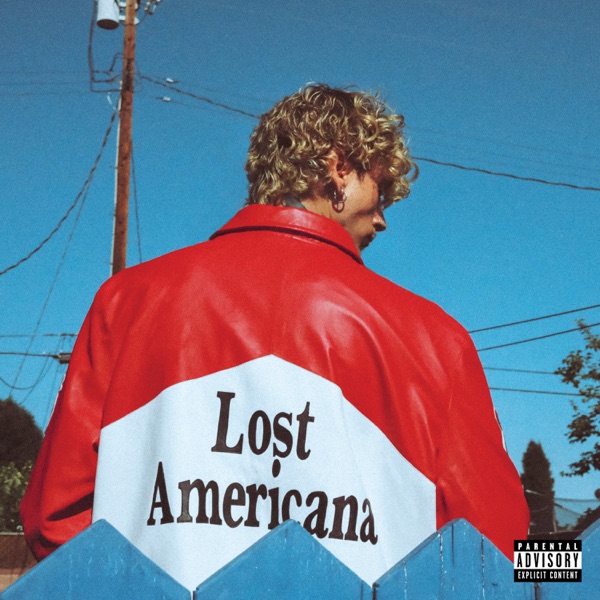
lost americana
2025 · 13 tracks
-
 Lace UpMachine Gun Kelly201013 tracks
 - Lace UpMachine Gun Kelly201213 tracks
-
 General AdmissionMachine Gun Kelly201513 tracks
 -
 bloomMachine Gun Kelly201713 tracks
 -
 Hotel DiabloMachine Gun Kelly201914 tracks
 -
 Tickets to My DownfallMachine Gun Kelly202015 tracks
 -
 MAINSTREAM SELLOUTMachine Gun Kelly202216 tracks
 -
 lost americanaMachine Gun Kelly202513 tracks
Deep Dive
Overview
Machine Gun Kelly, born Colson Baker in 1990, is an American rapper, singer, songwriter, producer, and actor who emerged from Cleveland in the early 2010s as a leading figure in rap-rock fusion. Operating under the stage name derived from Prohibition-era gangster George Kelly Barnes, MGK built his career on high-energy delivery, introspective lyricism, and a willingness to cross genre boundaries. From his early mixtape-era dominance through mainstream breakthrough and subsequent shifts toward pop-punk and alternative rock, Kelly has positioned himself as a perpetual genre-shifter, each album cycle reflecting evolving sonic and thematic interests.
Formation Story
Colson Baker grew up in Cleveland, Ohio, a city with a deep rock and hip-hop heritage but far removed from either coast’s rap machinery. Emerging from the underground mixtape scene in the late 2000s, Baker adopted the Machine Gun Kelly moniker and began building a regional following through relentless touring and self-released projects. His early work blended rapid-fire rap delivery with rock-influenced production, positioning him at the intersection of genres rather than squarely within traditional hip-hop. This outsider positioning—neither a pure rapper nor a rock musician—became his defining trademark and the foundation for everything that followed.
Breakthrough Moment
Machine Gun Kelly’s mainstream arrival crystallized with the release of Lace Up in 2012, a major-label debut that introduced his visceral rap-rock hybrid to a national audience. The album, released after earlier independent versions and mixtapes, featured production that married trap-influenced beats with guitar textures and showcased Kelly’s ability to shift between rapid rap flows and melodic sung passages. The project caught ears across alternative rock and hip-hop radio simultaneously, establishing him as a crossover commodity at a moment when genre boundaries were increasingly fluid. Lace Up signaled that MGK was no longer a regional phenomenon but a contender in the broader rock and rap marketplace.
Peak Era
The period from 2012 through 2017 represented Kelly’s most commercially powerful and artistically expansive phase. Albums including EST 4 Life (2012), Black Flag (2013), General Admission (2015), and bloom (2017) showcased his ability to iterate and refine his sound across multiple projects. During these years, he juggled touring, acting roles, and frequent collaborative work, maintaining visibility as both a recording artist and a live performer. His catalog expanded rapidly—sometimes to the point of oversaturation—but each release found him refining either his rap-rock formula or experimenting with new sonic territory. This prolific output cemented his status as a central figure in the rap-rock fusion landscape of the 2010s.
Musical Style
Machine Gun Kelly’s sound synthesizes rap-rock with hip-hop fundamentals, characterized by rapid, aggressive vocal delivery layered over production that balances percussion-heavy beats with distorted guitars and atmospheric textures. His early work emphasized the kinetic energy of trap-influenced production combined with rock instrumentation, creating a sound that appealed to both rap and alternative rock audiences. Lyrically, Kelly favored themes of personal struggle, ambition, relationships, and self-examination, often shifting between boastful rap flows and introspective sung melodies. Over time, his work expanded to encompass pop-punk elements, alternative hip-hop aesthetics, and experimental production choices, with later albums like Tickets to My Downfall (2020) and MAINSTREAM SELLOUT (2022) showing marked drift toward pop-punk and alternative rock territory. His vocal approach—sometimes rapped, sometimes sung, occasionally both within a single track—became a signature device, allowing him to occupy space across genres without fully committing to any single identity.
Major Albums
Lace Up (2012)
MGK’s major-label debut established his rap-rock formula with high-octane production and aggressive delivery, positioning him as a crossover artist bridging underground and mainstream audiences.
General Admission (2015)
A pivotal album showcasing Kelly’s range, blending rap-rock intensity with melodic pop-influenced moments and demonstrating expanded songwriting ambitions across a deeper tracklist.
bloom (2017)
Released as bloom, this project saw Kelly experimenting with production techniques and vocal approaches, refining the balance between rap and rock elements while maintaining his high-output recording pace.
Hotel Diablo (2019)
An introspective entry that deepened Kelly’s exploration of personal and relational themes while solidifying his transition toward rock-leaning sonics and away from pure rap-rock formulas.
Tickets to My Downfall (2020)
A marked stylistic pivot toward pop-punk and alternative rock, signaling Kelly’s willingness to abandon rap-centric framing in favor of guitar-driven melodies and sung vocal performances.
MAINSTREAM SELLOUT (2022)
A conceptual continuation of the pop-punk direction, doubling down on alternative rock aesthetics and reinforcing Kelly’s genre repositioning as a rock artist rather than a rapper.
Signature Songs
- “Wild Boy” — A definitive early anthem showcasing MGK’s aggressive delivery and rap-rock fusion over infectious production.
- “Bloody Valentine” — A stripped melodic track highlighting Kelly’s ability to shift from rap to sung vocals, demonstrating vocal range and emotional depth.
- “my ex’s best friend” — A contemporary pop-punk influenced track exemplifying his later sonic direction and genre evolution.
- “forget me too” — A collaborative piece reflecting Kelly’s willingness to experiment with features and production styles across his career.
Influence on Rock
Machine Gun Kelly’s primary contribution to rock music lies in his normalization of rap-rock fusion during a period when genre boundaries were increasingly porous. Rather than viewing rap and rock as opposing territories, Kelly positioned them as complementary aesthetics available to a single artist within a single project. His success in crossing over between hip-hop and rock radio—and later his full pivot toward pop-punk and alternative rock—demonstrated that audience appetite existed for artists who refused categorical limitation. In the 2020s landscape where genre fluidity is standard rather than exception, Kelly’s career path—while at times commercially calculating—reflected and reinforced broader trends toward hybrid sonic identities. His influence extends to younger rap-rock and alternative musicians who cite his crossover approach as permission to blend styles without apology.
Legacy
Machine Gun Kelly’s long-term legacy rests on his role as a transitional figure bridging rap-rock’s mainstream peak in the 2010s and the genre’s diversification in subsequent decades. His prolific output—multiple albums annually at various points in his career—established him as a constant presence in rock and alternative music discourse, though not always with unanimous critical enthusiasm. The marked genre shift visible across his discography, from Lace Up through MAINSTREAM SELLOUT, documents a real artistic evolution or, alternatively, a series of calculated commercial pivots depending on critical perspective. His visibility in acting, collaborations, and cultural commentary have maintained his relevance beyond pure music metrics. As streaming redefined album consumption and fan loyalty, Kelly’s expansive catalog found audiences across multiple platforms and demographic slices, ensuring continued presence regardless of critical consensus.
Fun Facts
- Machine Gun Kelly derived his stage name from George Kelly Barnes, a Prohibition-era gangster known as “Machine Gun Kelly,” deliberately choosing a historically loaded moniker to signal his artistic aggression.
- His prolific release schedule occasionally resulted in multiple albums per year across different labels and imprints, reflecting both industry complexity and his commitment to constant content output.
- Beyond music, Kelly developed a parallel acting career, diversifying his income and cultural profile across film and television projects alongside his recording work.
- The evolution from Tickets to My Downfall onward toward pop-punk and alternative rock reflected collaborations with rock-adjacent producers and musicians, signaling real genre migration rather than isolated experimentation.