
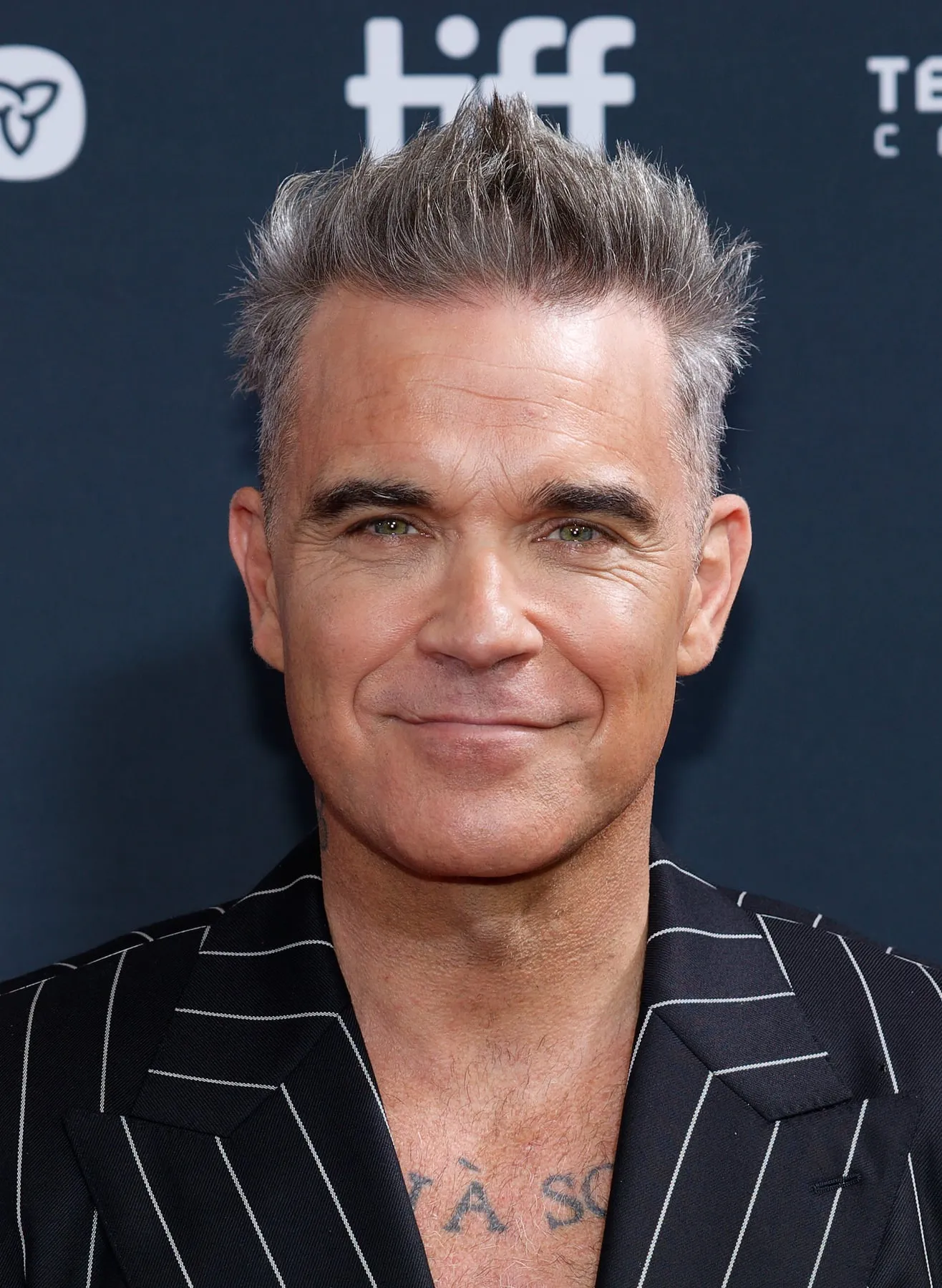
Photo by Kevin Payravi , licensed under CC BY-SA 4.0 · Wikimedia Commons
Rank #79
Robbie Williams
From Wikipedia
Robert Peter Williams is an English singer and songwriter. He found fame as a member of the pop group Take That from 1990 to 1995, launching a solo career in 1996. His debut studio album, Life thru a Lens, was released in 1997, and included his best-selling single "Angels". His second album, I've Been Expecting You, featured the songs "Millennium" and "She's the One", his first and second number one singles. His discography includes seven UK No. 1 singles, and all but one of his 14 studio albums have reached No. 1 in the UK. Six of his albums are among the top 100 biggest-selling albums in the UK, with two of them in the top 60, and he gained a Guinness World Record in 2006 for selling 1.6 million tickets in a single day during his Close Encounters Tour.
Discography & Previews
Browse through and click an album to open and play 30-second previews streamed from Apple Music.

Life Thru a Lens
1997 · 11 tracks

Sing When You’re Winning
2000 · 13 tracks
- 1 Let Love Be Your Energy ↗ 5:01
- 2 Better Man ↗ 3:25
- 3 Rock DJ ↗ 4:21
- 4 Supreme ↗ 4:20
- 5 Kids ↗ 4:49
- 6 If It's Hurting You ↗ 4:12
- 7 Singing for the Lonely ↗ 4:34
- 8 Love Calling Earth ↗ 4:08
- 9 Knutsford City Limits ↗ 4:47
- 10 Forever Texas ↗ 3:40
- 11 By All Means Necessary ↗ 4:48
- 12 The Road to Mandalay ↗ 4:00
- 13 Often (Live In the Dressing Room) ↗ 2:55
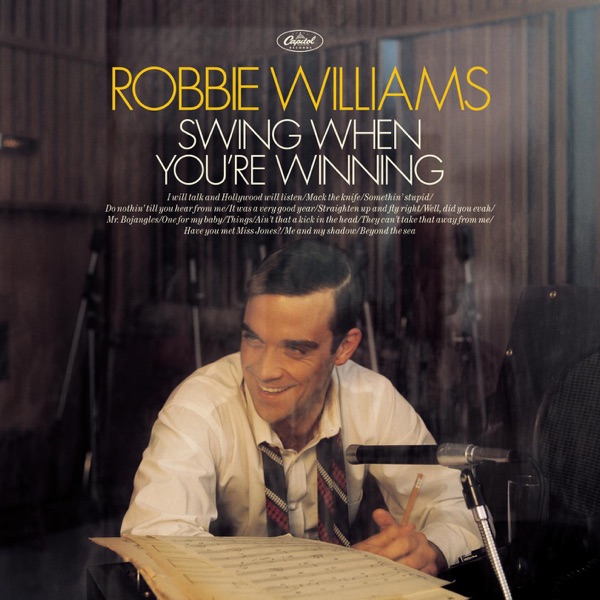
Swing When You’re Winning
2001 · 15 tracks
- 1 I Will Talk and Hollywood Will Listen ↗ 3:18
- 2 Mack the Knife ↗ 3:19
- 3 Somethin' Stupid ↗ 2:50
- 4 Do Nothing Till You Hear From Me ↗ 2:58
- 5 It Was a Very Good Year ↗ 4:29
- 6 Straighten Up and Fly Right ↗ 2:36
- 7 Well, Did You Evah ↗ 3:50
- 8 Mr. Bojangles ↗ 3:18
- 9 One For My Baby ↗ 4:18
- 10 Things ↗ 3:23
- 11 Ain't That a Kick In the Head ↗ 2:28
- 12 They Can't Take That Away From Me ↗ 3:08
- 13 Have You Met Miss Jones? (Swing When Version) ↗ 2:34
- 14 Me and My Shadow (As Performed By Sammy Davis Jr and Frank Sinatra) ↗ 3:16
- 15 Beyond the Sea (Hidden Track) ↗ 28:15

Escapology
2002 · 14 tracks
- 1 How Peculiar ↗ 3:13
- 2 Feel ↗ 4:24
- 3 Something Beautiful ↗ 4:49
- 4 Monsoon ↗ 3:47
- 5 Sexed Up ↗ 4:22
- 6 Love Somebody ↗ 4:10
- 7 Revolution ↗ 5:45
- 8 Handsome Man ↗ 3:57
- 9 Come Undone ↗ 4:38
- 10 Me and My Monkey ↗ 7:13
- 11 Song 3 ↗ 3:51
- 12 Hot Fudge ↗ 4:08
- 13 Cursed ↗ 4:02
- 14 Nan's Song (Hidden Tracks "How Peculiar (Reprise)" & "I Tried Love") ↗ 15:38

Rudebox
2006 · 17 tracks
- 1 Rudebox ↗ 4:44
- 2 Viva Life On Mars ↗ 4:51
- 3 Lovelight ↗ 4:02
- 4 BONGO BONG and Je Ne T'Aime Plus ↗ 4:48
- 5 She's Madonna ↗ 4:17
- 6 Keep On ↗ 4:19
- 7 Good Doctor ↗ 3:16
- 8 The Actor ↗ 4:06
- 9 Never Touch That Switch ↗ 2:47
- 10 Louise ↗ 4:47
- 11 We're the Pet Shop Boys ↗ 4:56
- 12 Burslem Normals ↗ 3:50
- 13 Kiss Me ↗ 3:16
- 14 The 80'S ↗ 4:17
- 15 The 90'S ↗ 5:34
- 16 Summertime ↗ 5:42
- 17 D******d ↗ 4:09
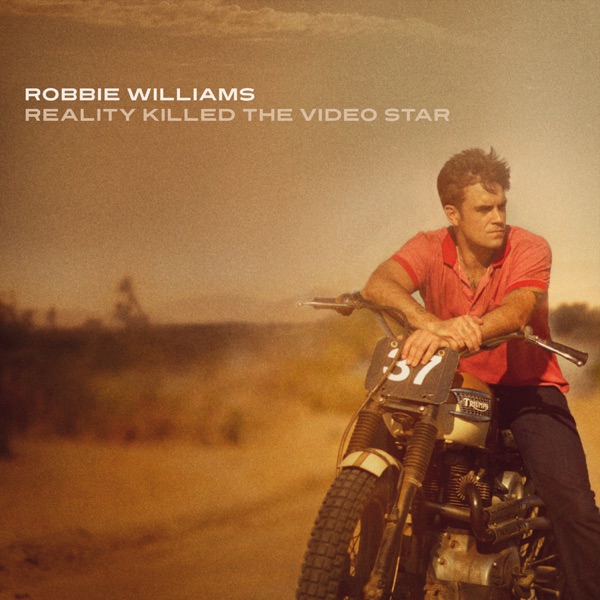
Reality Killed the Video Star
2009 · 14 tracks
- 1 Morning Sun ↗ 4:06
- 2 Bodies ↗ 4:04
- 3 You Know Me ↗ 4:21
- 4 Blasphemy ↗ 4:20
- 5 Do You Mind ↗ 4:06
- 6 Last Days of Disco ↗ 4:50
- 7 Somewhere ↗ 1:02
- 8 Deceptacon ↗ 5:01
- 9 Starstruck ↗ 5:22
- 10 Difficult For Weirdos ↗ 4:30
- 11 Superblind ↗ 4:46
- 12 Won't Do That ↗ 3:38
- 13 Morning Sun Reprise ↗ 1:24
- 14 Arizona ↗ 5:33

Take the Crown
2012 · 13 tracks
- 1 Be A Boy ↗ 4:39
- 2 Gospel ↗ 4:26
- 3 Candy ↗ 3:21
- 4 Different ↗ 4:53
- 5 Shit on The Radio ↗ 2:53
- 6 All That I Want ↗ 3:30
- 7 Hunting for You ↗ 3:58
- 8 Into the Silence ↗ 4:49
- 9 Hey Wow Yeah Yeah ↗ 2:53
- 10 Not Like the Others ↗ 4:16
- 11 Losers (feat. Lissie) ↗ 4:08
- 12 Reverse ↗ 3:56
- 13 Eight Letters ↗ 4:40

Swings Both Ways
2013 · 16 tracks
- 1 Shine My Shoes ↗ 3:24
- 2 Go Gentle ↗ 4:31
- 3 I Wan'na Be like You (feat. Olly Murs) ↗ 3:31
- 4 Swing Supreme ↗ 3:17
- 5 Swings Both Ways (feat. Rufus Wainwright) ↗ 3:59
- 6 Dream a Little Dream (feat. Lily Allen) ↗ 3:34
- 7 Soda Pop (feat. Michael Bublé) ↗ 3:19
- 8 Snowblind ↗ 3:19
- 9 Puttin' on the Ritz ↗ 2:32
- 10 Little Green Apples (feat. Kelly Clarkson) ↗ 3:17
- 11 Minnie the Moocher ↗ 3:42
- 12 If I Only Had a Brain ↗ 3:53
- 13 No One Likes a Fat Pop Star ↗ 2:52
- 14 Where There's Muck ↗ 4:10
- 15 16 Tons ↗ 2:37
- 16 Wedding Bells ↗ 4:37
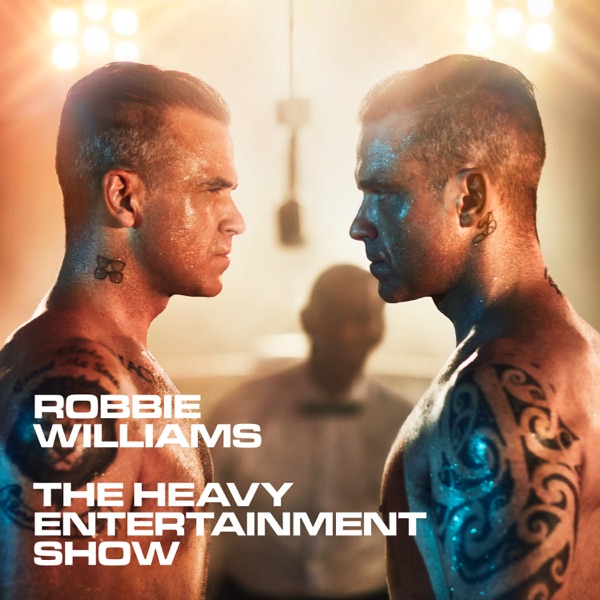
The Heavy Entertainment Show
2016 · 11 tracks

The Christmas Present
2019 · 24 tracks
- 1 Winter Wonderland ↗ 2:18
- 1 Time for Change ↗ 3:30
- 2 Merry Xmas Everybody (feat. Jamie Cullum) ↗ 3:34
- 2 Idlewild ↗ 4:08
- 3 Let It Snow! Let It Snow! Let It Snow! ↗ 1:57
- 3 Darkest Night ↗ 3:19
- 4 The Christmas Song (Chestnuts Roasting on an Open Fire) ↗ 3:12
- 4 Fairytales (feat. Rod Stewart) ↗ 3:34
- 5 Coco's Christmas Lullaby ↗ 2:55
- 5 Christmas (Baby Please Come Home) [feat. Bryan Adams] ↗ 2:44
- 6 Rudolph ↗ 3:40
- 6 Bad Sharon (feat. Tyson Fury) ↗ 3:41
- 7 Yeah! It's Christmas ↗ 2:48
- 7 Happy Birthday Jesus Christ ↗ 3:16
- 8 It's a Wonderful Life (feat. Poppa Pete) ↗ 2:52
- 8 New Year's Day ↗ 3:41
- 9 Let's Not Go Shopping ↗ 3:09
- 9 Snowflakes ↗ 3:41
- 10 Santa Baby (feat. Helene Fischer) ↗ 3:27
- 10 Home ↗ 4:11
- 11 Best Christmas Ever ↗ 3:46
- 11 Soul Transmission ↗ 4:14
- 12 One Last Christmas ↗ 3:33
- 13 Coco's Christmas Lullaby Reprise ↗ 1:15

-
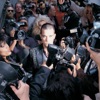 Life Thru a LensRobbie Williams199711 tracks
 -
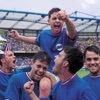 Sing When You’re WinningRobbie Williams200013 tracks
 -
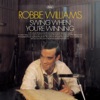 Swing When You’re WinningRobbie Williams200115 tracks
 -
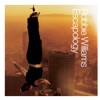 EscapologyRobbie Williams200214 tracks
 -
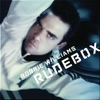 RudeboxRobbie Williams200617 tracks
 -
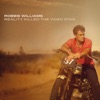 Reality Killed the Video StarRobbie Williams200914 tracks
 -
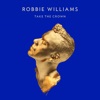 Take the CrownRobbie Williams201213 tracks
 -
 Swings Both WaysRobbie Williams201316 tracks
 -
 The Heavy Entertainment ShowRobbie Williams201611 tracks
 -
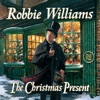 The Christmas PresentRobbie Williams201924 tracks
 -
 BRITPOPRobbie Williams202611 tracks
Deep Dive
Overview
Robbie Williams is an English singer and songwriter who emerged as one of the defining pop voices of the 1990s and beyond. After achieving initial fame as a member of Take That between 1990 and 1995, he transitioned to a solo career in 1996 that would ultimately eclipse his band years in commercial and cultural reach. His debut solo album, Life Thru a Lens, introduced the world to his gifts as a solo artist, while subsequent records established him as a fixture atop the UK charts and a major force in contemporary pop rock.
Formation Story
Robert Peter Williams was born in 1974 in England during an era of significant cultural and musical upheaval. The young Williams came of age during the 1980s, a period dominated by synthesiser-driven pop and new wave, and by the early 1990s he found his entry into the music industry as a member of Take That, a manufactured pop group that would become one of the decade’s defining acts. After five years with the band—a period that saw Take That rise to international prominence before fragmenting in 1995—Williams struck out as a solo artist, launching his solo career in 1996 with the intention of establishing himself outside the shadow of his former collective.
Breakthrough Moment
Williams’ emergence as a solo force crystallised with the release of his debut album Life Thru a Lens in 1997. The record introduced a softer, more introspective dimension to his artistry than Take That’s buoyant pop formula had allowed. The album’s lead single, “Angels,” became his signature song and one of the most enduring singles in modern British pop, achieving broad commercial success and critical recognition. “Angels” established Williams not merely as a former boy-band member seeking a second act, but as a credible solo songwriter with genuine commercial and emotional appeal, setting the trajectory for everything that followed.
Peak Era
The years from 1997 to 2006 represent Williams’ creative and commercial zenith. His second album, I’ve Been Expecting You (1998), consolidated his solo breakthrough with the UK number-one singles “Millennium” and “She’s the One,” confirming that his success was not a one-album phenomenon. Sing When You’re Winning (2000) continued this run of chart dominance, while the genre-bending Swing When You’re Winning (2001) showcased his willingness to venture into unexpected musical territory. Throughout this period, Williams accumulated seven UK number-one singles and established himself as a fixture atop the UK album charts; all but one of his 14 studio albums would eventually reach number one in the UK, an extraordinary commercial achievement. The Close Encounters Tour of 2006, during which he sold 1.6 million tickets in a single day—a Guinness World Record—exemplified his status as a stadium-filling superstar and demonstrated an audience loyalty that transcended typical pop consumption patterns.
Musical Style
Williams’ sound evolved considerably across his solo career, reflecting his influences and the shifting landscape of contemporary pop and rock. His early solo work drew from soft rock and contemporary pop-rock sensibilities, with “Angels” exemplifying a melodic accessibility combined with emotional directness. As his career progressed, Williams incorporated elements of dance music, electronic music, and even swing, as evidenced by the genre-jumping experiments of albums like Swing When You’re Winning. His vocal delivery—conversational yet powerful, capable of both tenderness and swagger—became his calling card, distinguishing him from contemporaries and allowing him to inhabit a wide range of musical contexts. Williams’ approach to songwriting favoured immediate melodic hooks and candid, sometimes vulnerable lyrical content, a combination that connected with audiences across demographic boundaries. Over time, his work encompassed pop rock, dance, soft rock, and elements of alternative rock, reflecting an artist unafraid to pursue stylistic variation within a broadly pop-oriented framework.
Major Albums
Life Thru a Lens (1997)
Williams’ debut solo statement introduced his voice as a solo artist and featured “Angels,” which became one of the most successful British pop singles of the decade and remains his defining song. The album established the introspective, melodically sophisticated approach that would characterise his solo work.
I’ve Been Expecting You (1998)
The follow-up consolidated his breakthrough with multiple hit singles, including the UK number-ones “Millennium” and “She’s the One,” and demonstrated that his initial success was sustainable and rooted in genuine songwriting credibility rather than novelty.
Sing When You’re Winning (2000)
This album continued Williams’ commercial dominance in the UK charts and showcased his growing confidence as a solo artist, balancing radio-friendly pop with deeper album tracks that rewarded repeated listening.
Swing When You’re Winning (2001)
A genre departure into swing and jazz standards, this album revealed Williams’ ambition to transcend pop conventions and his confidence in his abilities as an interpreter of material beyond the contemporary pop idiom.
Escapology (2002)
Released during a period of sustained chart success, Escapology reinforced Williams’ position as the UK’s dominant pop artist and continued his pattern of reaching number one on the album charts.
Intensive Care (2005)
This album appeared at a moment of established superstardom and preceded the Close Encounters Tour that would set the single-day ticket-sales record, cementing Williams’ status as one of the era’s premier live attractions.
Signature Songs
- “Angels” (1997) — His breakthrough and most enduring single, a soft-rock ballad that became synonymous with Williams’ name and remains one of the most recognisable British pop songs of the modern era.
- “Millennium” (1998) — A UK number-one single that showcased Williams’ ability to craft modern pop hooks and demonstrated the staying power of his debut-album success.
- “She’s the One” (1998) — His second consecutive UK number-one single, further establishing him as a singles artist of rare commercial consistency.
- “Let Me Be Me” (2000) — A representative track from his commercial peak that balanced accessibility with emotional authenticity.
Influence on Rock
While Williams emerged from and operated primarily within pop frameworks, his trajectory influenced the broader landscape of British pop and rock music in the 1990s and 2000s. His successful transition from boy-band member to credible solo artist provided a template for subsequent pop performers seeking solo careers beyond manufactured groups. His willingness to experiment with genre—swing, dance, electronic elements—within a fundamentally pop context expanded what was commercially viable for contemporary artists. The success of Life Thru a Lens and its successors helped establish a market for introspective, emotionally direct pop songwriting in the UK, influencing the sonic and thematic directions of contemporary British pop throughout the following decade. His influence extended to the broader Britpop era, sharing cultural space with rock-oriented contemporaries while operating in a distinctly pop idiom.
Legacy
Robbie Williams remains one of the most commercially successful British pop artists of the modern era, with a catalogue that continues to generate substantial streaming traffic and periodic chart returns. His record of UK number-one albums and singles, combined with his extraordinary touring success, established a standard for pop superstardom in the late 20th and early 21st centuries. The continued relevance of “Angels” as a cultural touchstone—played at sporting events, public gatherings, and memorials—speaks to the durability of his songwriting and the emotional resonance his work achieved with audiences. His career trajectory from boy-band member to global solo superstar remains one of the most complete commercial arcs in modern pop music, and his influence on subsequent generations of British pop artists continues to reverberate through the industry.
Fun Facts
- Williams achieved a Guinness World Record in 2006 by selling 1.6 million tickets in a single day during his Close Encounters Tour, an extraordinary demonstration of his drawing power as a live performer.
- Six of his albums appear among the top 100 biggest-selling albums in the UK chart history, with two of them ranking in the top 60, a testament to the enduring commercial success of his catalogue.
- All but one of his 14 studio albums have reached number one on the UK charts, an achievement that places him among the most consistent chart performers in British music history.
- His 2001 album Swing When You’re Winning represented an unexpected genre pivot into swing and jazz standards, demonstrating his confidence in exploring musical territory far removed from contemporary pop.