
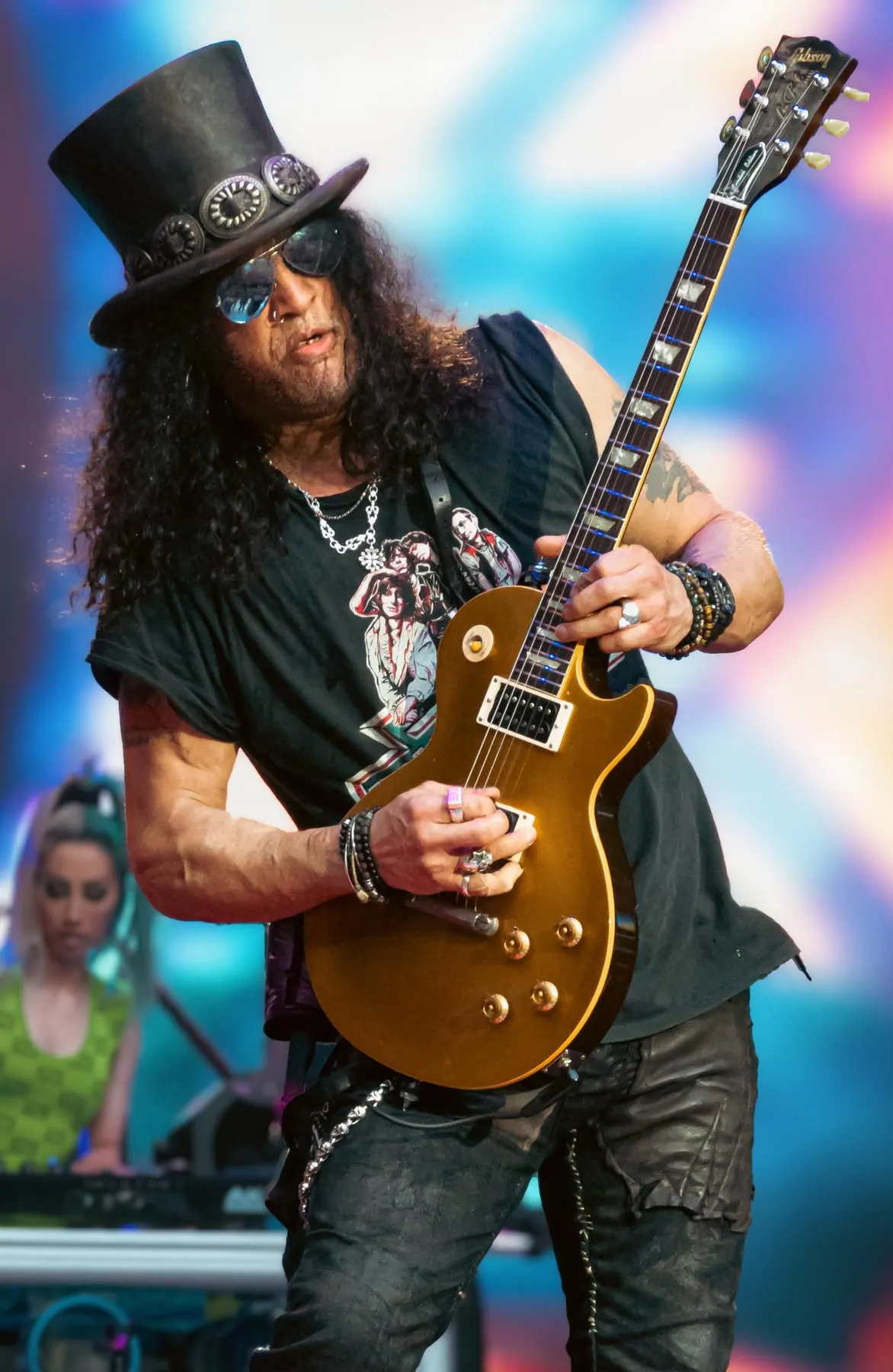
Photo by Kreepin Deth , licensed under CC BY-SA 4.0 · Wikimedia Commons
Rank #104
Slash
From Wikipedia
Saul Hudson, known professionally as Slash, is a British and American musician, best known as the lead guitarist of the hard rock band Guns N' Roses, with whom he achieved worldwide success beginning in the late 1980s. He has received critical acclaim and is considered one of the greatest guitarists in history.
Discography & Previews
Browse through and click an album to open and play 30-second previews streamed from Apple Music.

Slash
2010 · 15 tracks
- 1 Ghost (feat. Ian Astbury) ↗ 3:36
- 2 Crucify the Dead (feat. Ozzy Osbourne) ↗ 4:04
- 3 Beautiful Dangerous (feat. Fergie) ↗ 4:39
- 4 Back from Cali' (feat. Myles Kennedy) ↗ 3:36
- 5 Promise (feat. Chris Cornell) ↗ 4:41
- 6 By the Sword (feat. Andrew Stockdale) ↗ 4:51
- 7 Gotten (feat. Adam Levine) ↗ 5:03
- 8 Doctor Alibi (feat. Lemmy Kilmeister) ↗ 3:10
- 9 Watch This (feat. Dave Grohl & Duff McKagan) ↗ 3:53
- 10 I Hold On (feat. Kid Rock) ↗ 4:19
- 11 Nothing to Say (feat. M Shadows) ↗ 5:25
- 12 Starlight (feat. Myles Kennedy) ↗ 5:26
- 13 Saint Is a Sinner Too (feat. Rocco DeLuca) ↗ 3:29
- 14 We're All Gonna Die (feat. Iggy Pop) ↗ 4:32
- 15 Mother Maria (feat. Beth Hart) ↗ 5:18

Apocalyptic Love
2012 · 13 tracks
- 1 Apocalyptic Love (feat. Myles Kennedy & The Conspirators) ↗ 3:29
- 2 One Last Thrill (feat. Myles Kennedy & The Conspirators) ↗ 3:10
- 3 Standing In the Sun (feat. Myles Kennedy & The Conspirators) ↗ 4:04
- 4 You're a Lie (feat. Myles Kennedy & The Conspirators) ↗ 3:51
- 5 No More Heroes (feat. Myles Kennedy & The Conspirators) ↗ 4:24
- 6 Halo (feat. Myles Kennedy & The Conspirators) ↗ 3:23
- 7 We Will Roam (feat. Myles Kennedy & The Conspirators) ↗ 4:50
- 8 Anastasia (feat. Myles Kennedy & The Conspirators) ↗ 6:07
- 9 Not for Me (feat. Myles Kennedy & The Conspirators) ↗ 5:22
- 10 Bad Rain (feat. Myles Kennedy & The Conspirators) ↗ 3:47
- 11 Hard & Fast (feat. Myles Kennedy & The Conspirators) ↗ 3:02
- 12 Far and Away (feat. Myles Kennedy & The Conspirators) ↗ 5:15
- 13 Shots Fired (feat. Myles Kennedy & The Conspirators) ↗ 3:48

World on Fire
2014 · 17 tracks
- 1 World On Fire (feat. Myles Kennedy & The Conspirators) ↗ 4:31
- 2 Shadow Life (feat. Myles Kennedy & The Conspirators) ↗ 4:01
- 3 Automatic Overdrive (feat. Myles Kennedy & The Conspirators) ↗ 3:36
- 4 Wicked Stone (feat. Myles Kennedy & The Conspirators) ↗ 5:28
- 5 30 Years To Life (feat. Myles Kennedy & The Conspirators) ↗ 5:08
- 6 Bent To Fly (feat. Myles Kennedy & The Conspirators) ↗ 4:57
- 7 Stone Blind (feat. Myles Kennedy & The Conspirators) ↗ 3:50
- 8 Too Far Gone (feat. Myles Kennedy & The Conspirators) ↗ 4:07
- 9 Beneath The Savage Sun (feat. Myles Kennedy & The Conspirators) ↗ 5:49
- 10 Withered Delilah (feat. Myles Kennedy & The Conspirators) ↗ 3:10
- 11 Battleground (feat. Myles Kennedy & The Conspirators) ↗ 6:59
- 12 Dirty Girl (feat. Myles Kennedy & The Conspirators) ↗ 4:14
- 13 Iris Of The Storm (feat. Myles Kennedy & The Conspirators) ↗ 4:01
- 14 Avalon (feat. Myles Kennedy & The Conspirators) ↗ 3:01
- 15 The Dissident (feat. Myles Kennedy & The Conspirators) ↗ 4:26
- 16 Safari Inn (feat. Myles Kennedy & The Conspirators) ↗ 3:27
- 17 The Unholy (feat. Myles Kennedy & The Conspirators) ↗ 6:48

Living the Dream
2018 · 12 tracks
- 1 The Call of the Wild (feat. Myles Kennedy & The Conspirators) ↗ 3:59
- 2 Serve You Right (feat. Myles Kennedy & The Conspirators) ↗ 5:12
- 3 My Antidote (feat. Myles Kennedy & The Conspirators) ↗ 4:17
- 4 Mind Your Manners (feat. Myles Kennedy & The Conspirators) ↗ 3:38
- 5 Lost Inside the Girl (feat. Myles Kennedy & The Conspirators) ↗ 6:30
- 6 Read Between the Lines (feat. Myles Kennedy & The Conspirators) ↗ 3:37
- 7 Slow Grind (feat. Myles Kennedy & The Conspirators) ↗ 3:35
- 8 The One You Loved Is Gone (feat. Myles Kennedy & The Conspirators) ↗ 4:50
- 9 Driving Rain (feat. Myles Kennedy & The Conspirators) ↗ 4:10
- 10 Sugar Cane (feat. Myles Kennedy & The Conspirators) ↗ 3:09
- 11 The Great Pretender (feat. Myles Kennedy & The Conspirators) ↗ 5:25
- 12 Boulevard of Broken Hearts (feat. Myles Kennedy & The Conspirators) ↗ 4:06

4
2022 · 10 tracks
- 1 The River Is Rising (feat. Myles Kennedy and the Conspirators) ↗ 3:43
- 2 Whatever Gets You By (feat. Myles Kennedy and the Conspirators) ↗ 3:40
- 3 C'est la vie (feat. Myles Kennedy and the Conspirators) ↗ 4:38
- 4 The Path Less Followed (feat. Myles Kennedy and the Conspirators) ↗ 3:41
- 5 Actions Speak Louder Than Words (feat. Myles Kennedy and the Conspirators) ↗ 4:02
- 6 Spirit Love (feat. Myles Kennedy and the Conspirators) ↗ 4:15
- 7 Fill My World (feat. Myles Kennedy and the Conspirators) ↗ 5:28
- 8 April Fool (feat. Myles Kennedy and the Conspirators) ↗ 4:33
- 9 Call Off the Dogs (feat. Myles Kennedy and the Conspirators) ↗ 3:16
- 10 Fall Back To Earth (feat. Myles Kennedy and the Conspirators) ↗ 6:23

Orgy of the Damned
2024 · 12 tracks
- 1 The Pusher ↗ 7:08
- 2 Crossroads (feat. Gary Clark Jr.) ↗ 5:35
- 3 Hoochie Coochie Man ↗ 6:43
- 4 Oh Well (feat. Chris Stapleton) ↗ 4:34
- 5 Key to the Highway ↗ 5:09
- 6 Awful Dream ↗ 5:32
- 7 Born Under a Bad Sign ↗ 5:01
- 8 Papa Was a Rolling Stone ↗ 7:52
- 9 Killing Floor ↗ 4:19
- 10 Living for the City ↗ 6:52
- 11 Stormy Monday ↗ 7:58
- 12 Metal Chestnut ↗ 3:02
-
 SlashSlash201015 tracks
 -
 Apocalyptic LoveSlash201213 tracks
 -
 World on FireSlash201417 tracks
 -
 Living the DreamSlash201812 tracks
 -
 4Slash202210 tracks
 -
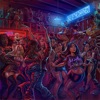 Orgy of the DamnedSlash202412 tracks
Deep Dive
Overview
Saul Hudson, known professionally as Slash, is a British-American musician whose name is synonymous with the electric guitar and the sound of 1980s hard rock. While he rose to international prominence as the lead guitarist of Guns N’ Roses—a band that defined the hard rock landscape from the late 1980s onward—Slash has maintained an equally significant solo career spanning nearly three decades. His work bridges blues rock tradition with the heavier textures of glam metal and hard rock, establishing him as one of the most recognizable and influential guitarists in rock history.
Formation Story
Slash was born in 1965 in the United Kingdom to a British mother and American father, navigating a transatlantic upbringing that would inform his approach to music. Growing up between the UK and the United States, he absorbed the blues-rock heritage of both countries while the glam rock scene of the 1970s was reshaping British popular music. His early exposure to classic rock and blues guitarists, combined with the sonic experimentation of the era, provided the foundational vocabulary from which his distinctive style would emerge. By the mid-1980s, he had positioned himself within the Los Angeles hard rock scene, where he would soon cross paths with the musicians who would form Guns N’ Roses.
Breakthrough Moment
Slash’s international breakthrough came with Guns N’ Roses’ 1987 debut album Appetite for Destruction, which sold millions of copies worldwide and established him as a guitar hero for the MTV age. The band’s massive success—sustained through the early 1990s—made Slash a household name and gave him the platform and resources to pursue solo work. His first solo venture, the album Thunder (1995), marked his formal entry into solo recording and demonstrated that his guitar prowess could carry a project independent of Guns N’ Roses’ commercial machinery. This album proved both to himself and to the industry that Slash possessed the creative vision and technical command to sustain a parallel career.
Peak Era
Slash’s solo career gained significant momentum beginning in 2010 with the release of his self-titled album Slash, which reunited him with vocalist Myles Kennedy and marked a creative and commercial turning point. The period from 2010 through the mid-2010s saw him release Apocalyptic Love (2012) and World on Fire (2014), establishing a prolific rhythm and cementing his status as an active, contemporary recording artist rather than a legacy act. These albums demonstrated a mature approach to songwriting and arrangement, with Kennedy’s voice providing a consistent focal point for Slash’s expansive guitar work. The commercial and critical success of this run proved that Slash’s appeal transcended nostalgia and that audiences remained invested in his artistic evolution.
Musical Style
Slash’s sound is rooted in blues-rock vocabulary—minor pentatonic scales, expressive string-bending, and a tone that prioritizes sustain and harmonic richness over speed for its own sake. His playing draws from classic blues and rock lineage while embracing the heavier, more distorted textures of 1980s hard rock and glam metal. He favors the Gibson Les Paul, an instrument choice that anchors his sonic identity and contributes to the thick, warm distortion that has become his trademark. His solos are characterized by melodic phrasing, deliberate pacing, and a respect for song structure—he builds tension through layering and dynamics rather than through technical display alone. Over his career, his approach has remained remarkably consistent while deepening in harmonic sophistication, particularly evident in his later solo work where production clarity allows the nuances of his playing to emerge more vividly.
Major Albums
Thunder (1995)
Slash’s debut solo album established his capacity to lead a project, combining blues-rock foundations with the production values and guest vocalists that would define his solo approach.
Slash (2010)
This self-titled effort marked his return to focused solo recording after a long interval and introduced the partnership with vocalist Myles Kennedy that would prove central to his subsequent output.
Apocalyptic Love (2012)
Released two years after his comeback, this album deepened the collaboration with Kennedy and demonstrated Slash’s renewed commitment to consistent solo recording and touring.
World on Fire (2014)
Continuing the momentum established in 2010, this album further refined the Slash-Kennedy formula and solidified his standing as an active, contemporary recording artist.
Living the Dream (2018)
This album represented another evolution in his solo work, showcasing the durability of his artistic partnership and his continued relevance in hard rock recording.
Orgy of the Damned (2024)
Slash’s most recent album demonstrates that at nearly sixty years old, he remains engaged in the creative process and committed to releasing new material.
Signature Songs
- “Estranged” — A Guns N’ Roses epic that showcases Slash’s ability to sustain tension and drama across an extended guitar odyssey.
- “Sweet Child o’ Mine” — The 1988 Guns N’ Roses single that remains one of rock’s most recognizable riffs and defined Slash’s public identity.
- “Patience” — A Guns N’ Roses acoustic showcase that demonstrated his versatility beyond heavy distortion.
Influence on Rock
Slash’s influence on rock guitar extends across generations. He proved that blues-based, legible guitar lines could coexist with the heavier production and attitude of 1980s hard rock without sacrificing musicality. His approach inspired countless guitarists to prioritize tone and phrasing over purely technical virtuosity, and his commitment to maintaining a solo career alongside his membership in Guns N’ Roses (following the band’s 2016 reunion) established a model for established rock musicians seeking continued creative autonomy. His work with Guns N’ Roses shaped the hard rock template that influenced countless bands from the 1990s onward, while his solo output demonstrated that legendary rock musicians could remain artistically vital across multiple decades.
Legacy
Slash remains one of the most celebrated and recognizable guitarists in rock history, his status confirmed not only by commercial success and critical acclaim but by the cultural penetration of the riffs he created. His decades-spanning solo career, running parallel to his work with Guns N’ Roses, has positioned him as a rare example of an artist who successfully maintained creative independence while remaining central to one of rock’s most significant bands. His recordings remain staples of rock radio and streaming platforms, and his influence continues to shape how guitarists approach both the technical and expressive dimensions of their instrument. The consistency and quality of his solo output from 2010 onward, continuing through 2024, demonstrate an artist unwilling to coast on historical achievement and committed to the creative process itself.
Fun Facts
- Slash was born in the United Kingdom before his family relocated to the United States, making him both a British and American citizen and contributing to his position as a transatlantic rock figure.
- His professional name “Slash” derives from a childhood nickname, a moniker so effective and iconic that his birth name remains far less recognizable to the general public.
- Across his solo career, he has recorded with multiple record labels including Geffen Records, RCA Records, EMI, Roadrunner Records, and Eagle Rock Entertainment, demonstrating flexibility in his career partnerships.
- His most recent solo album, Orgy of the Damned, came out in 2024, confirming his continued activity in the studio and his refusal to retire from recording despite his legendary status.