
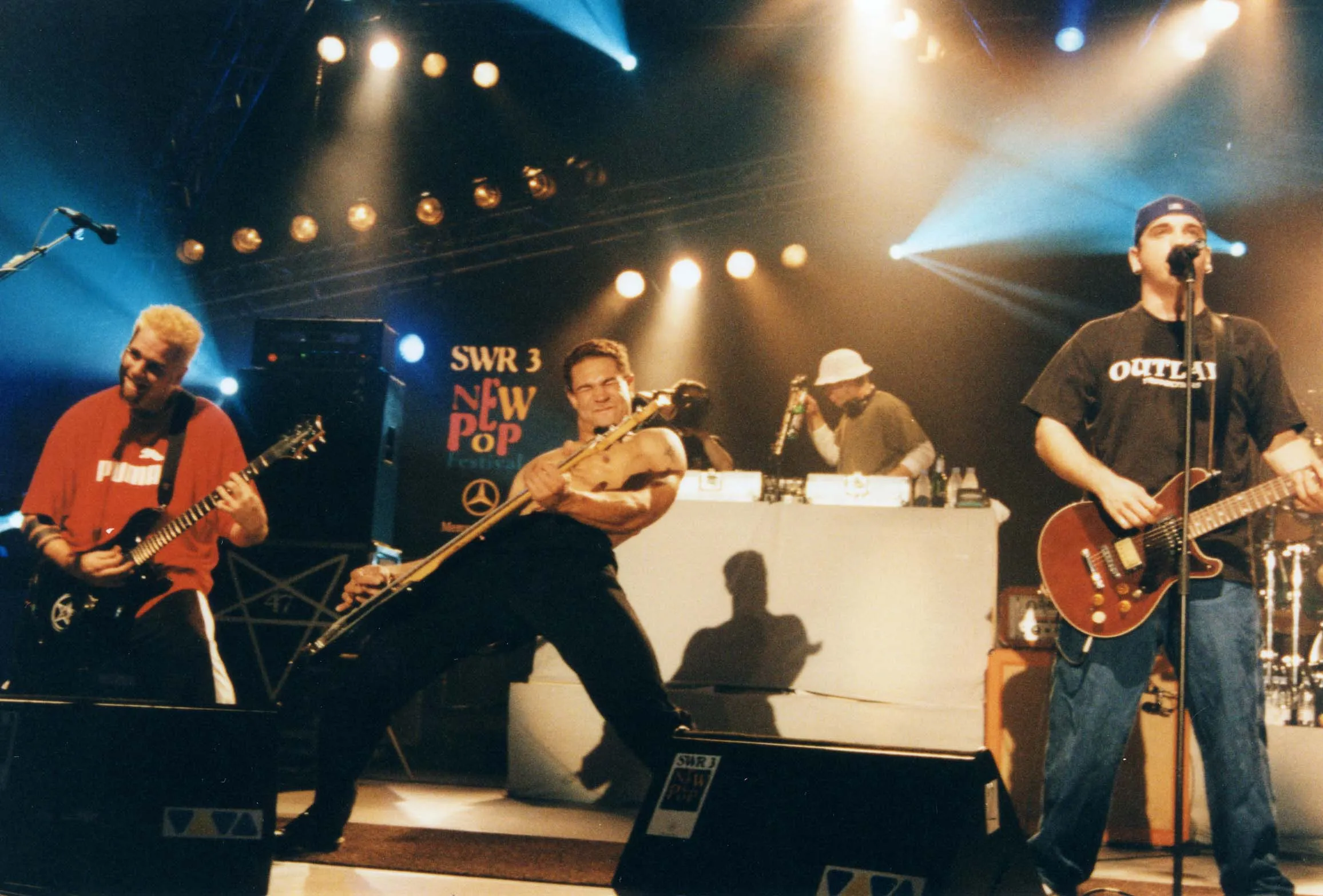
Photo by Craig M. Groshek , licensed under Public domain · Wikimedia Commons
Rank #320
Bloodhound Gang
From Wikipedia
Bloodhound Gang is an American rock band formed by James "Jimmy Pop" Franks and Michael "Daddy Long Legs" Bowe in 1992 in King of Prussia, Pennsylvania. Its lineup since 2009 has consisted of Pop, "Evil" Jared Hasselhoff (bass), Daniel P. Carter (guitar), Harry "DJ Q-Ball" Dean Jr. (keyboards), and Adam "The Yin" Perry (drums).
Members
- Jimmy Pop (1988–2015)
- Jared Hasselhoff (1995–2015)
- Adam Perry (2006–2015)
- Daniel P. Carter (2009–2015)
Discography & Previews
Browse through and click an album to open and play 30-second previews streamed from Apple Music.
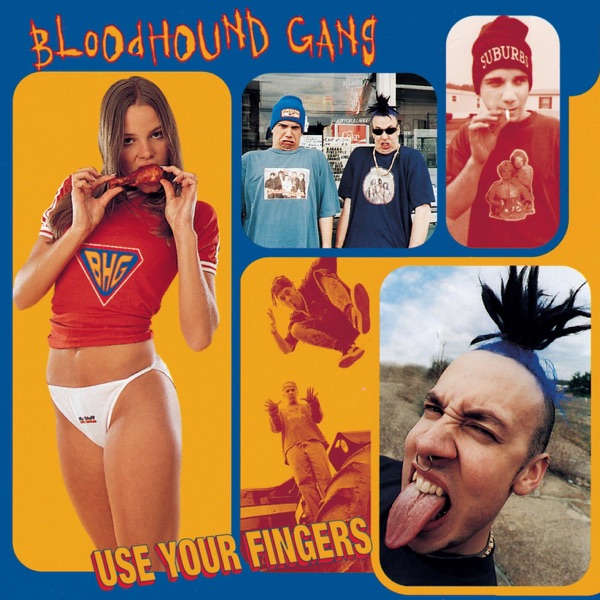
Use Your Fingers
1995 · 20 tracks
- 1 Rip Taylor Is God ↗ 1:23
- 2 We Are the Knuckleheads ↗ 2:39
- 3 Legend In My Spare Time ↗ 3:06
- 4 B.H.G.P.S.A. ↗ 0:22
- 5 Mama Say ↗ 2:59
- 6 Kids In America ↗ 4:23
- 7 You're Pretty When I'm Drunk ↗ 3:56
- 8 The Evils of Placenta Hustling ↗ 0:19
- 9 One Way ↗ 3:06
- 10 S****y Record Offer ↗ 0:59
- 11 Go Down ↗ 2:26
- 12 Earlameyer the Butt Pirate ↗ 0:09
- 13 No Rest for the Wicked ↗ 2:50
- 14 She Ain't Got No Legs ↗ 2:28
- 15 We Like Meat ↗ 0:04
- 16 Coo Coo Ca Choo ↗ 2:37
- 17 Rang Dang ↗ 3:02
- 18 Nightmare At the Apollo ↗ 0:57
- 19 K.I.D.S. Incorporated (Bonus B-Side Independent European Import Bootleg Outtake) ↗ 2:20
- 20 Hidden Track ↗ 0:47

One Fierce Beer Coaster
1996 · 12 tracks
- 1 Kiss Me Where It Smells Funny ↗ 3:05
- 2 Lift Your Head Up High (And Blow Your Brains Out) ↗ 4:58
- 3 Fire Water Burn ↗ 4:52
- 4 I Wish I Was Queer So I Could Get Chicks ↗ 3:49
- 5 Why's Everybody Always Pickin' On Me? ↗ 3:22
- 6 It's Tricky ↗ 2:36
- 7 Asleep at the Wheel ↗ 4:06
- 8 Shut Up ↗ 3:15
- 9 Your Only Friends Are Make Believe ↗ 7:02
- 10 Boom ↗ 4:06
- 11 Going Nowhere Slow ↗ 4:21
- 12 Reflections of Remoh ↗ 0:52

Hooray for Boobies
1999 · 19 tracks
- 1 I Hope You Die ↗ 3:40
- 2 The Inevitable Return of the Great White Dope ↗ 4:02
- 3 Mama's Boy ↗ 0:35
- 4 Three Point One Four ↗ 3:55
- 5 Mope ↗ 4:37
- 6 Yummy Down On This ↗ 3:49
- 7 The Ballad of Chasey Lain ↗ 2:22
- 8 R.S.V.P. ↗ 0:16
- 9 Magna Cum Nada ↗ 4:01
- 10 The Bad Touch ↗ 4:21
- 11 The Cough Came With a Prize ↗ 0:15
- 12 Take the Long Way Home ↗ 3:10
- 13 Hell Yeah ↗ 5:02
- 14 Right Turn Clyde ↗ 5:25
- 15 This Is Stupid ↗ 0:10
- 16 A Lap Dance Is So Much Better When the Stripper Is Crying ↗ 5:38
- 17 10 Coolest Things About New Jersey ↗ 0:10
- 18 Along Comes Mary ↗ 3:22
- 19 Hidden Track ↗ 4:53

Hefty Fine
2005 · 12 tracks
- 1 Strictly for the Tardcore (Skit) [Edited Version] ↗ 0:09
- 2 Balls Out (Edited Version) ↗ 4:19
- 3 Foxtrot Uniform Charlie Kilo ↗ 2:52
- 4 I'm the Least You Could Do (Edited Version) ↗ 3:58
- 5 Farting With a Walkman On (Edited Version) ↗ 3:27
- 6 Ralph Wiggum ↗ 2:53
- 7 Something Diabolical ↗ 5:10
- 8 Overheard In a Wawa Parking Lot (Skit) [Edited Version] ↗ 0:04
- 9 Pennsylvania (Edited Version) ↗ 2:57
- 10 Uhn Tiss Uhn Tiss Uhn Tiss (Edited Version) ↗ 4:20
- 11 No Hard Feelings [Edited Version] ↗ 5:13
- 12 Hefty Fine (Edited Version) ↗ 0:04

Hard‐Off
2015 · 11 tracks
- 1 My Dad Says That's for Pussies ↗ 2:52
- 2 Dimes ↗ 4:27
- 3 American Bitches ↗ 3:46
- 4 Chew Toy ↗ 3:15
- 5 Uncool as Me (feat. Joey Fatone) ↗ 3:40
- 6 Clean Up in Aisle Sexy ↗ 2:52
- 7 Diary of a Stranger ↗ 3:46
- 8 Socially Awkward Penguin ↗ 3:17
- 9 Think Outside the Box ↗ 4:16
- 10 We're Gonna Bring the Party to You ↗ 5:00
- 11 Bumblebees ↗ 1:20
-
 Use Your FingersBloodhound Gang199520 tracks
 -
 One Fierce Beer CoasterBloodhound Gang199612 tracks
 -
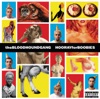 Hooray for BoobiesBloodhound Gang199919 tracks
 -
 Hefty FineBloodhound Gang200512 tracks
 -
 Hard‐OffBloodhound Gang201511 tracks
Deep Dive
Overview
Bloodhound Gang stands as one of rock music’s most unabashed provocateurs, a Pennsylvania-based ensemble that married rap-rock instrumentation with comedy, shock value, and crude humor to build a devoted cult following across two decades. Formed in King of Prussia in the late 1980s, the band emerged from a cultural moment when alternative rock’s boundaries were expanding and hip-hop’s influence on rock was reshaping the genre’s possibilities. Rather than chase mainstream credibility through earnest musicianship or introspection, Bloodhound Gang leaned into irreverence, making deliberate bad taste and comedic excess their trademark.
Formation Story
Bloodhound Gang coalesced around the partnership of James “Jimmy Pop” Franks and Michael “Daddy Long Legs” Bowe, who formed the core of the project in King of Prussia, Pennsylvania in the early 1990s. The band’s emergence coincided with the broader rap-rock moment of the mid-1990s, when acts like Beastie Boys, Faith No More, and later Limp Bizkit demonstrated that rap and rock could be fused into commercially viable and artistically credible forms. Where many acts in that space sought to balance the two genres’ strengths, Bloodhound Gang instead treated their musical framework as a vehicle for comedy and provocation, prioritizing entertainment spectacle and audience shock over musical innovation.
Breakthrough Moment
Bloodhound Gang’s first studio album, Use Your Fingers (1995), introduced their signature blend of rap-inflected verses, heavy rock instrumentation, and deliberately juvenile humor. The follow-up, One Fierce Beer Coaster (1996), solidified their reputation as provocateurs willing to push past conventions of taste. However, it was Hooray for Boobies (1999) that elevated them into broader cultural awareness, securing their status as a dependable draw for shock-value entertainment. This album became their commercial anchor, marking the point at which college radio, MTV, and tour circuits began treating them as a legitimate—if unconventional—attraction in rock music’s ecosystem.
Peak Era
The period from the late 1990s through the mid-2000s represented Bloodhound Gang’s commercial and creative apogee. Hooray for Boobies and the subsequent Hefty Fine (2005) cemented their position as reliable generators of controversy and humor within rock culture. During this window, the band maintained a touring schedule and release cycle that kept them relevant in rock discourse, even as their approach remained deliberately marginal to mainstream rock’s center. Their live shows became known as much for theatrical excess and audience interaction as for musical performance, transforming the concert experience into an extension of their recorded bad-taste aesthetic.
Musical Style
Bloodhound Gang’s sound synthesized rap-rock’s foundational elements—sampled beats, rhythmic rap delivery, and loud-soft dynamics borrowed from alternative rock—into a framework designed primarily for entertainment rather than musicianship. Lyrically, the band favored crude sexual humor, shock punchlines, and deliberately offensive subject matter, mirroring the shock-comedy trajectory of their era rather than rock’s earnest traditions. The instrumentation typically paired rap-styled percussion and beats with guitar-driven sections that drew from alternative rock, creating a hybrid that felt equally at home in rock venues and on MTV’s comedic programming. Rather than evolve this sound substantially across albums, Bloodhound Gang refined it, maintaining consistency that allowed fans to know exactly what they would receive: heavy-handed jokes, provocative imagery, and music designed to provoke laughter and offense in equal measure.
Major Albums
Use Your Fingers (1995)
Their debut introduced the formula that would define their career: rap-rock instrumentation married to shock-comedy subject matter and crude humor, establishing Bloodhound Gang as a band more interested in provocation than progression.
One Fierce Beer Coaster (1996)
This second outing refined their approach and expanded their audience, demonstrating that their shock-value model could sustain listener interest across a full-length release while maintaining their deliberate amateurism as an aesthetic choice.
Hooray for Boobies (1999)
Their commercial peak, this album transcended college radio and cult fandom to reach mainstream rock audiences, proving that comedy and shock value could function as legitimate selling points in late-1990s rock culture.
Hefty Fine (2005)
Released after a six-year gap, Hefty Fine showed the band returning to active recording with their formula intact, targeting the post-nu-metal era’s audiences while maintaining the crude humor and rap-rock instrumentation that defined their identity.
Signature Songs
- The Bad Touch — A sexually explicit novelty that became their most recognizable track, defining their peak-era sound and shock-comedy approach.
- Foxtrot Uniform Charlie Kilo — Another explicit-humor showcase that exemplified their willingness to make taboo subject matter their commercial focus.
- No Hard Feelings — Demonstrated the band’s capacity to work within rock’s emotional registers while maintaining their irreverent sensibility.
- Mope — Showcased their ability to construct rap-rock arrangements that worked as both comedy vehicles and functional rock songs.
Influence on Rock
Bloodhound Gang’s impact on rock resided less in musical innovation than in cultural permission-giving. They demonstrated that shock value, comedy, and deliberate bad taste could function as legitimate rock strategies, paving the way for later acts willing to prioritize entertainment spectacle over critical credibility. While they never influenced rock’s sound architecture, they expanded what rock could be about and how rock audiences could respond to music outside traditional frameworks of earnestness or virtuosity. Their existence validated comedy and provocation as viable alternative-rock currencies, particularly in the post-grunge moment when rock’s moral seriousness had begun to feel stale to younger audiences.
Legacy
Bloodhound Gang’s legacy rests on their refusal to apologize for entertainment over artistry. In an era when rock increasingly demanded that even comedic acts demonstrate technical proficiency or emotional depth, the band remained unapologetically devoted to shock value and crude humor. Their albums remain touchstones of late-1990s and early-2000s rock culture, period pieces that document an era when shock-rock and comedy-rock occupied genuine cultural space within rock’s margins. While streaming and contemporary culture have shifted away from their particular brand of provocation, their existence in rock’s historical record testifies to a moment when rock music could accommodate voices dedicated purely to entertainment spectacle and audience transgression.
Fun Facts
- The band’s name references a canine bloodhound used in the Warner Bros. animated series Droopy, connecting their comedic sensibility to cartoon culture.
- Bloodhound Gang’s live performances became legendary in rock communities for their unpredictability, theatrical props, and direct audience provocation.
- The band maintained consistent personnel across their most commercially successful years, with the 2009 lineup remaining stable through their 2015 recording cycle.
- Their willingness to appear on MTV, tour extensively, and maintain a visible online presence allowed them to build a fanbase that transcended conventional rock radio, existing primarily through concert attendance and word-of-mouth.