
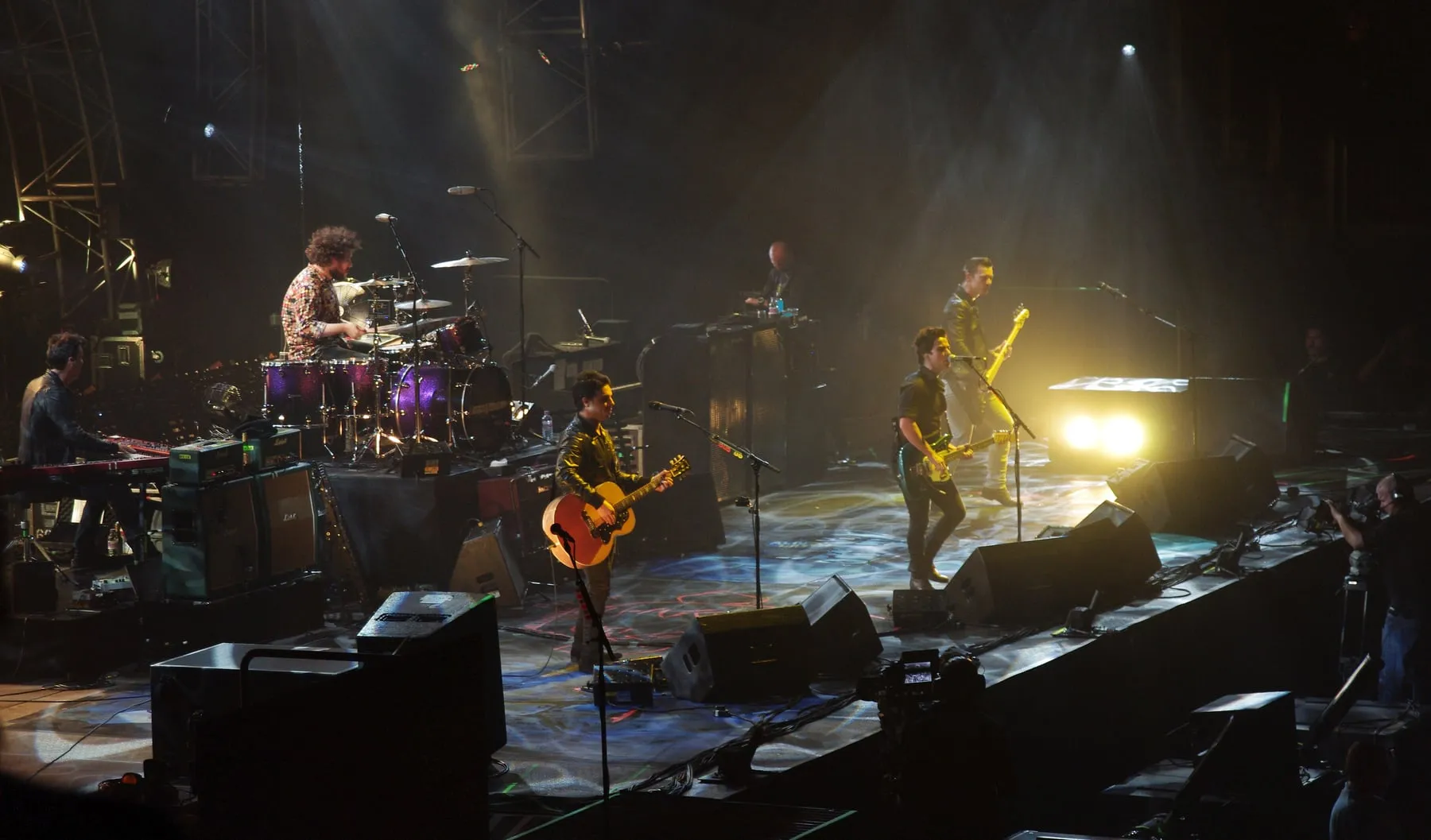
Photo by mattbuck ( category ) , licensed under CC BY-SA 4.0 · Wikimedia Commons
Rank #289
Stereophonics
From Wikipedia
Stereophonics are a Welsh rock band formed in 1992 in the village of Cwmaman in the Cynon Valley. The band consists of Kelly Jones, Richard Jones, Adam Zindani, Jamie Morrison and touring member Tony Kirkham. The group previously included Stuart Cable (1992–2003) and then Javier Weyler (2004–2012) on drums. Stereophonics have released thirteen studio albums, including nine UK number one albums. A successful compilation album, Decade in the Sun, was released in November 2008 and charted at number two on the UK Albums chart.
Members
- Stuart Cable
Discography & Previews
Browse through and click an album to open and play 30-second previews streamed from Apple Music.

Word Gets Around
1997 · 12 tracks
- 1 A Thousand Trees ↗ 3:03
- 2 Looks Like Chaplin ↗ 2:32
- 3 More Life In a Tramps Vest ↗ 2:20
- 4 Local Boy In the Photograph ↗ 3:22
- 5 Traffic ↗ 4:54
- 6 Not Up to You ↗ 4:36
- 7 Check My Eyelids for Holes ↗ 2:42
- 8 Same Size Feet ↗ 4:00
- 9 Last of the Big Time Drinkers ↗ 2:45
- 10 Goldfish Bowl ↗ 3:03
- 11 Too Many Sandwiches ↗ 5:01
- 12 Billy Davey's Daughter ↗ 3:45

Performance and Cocktails
1999 · 13 tracks
- 1 Roll Up and Shine ↗ 3:58
- 2 The Bartender and the Thief ↗ 2:54
- 3 Hurry Up and Wait ↗ 4:40
- 4 Pick a Part That's New ↗ 3:34
- 5 Just Looking ↗ 4:13
- 6 Half the Lies You Tell Ain't True ↗ 2:56
- 7 I Wouldn't Believe Your Radio ↗ 3:50
- 8 T-Shirt Sun Tan ↗ 4:05
- 9 Is Yesterday, Tomorrow, Today? ↗ 4:02
- 10 A Minute Longer ↗ 3:46
- 11 She Takes Her Clothes Off ↗ 3:56
- 12 Plastic California ↗ 4:31
- 13 I Stopped to Fill My Car Up ↗ 4:30

Just Enough Education to Perform
2001 · 12 tracks
- 1 Vegas Two Times ↗ 4:29
- 2 Lying In the Sun ↗ 4:31
- 3 Mr. Writer ↗ 5:19
- 4 Step On My Old Size Nines ↗ 4:01
- 5 Have a Nice Day ↗ 3:25
- 6 Nice to Be Out ↗ 3:09
- 7 Handbags and Gladrags ↗ 4:37
- 8 Watch Them Fly Sundays ↗ 3:30
- 9 Everyday I Think of Money ↗ 3:25
- 10 Maybe ↗ 4:35
- 11 Caravan Holiday ↗ 3:13
- 12 Rooftop ↗ 11:25

You Gotta Go There to Come Back
2003 · 14 tracks
- 1 Help Me (She's Out of Her Mind) ↗ 6:55
- 2 Maybe Tomorrow ↗ 4:33
- 3 Madame Helga ↗ 3:53
- 4 Moviestar (Full Length Version) ↗ 4:43
- 5 You Stole My Money Honey ↗ 4:17
- 6 Getaway ↗ 4:08
- 7 Climbing the Wall ↗ 4:54
- 8 Jealousy ↗ 4:25
- 9 I'm Alright (You Gotta Go There to Come Back) ↗ 4:36
- 10 Nothing Precious At All ↗ 4:18
- 11 Rainbows and Pots of Gold ↗ 4:08
- 12 I Miss You Now ↗ 4:51
- 13 High As the Ceiling ↗ 3:18
- 14 Since I Told You It's Over ↗ 4:43


Pull the Pin
2007 · 12 tracks


Keep the Village Alive
2015 · 16 tracks
- 1 C'est La Vie ↗ 3:40
- 2 White Lies ↗ 3:56
- 3 Sing Little Sister ↗ 3:26
- 4 I Wanna Get Lost With You ↗ 3:50
- 5 Song For The Summer ↗ 2:55
- 6 Fight Or Flight ↗ 3:41
- 7 My Hero ↗ 3:48
- 8 Sunny ↗ 4:20
- 9 Into The World ↗ 4:03
- 10 Mr And Mrs Smith ↗ 6:49
- 11 Ancient Rome (Bonus Track) ↗ 4:44
- 12 Let Me In (Bonus Track) ↗ 4:07
- 13 Blame (You Never Give Me Your Money) [Bonus Track] ↗ 4:37
- 14 You Are My Energy (Bonus Track) ↗ 4:00
- 15 You're My Star (Acoustic) (Bonus Track) ↗ 5:23
- 16 I Wanna Get Lost With You (Acoustic) ↗ 4:17

Scream Above the Sounds
2017 · 11 tracks

Kind
2019 · 10 tracks
- 1 I Just Wanted the Goods ↗ 4:33
- 2 Fly Like an Eagle ↗ 4:33
- 3 Make Friends with the Morning ↗ 4:51
- 4 Stitches ↗ 4:46
- 5 Hungover for You ↗ 4:08
- 6 Bust This Town ↗ 3:55
- 7 This Life Ain’t Easy (But It’s the One That We All Got) ↗ 6:12
- 8 Street of Orange Light ↗ 3:02
- 9 Don't Let the Devil Take Another Day ↗ 3:04
- 10 Restless Mind ↗ 3:10

Oochya!
2022 · 15 tracks
- 1 Hanging On Your Hinges ↗ 2:57
- 2 Forever ↗ 4:25
- 3 When You See It ↗ 4:22
- 4 Do Ya Feel My Love? ↗ 3:58
- 5 Right Place Right Time ↗ 4:42
- 6 Close Enough To Drive Home ↗ 4:06
- 7 Leave The Light On ↗ 4:55
- 8 Running Round My Brain ↗ 3:30
- 9 Every Dog Has Its Day ↗ 4:49
- 10 You're My Soul ↗ 5:22
- 11 All I Have Is You ↗ 5:45
- 12 Made A Mess Of Me ↗ 4:00
- 13 Seen That Look Before ↗ 4:24
- 14 Don't Know What Ya Got ↗ 4:50
- 15 Jack In A Box ↗ 2:17

Make 'em Laugh, Make 'em Cry, Make 'em Wait
2025 · 8 tracks
-
 Word Gets AroundStereophonics199712 tracks
 -
 Performance and CocktailsStereophonics199913 tracks
 -
 Just Enough Education to PerformStereophonics200112 tracks
 -
 You Gotta Go There to Come BackStereophonics200314 tracks
 -
 Language. Sex. Violence. Other?Stereophonics200511 tracks
 -
 Pull the PinStereophonics200712 tracks
 -
 Keep Calm and Carry OnStereophonics200912 tracks
 -
 Graffiti on the TrainStereophonics201310 tracks
 -
 Keep the Village AliveStereophonics201516 tracks
 -
 Scream Above the SoundsStereophonics201711 tracks
 -
 KindStereophonics201910 tracks
 -
 Oochya!Stereophonics202215 tracks
 -
 Make 'em Laugh, Make 'em Cry, Make 'em WaitStereophonics20258 tracks
Deep Dive
Overview
Stereophonics are a Welsh rock band formed in 1992 in the village of Cwmaman in the Cynon Valley, a region in South Wales with a rich industrial heritage. Over three decades, they became one of Britain’s most sustained and commercially successful rock acts, releasing thirteen studio albums and securing nine UK number-one chart positions. The band emerged as British rock music shifted from the 1990s Britpop explosion toward a harder, more working-class brand of alternative rock that would define the post-2000 landscape.
Formation Story
Stereophonics coalesced in Cwmaman in 1992, a small Welsh mining village that would remain central to the band’s identity and public mythology. The founding lineup included Kelly Jones as vocalist and guitarist, Richard Jones on bass, and Stuart Cable on drums. The band’s origins in a postindustrial Welsh community distinguished them from the London-centric Britpop movement emerging at the same time; they carried instead an authenticity rooted in working-class regional life. The group spent their early years building a following in Wales and across the UK before signing to a major label.
Breakthrough Moment
Stereophonics’ breakthrough arrived with their debut album Word Gets Around in 1997, which introduced their blues-influenced hard rock sound to a wider audience. The album established the sonic template that would carry them forward: distorted guitars, Jones’s gravelly vocal delivery, and straightforward, often autobiographical lyrics. Their second album, Performance and Cocktails (1999), consolidated that success and further solidified their standing as serious post-Britpop contenders, proving they were far more than a one-album act. By the turn of the millennium, Stereophonics had established themselves as major fixtures in British rock.
Peak Era
The early 2000s represented Stereophonics’ commercial and creative peak. Between 2001 and 2005, they released a string of successful albums: J.E.E.P. and Just Enough Education to Perform in 2001, You Gotta Go There to Come Back in 2003, and Language. Sex. Violence. Other? in 2005. During this period, the band refined their craft and maintained consistent chart success, accumulating multiple UK number-one albums. The 2008 compilation Decade in the Sun charted at number two on the UK Albums chart, underscoring their enduring popularity and commercial foothold heading into the 2010s.
Musical Style
Stereophonics’ sound is rooted in hard rock and alternative rock, with blues-based sensibilities that distinguish them from the more melodic or art-school oriented strands of Britpop. Kelly Jones’s baritone vocal style—gruff, unpolished, emotionally direct—became their signature. The rhythm section of Richard Jones’s bass and the drumming (first Stuart Cable until 2003, then Javier Weyler from 2004 to 2012) provided a solid, driving foundation. The band’s songwriting tends toward personal and social observation without pretension; lyrics often address working-class life, relationships, and Welsh identity. Over time, their sound has remained relatively consistent rather than experimental, a choice that has secured their appeal across generations of rock listeners.
Major Albums
Word Gets Around (1997)
Their debut introduced the core Stereophonics sound: blues-inflected hard rock with Jones’s distinctive gravelly vocals and lyrically grounded storytelling that set them apart from more polished contemporaries.
Performance and Cocktails (1999)
The second album proved their staying power, deepening their commercial foothold and refining the formula that had worked on their debut while expanding their audience across the UK and Europe.
Just Enough Education to Perform (2001)
This album marked the band’s full arrival at stadium-rock status, with a bigger production sound and an increasingly confident songwriting approach that resonated across multiple markets.
You Gotta Go There to Come Back (2003)
Released in the wake of Stuart Cable’s departure, this album demonstrated the band’s resilience and adaptability as they navigated a significant lineup change while maintaining creative momentum.
Keep Calm and Carry On (2009)
Part of their sustained catalogue of the 2000s and 2010s, this record showed Stereophonics continuing to record and tour actively, sustaining their relevance in an era of shifting rock radio formats.
Signature Songs
- “Word Gets Around” — The title track of their debut, establishing the blues-rock foundation and working-class storytelling that became their calling card.
- “Dakota” — A standout track that showcased their ability to craft memorable, emotionally resonant rock songs with mass appeal.
- “Caravan Holiday” — A staple of their live repertoire, capturing the band’s knack for accessible, sing-along rock anthems.
- “Have a Nice Day” — Another key track highlighting their fusion of hard rock musicianship with deeply personal, conversational lyricism.
Influence on Rock
Stereophonics arrived at a moment when Britpop was fragmenting and British rock music was seeking new directions beyond the mid-1990s mainstream. By asserting a deliberately unglamorous, guitar-driven hard rock approach rooted in working-class authenticity, they helped establish post-Britpop as a legitimate successor movement. Their refusal to chase trends, combined with sustained commercial success, demonstrated that traditional rock formats—electric guitars, standard song structures, emotional directness—remained viable in the 21st century. The band’s longevity and consistency influenced subsequent generations of UK rock bands who similarly prioritized musicianship and regional identity over fashionable innovation.
Legacy
Stereophonics’ career spanning more than three decades places them among the most durable British rock acts of the post-1990 era. The release of Decade in the Sun in 2008, which charted at number two in the UK, formalized their status as an established heritage act. Their thirteen studio albums—from Word Gets Around through Make ‘em Laugh, Make ‘em Cry, Make ‘em Wait (2025)—document the trajectory of a band that has evolved gradually rather than dramatically, maintaining core strengths while responding to contemporary studio production techniques. They remain active touring and recording artists, with streaming platforms and arena tours continuing to sustain their presence in rock music.
Fun Facts
- Stereophonics originated in Cwmaman, a small village in the Cynon Valley in South Wales, a region with deep mining heritage that shaped the band’s working-class identity and cultural perspective.
- The band released a covers project album, The Covers Project, in 2002, stepping outside their original material to reinterpret songs across various genres.
- Stuart Cable, the band’s original drummer who played on their breakthrough albums, left the group in 2003 and was succeeded by Javier Weyler, who remained with the band until 2012.
- Stereophonics have secured nine UK number-one albums across their career, placing them among the most chart-successful British rock bands of their era.