
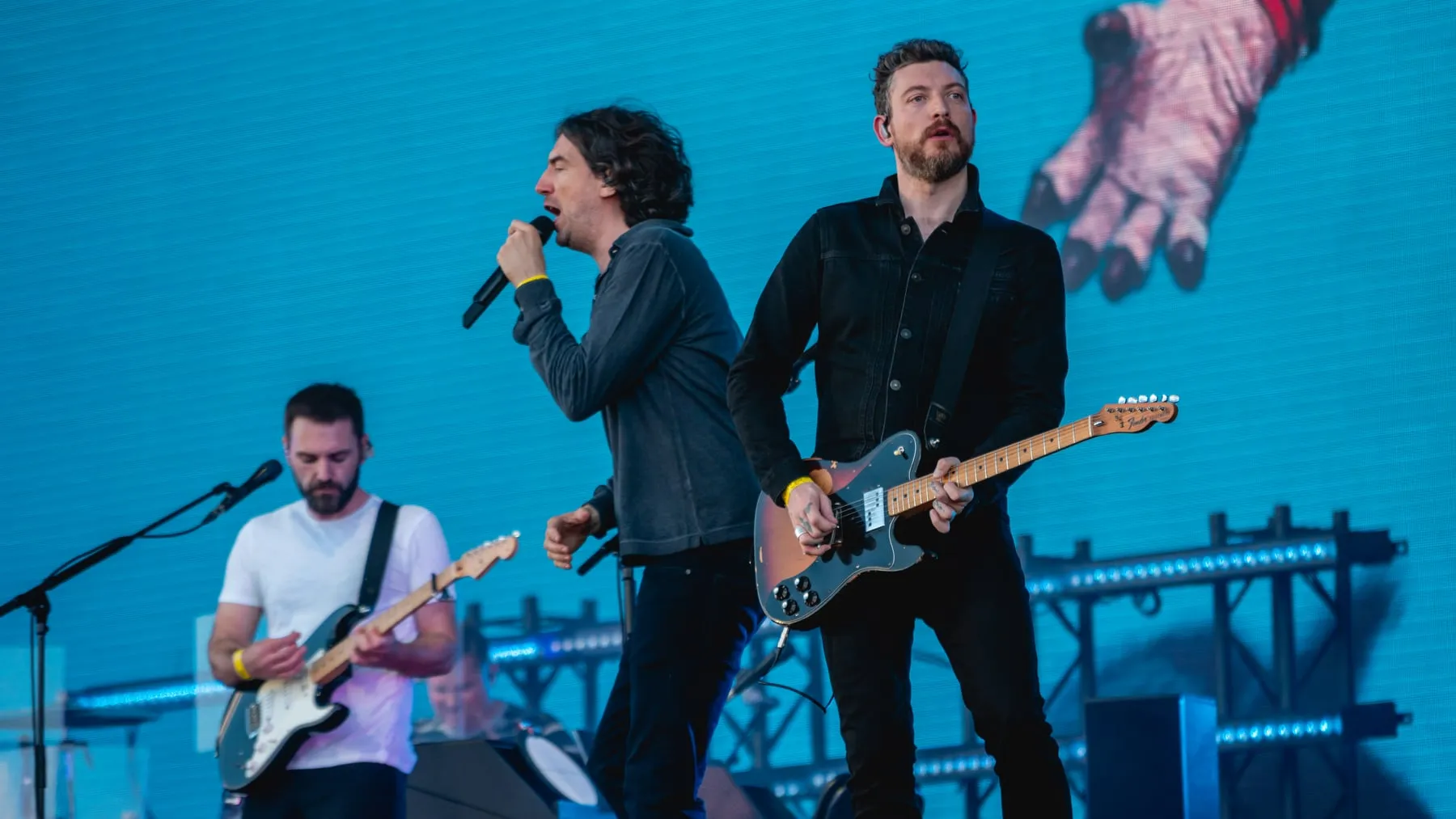
Photo by Raph_PH , licensed under CC BY 2.0 · Wikimedia Commons
Rank #217
Snow Patrol
From Wikipedia
Snow Patrol are a Northern Irish rock band formed in 1994 in Dundee, Scotland, consisting of Gary Lightbody, Nathan Connolly, and Johnny McDaid ; Lightbody is the band's sole remaining original member.
Members
- Gary Lightbody (1994–present)
- Mark McClelland (1994–2005)
- Jonny Quinn (1997–2023)
- Nathan Connolly (2002–present)
- Paul Wilson (2005–2023)
- Tom Simpson (2005–2013)
- Johnny McDaid (2011–present)
Discography & Previews
Browse through and click an album to open and play 30-second previews streamed from Apple Music.

Songs for Polarbears
1998 · 23 tracks
- 1 Downhill from Here ↗ 3:23
- 2 Starfighter Pilot ↗ 3:20
- 3 The Last Shot Ringing in My Ears ↗ 4:26
- 4 Absolute Gravity ↗ 2:45
- 5 Get Balsamic Vinegar...Quick You Fool ↗ 3:27
- 6 Mahogany ↗ 2:47
- 7 NYC ↗ 4:27
- 8 Little Hide ↗ 2:41
- 9 Make Up ↗ 2:12
- 10 Velocity Girl ↗ 4:37
- 11 Days Without Paracetamol ↗ 3:32
- 12 Fifteen Minutes Old ↗ 3:09
- 13 Favourite Friend ↗ 2:46
- 14 One Hundred Things You Should Have Done in Bed ↗ 6:18
- 15 Sticky Teenage Twin ↗ 2:08
- 16 Limited Edition ↗ 2:33
- 17 Jj ↗ 1:47
- 18 My Last Girlfriend ↗ 3:00
- 19 T.M.T ↗ 2:52
- 20 I Could Stay Away Forever ↗ 4:28
- 21 When You're Right, You're Right (Darth Vader Bringing in His Washing Mix) ↗ 3:31
- 22 Raze the City ↗ 4:21
- 23 Riot, Please ↗ 2:52

When It’s All Over We Still Have to Clear Up
2001 · 16 tracks
- 1 Never Gonna Fall in Love Again (Remastered) ↗ 2:10
- 2 Ask Me How I Am (Remastered) ↗ 2:35
- 3 Making Enemies (Remastered) ↗ 4:19
- 4 Black and Blue (Remastered) ↗ 3:40
- 5 Last Ever Lone Gunman (Remastered) ↗ 2:43
- 6 If I'd Found the Right Words to Say (Remastered) ↗ 4:47
- 7 Batten Down the Hatch (Remastered) ↗ 3:30
- 8 One Night Is Not Enough (Remastered) ↗ 3:23
- 9 Chased by... I Don't Know What (Remastered) ↗ 2:41
- 10 On / Off (Remastered) ↗ 2:40
- 11 An Olive Grove Facing the Sea (Remastered) ↗ 5:18
- 12 When It's All over We Still Have to Clear Up (Remastered) ↗ 3:18
- 13 Make Love to Me Forever (Remastered) ↗ 2:55
- 14 Firelight (Remastered) ↗ 3:45
- 15 Hollow as I Am (Remastered) ↗ 2:35
- 16 And Then I'm Gonna (Remastered) ↗ 2:59

Final Straw
2003 · 12 tracks
- 1 How To Be Dead ↗ 3:22
- 2 Wow ↗ 4:02
- 3 Gleaming Auction ↗ 2:04
- 4 Whatever's Left ↗ 2:40
- 5 Spitting Games (Revised Edit) ↗ 3:46
- 6 Chocolate (Revised) ↗ 3:02
- 7 Run (Revised) ↗ 5:55
- 8 Grazed Knees ↗ 2:55
- 9 Ways & Means ↗ 4:48
- 10 Tiny Little Fractures ↗ 2:26
- 11 Somewhere a Clock Is Ticking ↗ 4:32
- 12 Same (UK Bonus Track) ↗ 3:56

Eyes Open
2006 · 11 tracks
- 1 You're All I Have ↗ 4:33
- 2 Hands Open ↗ 3:17
- 3 Chasing Cars ↗ 4:28
- 4 Shut Your Eyes ↗ 3:17
- 5 It's Beginning to Get to Me ↗ 4:36
- 6 You Could Be Happy ↗ 3:02
- 7 Make This Go On Forever ↗ 5:47
- 8 Set the Fire to the Third Bar (feat. Martha Wainwright) ↗ 3:24
- 9 Headlights On Dark Roads ↗ 3:31
- 10 Open Your Eyes ↗ 5:41
- 11 The Finish Line ↗ 3:28

A Hundred Million Suns
2008 · 11 tracks
- 1 If There's a Rocket Tie Me to It ↗ 4:19
- 2 Crack the Shutters ↗ 3:21
- 3 Take Back the City ↗ 4:38
- 4 Lifeboats ↗ 4:42
- 5 The Golden Floor ↗ 3:18
- 6 Please Just Take These Photos from My Hands ↗ 4:26
- 7 Set Down Your Glass ↗ 3:43
- 8 The Planets Bend Between Us ↗ 4:16
- 9 Engines ↗ 5:08
- 10 Disaster Button ↗ 3:55
- 11 The Lightning Strike ↗ 16:18

Fallen Empires
2011 · 15 tracks
- 1 I'll Never Let Go ↗ 4:43
- 2 Called Out in the Dark ↗ 4:02
- 3 The Weight of Love ↗ 4:16
- 4 This Isn't Everything You Are ↗ 4:58
- 5 The Garden Rules ↗ 4:28
- 6 Fallen Empires ↗ 5:20
- 7 Berlin ↗ 2:04
- 8 Lifening ↗ 3:53
- 9 New York ↗ 4:02
- 10 In the End ↗ 4:00
- 11 Those Distant Bells ↗ 3:18
- 12 The Symphony ↗ 6:06
- 13 The President ↗ 4:35
- 14 Broken Bottles Form a Star (Prelude) ↗ 1:30
- 15 This Isn't Everything You Are (Acoustic Version) [Bonus Track] ↗ 4:53


The Forest Is the Path
2024 · 12 tracks
- 1 All ↗ 4:19
- 2 The Beginning ↗ 3:31
- 3 Everything's Here And Nothing's Lost ↗ 4:06
- 4 Your Heart Home ↗ 3:40
- 5 This Is The Sound Of Your Voice ↗ 4:31
- 6 Hold Me In The Fire ↗ 4:00
- 7 Years That Fall ↗ 3:52
- 8 Never Really Tire ↗ 5:54
- 9 These Lies ↗ 4:48
- 10 What If Nothing Breaks? ↗ 3:42
- 11 Talking About Hope ↗ 3:56
- 12 The Forest Is The Path ↗ 4:31
-
 Songs for PolarbearsSnow Patrol199823 tracks
 -
 When It’s All Over We Still Have to Clear UpSnow Patrol200116 tracks
 -
 Final StrawSnow Patrol200312 tracks
 -
 Eyes OpenSnow Patrol200611 tracks
 -
 A Hundred Million SunsSnow Patrol200811 tracks
 -
 Fallen EmpiresSnow Patrol201115 tracks
 -
 WildnessSnow Patrol201810 tracks
 -
 The Forest Is the PathSnow Patrol202412 tracks
Deep Dive
Overview
Snow Patrol are a Northern Irish rock band that emerged from Dundee, Scotland in 1994 and rose to mainstream prominence in the 2000s. Built around Gary Lightbody’s melancholic vocal delivery and introspective songwriting, the band crafted a brand of alternative rock that blended atmospheric instrumentation with emotionally direct lyrics. Their 2006 album Eyes Open and its hit single “Chasing Cars” became inescapable on global radio, establishing them as one of the decade’s most commercially successful acts in the genre.
Formation Story
Snow Patrol began in 1994 in Dundee, Scotland, when Gary Lightbody and Mark McClelland formed the group’s nucleus. The early lineup rounded out with Jonny Quinn joining in 1997, creating the foundational three-piece. Throughout the late 1990s, the band remained largely unknown outside their regional scene, recording and performing while developing the compositional approach that would define their later work. Nathan Connolly joined in 2002, followed by Tom Simpson and Paul Wilson in 2005, solidifying the ensemble that would record their breakthrough album.
Breakthrough Moment
Snow Patrol’s ascent accelerated with the release of Final Straw in 2003, an album that demonstrated significant creative refinement and caught the attention of wider audiences. However, their true mainstream breakthrough arrived with Eyes Open in 2006. That album spawned “Chasing Cars,” a spare, propulsive track built on fingerpicked guitar and restrained drums that became a ubiquitous presence on radio stations worldwide. The song’s combination of emotional vulnerability and melodic accessibility made it the entry point for millions of listeners into Snow Patrol’s catalog. The album’s success established the band as major commercial players and cemented their position in the alternative rock mainstream.
Peak Era
The period from 2006 to 2011 represented Snow Patrol’s creative and commercial zenith. Following the success of Eyes Open, they released A Hundred Million Suns in 2008, an album that consolidated their sound and further expanded their audience. The band toured extensively during this window, becoming festival regulars and arena headliners across Europe and North America. Their third major album for Fiction Records, Fallen Empires (2011), continued their commercial trajectory and marked the completion of a creative cycle that had begun with Final Straw. This era defined Snow Patrol’s identity as a major stadium rock act, though one rooted in indie sensibilities and emotional introspection rather than bombast.
Musical Style
Snow Patrol’s sound emerged from the post-punk revival and alternative rock traditions of the 1990s and early 2000s, characterized by atmospheric yet direct arrangements. Lightbody’s vocals—often distant and wistful, sometimes rising to cathartic intensity—sit at the center of the band’s approach. The instrumental palette typically centers on clean electric guitar lines, often fingerpicked or played with subtle effects, layered over steady drums and bass that prioritize clarity and space over density. Production-wise, the band favored transparent recording that privileged songwriting and melody over elaborate overdubs. Their songwriting typically gravitated toward themes of loss, longing, and emotional introspection, with lyrics that worked at the intersection of the poetic and the plainspoken. This combination of melodic sensibility and emotional directness proved particularly effective in the 2000s alternative rock mainstream, when similar approaches were championed by acts across the UK and US indie rock landscape.
Major Albums
Eyes Open (2006)
The album that established Snow Patrol as a global commercial force, Eyes Open features “Chasing Cars” and showcases the band’s ability to craft memorable, emotionally resonant rock songs with mainstream appeal without sacrificing artistic integrity.
Final Straw (2003)
Snow Patrol’s third album marked a significant leap in songwriting maturity and production sophistication, setting the stage for the breakthrough that Eyes Open would deliver three years later.
A Hundred Million Suns (2008)
Released two years after their peak commercial moment, this album consolidated Snow Patrol’s status as arena headliners while exploring thematic and sonic territories opened by its predecessor.
Fallen Empires (2011)
The band’s fifth studio album continued their commercial success and featured the full presence of Johnny McDaid, who had joined in 2011, signaling a new chapter in the group’s evolution.
When It’s All Over We Still Have to Clear Up (2001)
Released before their commercial breakthrough, this early album documents the band’s developing sound and songwriting approach during their transition from regional act to national contenders.
Wildness (2018)
After a seven-year gap following Fallen Empires, Snow Patrol returned with Wildness, demonstrating their continued relevance and capacity for reinvention in the streaming era.
Signature Songs
- “Chasing Cars” — The track that became Snow Patrol’s calling card; a globally ubiquitous radio hit built on elegant restraint and emotional directness.
- “Run” — An earlier single that helped establish the band’s knack for crafting melodically compelling yet emotionally vulnerable rock songs.
- “Chocolate” — A mid-career single showcasing the band’s ability to balance pop sensibility with alternative rock credibility.
- “The Planets Bend Between Us” — A showcase for Lightbody’s vocal range and the band’s instinct for expansive, layered arrangements.
Influence on Rock
Snow Patrol’s commercial success in the 2000s validated a particular strand of alternative rock: emotionally direct, melodically strong, and production-conscious, yet rooted in indie rock’s compositional traditions. Their ability to achieve mainstream radio penetration without resorting to cliché or bombast influenced subsequent acts attempting to navigate the alternative rock mainstream. The band demonstrated that introspection and sensitivity could coexist with stadium-sized ambition, a lesson absorbed by numerous alternative acts of the subsequent decade. Their template of fingerpicked guitar, restrained production, and confessional lyrics prefigured broader trends in indie rock’s relationship to the mainstream.
Legacy
Snow Patrol’s presence in popular culture extends well beyond their commercial peak. “Chasing Cars” achieved a cultural omnipresence unusual for rock songs in the streaming era, accumulating billions of streams and remaining a staple of curated playlists worldwide. The band’s body of work between 2003 and 2011 established them as significant figures in 2000s alternative rock, with their albums continuing to reach new audiences through streaming services and cultural reissues. Despite changes in membership—with Gary Lightbody remaining the sole continuous member and Jonny Quinn departing in 2023—the band continued recording and performing into the 2020s, releasing The Forest Is the Path in 2024. Their longevity and adaptation to the post-album era reflect the band’s foundational strength: the quality and accessibility of their core songwriting.
Fun Facts
- Snow Patrol’s formation in Dundee, Scotland, placed them at the geographic and cultural nexus of post-punk revival activity in the mid-1990s, though they would develop a sound quite distinct from the guitar-driven post-punk aesthetics dominant at the time.
- The band signed to Fiction Records, an imprint that became a major force in the 2000s alternative rock marketplace, housing numerous acts who achieved similar cross-genre and commercial success during the period.
- Gary Lightbody has remained the sole continuous member since the band’s inception in 1994, surviving complete turnover of the rhythm section and the addition of Johnny McDaid in 2011.