
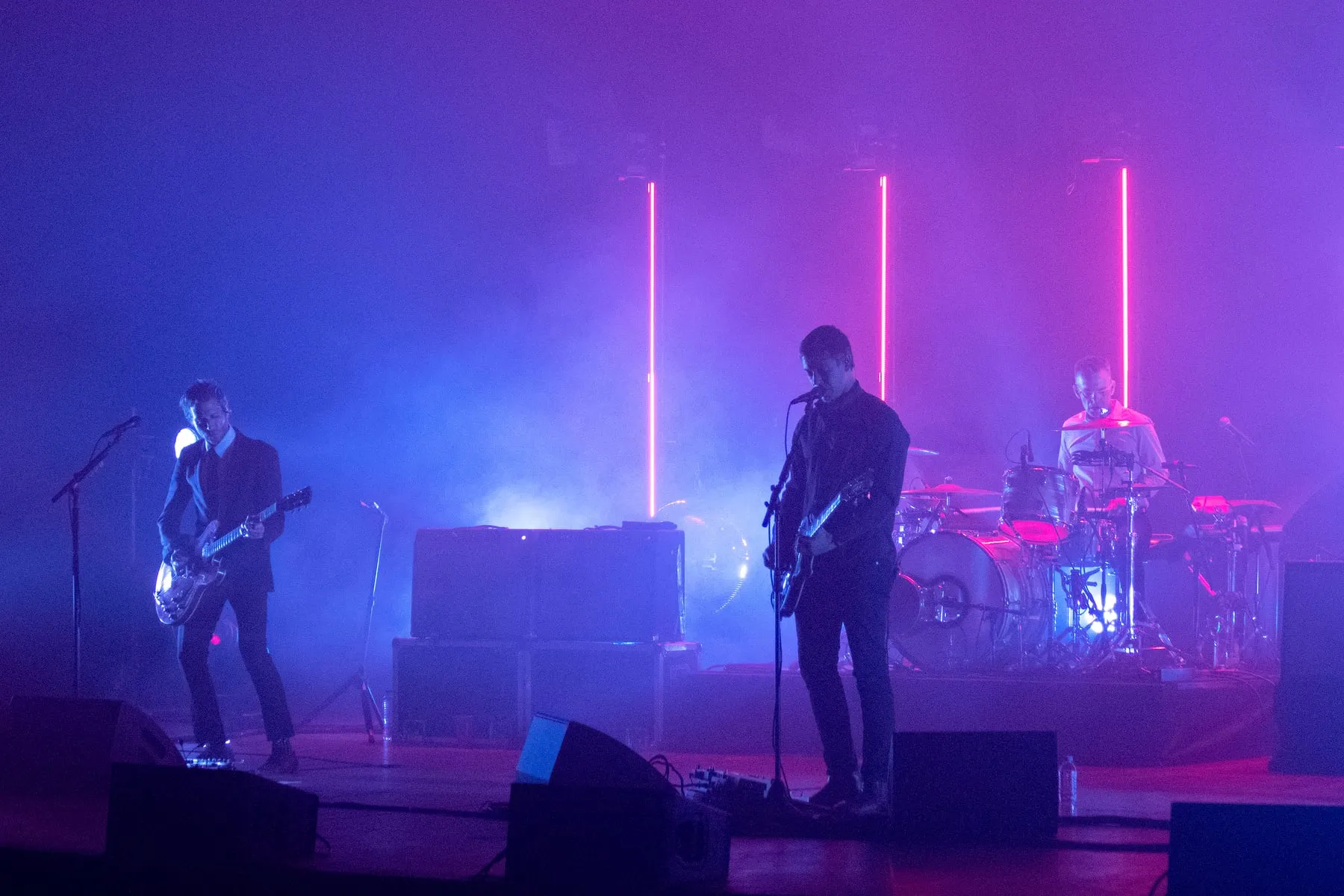
Photo by Secretaría de Cultura Ciudad de México from México , licensed under CC BY 2.0 · Wikimedia Commons
Rank #479
Interpol
From Wikipedia
Interpol is an American rock band from Manhattan, New York. Formed in 1997, their original line-up consisted of Paul Banks, Daniel Kessler, Carlos Dengler, and Greg Drudy (drums). Drudy left the band in 2000 and was replaced by Sam Fogarino. Dengler left to pursue other projects in 2010, with Banks taking on the additional in-studio role of bassist for their next three albums.
Members
- Daniel Kessler
- Paul Banks
- Sam Fogarino
Discography & Previews
Browse through and click an album to open and play 30-second previews streamed from Apple Music.



Our Love to Admire
2007 · 12 tracks


Marauder
2018 · 13 tracks
- 1 If You Really Love Nothing ↗ 4:26
- 2 The Rover ↗ 3:38
- 3 Complications ↗ 3:54
- 4 Flight of Fancy ↗ 3:52
- 5 Stay In Touch ↗ 4:53
- 6 Interlude 1 ↗ 1:01
- 7 Mountain Child ↗ 3:08
- 8 Nysmaw ↗ 3:17
- 9 Surveillance ↗ 4:13
- 10 Number 10 ↗ 3:13
- 11 Party's Over ↗ 3:39
- 12 Interlude 2 ↗ 1:03
- 13 It Probably Matters ↗ 4:08

-
 Turn On the Bright LightsInterpol200211 tracks
 -
 AnticsInterpol200410 tracks
 -
 Our Love to AdmireInterpol200712 tracks
 -
 InterpolInterpol201010 tracks
 -
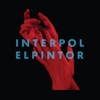 El PintorInterpol201411 tracks
 -
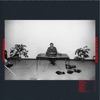 MarauderInterpol201813 tracks
 -
 The Other Side of Make‐BelieveInterpol202211 tracks
Deep Dive
Overview
Interpol is an American rock band from Manhattan that emerged in 1997 as a defining voice of the post-punk revival movement. Operating across indie rock and alternative rock terrain, the band crystallized a particular aesthetic of urban alienation and angular guitar work that would resonate with early-2000s audiences hungry for rock music rooted in post-punk’s emotional austerity. Their trajectory from local New York act to international touring band maps onto the broader indie-rock boom of the 2000s, with their first two albums establishing a template that influenced a generation of guitar-driven rock bands.
Formation Story
Interpol coalesced in Manhattan in 1997 from the convergence of musicians drawn to post-punk’s skeletal energy. The original lineup featured Paul Banks on vocals and guitar, Daniel Kessler on guitar, Carlos Dengler on bass, and Greg Drudy on drums. This founding quartet emerged from New York’s downtown rock scene, channeling the city’s rich lineage of art-rock and punk while absorbing contemporary influences from across the Atlantic. The band’s early identity was forged in the practice spaces and small venues of Manhattan, where they developed the interlocking guitar textures and economical songwriting that would become their calling card.
Breakthrough Moment
Interpol’s arrival as a major force came with the release of Turn On the Bright Lights in 2002. The debut album was a watershed moment: a lean, propulsive record that announced the band as serious architects of post-punk form rather than mere revivalists. Tracks like “Obstacle 1” and the title track laid out their aesthetic in sharp relief—driving basslines, tension between two guitars, Banks’s deadpan vocals delivered with understated intensity. The album’s success established Interpol as one of the leading bands of the post-punk revival, drawing comparisons to Joy Division and Gang of Four while remaining unmistakably contemporary. By the release of Antics in 2004, the band had become a fixture on international festival bills and in the touring circuit that defined indie rock’s early-2000s heyday.
Peak Era
The period spanning Antics (2004) through Our Love to Admire (2007) represented Interpol’s most commercially prominent and critically assured window. Antics deepened the template of their debut, with tracks of greater melodic sophistication balanced against the same restrained production aesthetic. Our Love to Admire pushed further, introducing greater textural variety and atmospheric density while maintaining the band’s core identity. During these years, Interpol toured globally, playing major festivals and selling out venues in markets across North America, Europe, and beyond. They had become the kind of band that could headline mid-sized venues and appear on festival lineups alongside established acts—a reliable draw for audiences seeking intelligent, guitar-driven rock music.
Musical Style
Interpol’s sound is built on the architecture of post-punk: propulsive, syncopated rhythms anchored by melodic basslines; two interlocking guitars that favor tension and interplay over chordal density; and vocals that function as an instrument of mood rather than conventional melody. Paul Banks’s delivery is characteristically restrained, his lyrics often fragmentary and introspective, delivered with a cool distance that recalls post-punk’s emotional reserve. The band’s production across their core early albums favors clarity and separation—each instrument audible in its own space—rather than wall-of-sound compression. As the band evolved across albums from Antics through Our Love to Admire, they experimented with greater atmospheric textures and broader dynamic range while remaining fundamentally rooted in post-punk’s formal discipline. The departure of Carlos Dengler in 2010, with Banks assuming additional bass duties in the studio for subsequent records, marked a shift in the band’s internal chemistry, though their core sonic identity persisted.
Major Albums
Turn On the Bright Lights (2002)
Interpol’s debut is a definitive statement of post-punk revival principles: economical, tightly wound, and shot through with Manhattan’s urban atmosphere. Tracks like “Obstacle 1” and “NYC” became signature songs that established the band’s aesthetic at the widest possible level.
Antics (2004)
The follow-up refined and expanded the band’s approach, deepening both the melodic sophistication of their songwriting and the production clarity of their sound. Antics solidified Interpol’s position as leaders of their moment in rock music.
Our Love to Admire (2007)
This third album introduced greater textural variety and atmospheric experiment while maintaining the band’s disciplined post-punk core. It represented a natural evolution for a band at the height of their creative powers.
Interpol (2010)
The self-titled fourth album arrived amid lineup changes, with Dengler’s departure and Banks’s shift to studio bass duties. The record showcased the band navigating transition while sustaining their essential identity across seven studio albums.
El Pintor (2014)
Interpol’s fifth studio album marked a continuation of their artistic trajectory, with the band exploring their established sound across another iteration of their conceptual and sonic concerns.
The Other Side of Make‐Believe (2022)
The band’s most recent studio album demonstrates their longevity as a working rock band, continuing to document their evolution across three decades of activity.
Signature Songs
- “Obstacle 1” — The propulsive debut single that introduced Interpol’s post-punk aesthetic to mass audiences, built on a driving bassline and interlocking guitars.
- “Evil” — A signature track from Antics that exemplifies the band’s gift for melodic restraint and atmospheric density.
- “NYC” — Banks’s portrait of Manhattan alienation that became one of the band’s most recognizable anthems.
- “Rest My Chemistry” — A standout from Our Love to Admire that showcases the band’s mastery of dynamic tension and release.
Influence on Rock
Interpol arrived at a moment when rock music was fragmenting into numerous microgenres, and their embrace of post-punk’s formal language proved influential across the 2000s indie-rock landscape. By offering a serious, intellectually engaged alternative to both stadium rock and the maximalist tendencies of some contemporary indie acts, they created space for a renewed interest in post-punk’s spareness and emotional economy. Bands that emerged in their wake often bore the imprint of their approach: the use of two guitars as a primary textural and melodic tool, the emphasis on bassline as compositional anchor, and the cultivation of cool detachment as a vocal stance. Their impact extended beyond direct imitators to reshape expectations around what post-punk revival could sound like in the twenty-first century.
Legacy
Interpol has sustained a recording and touring career across more than two decades, a rarity for bands that emerged in the indie-rock boom of the early 2000s. The release of studio albums across the 2010s and into the 2020s—El Pintor, Marauder, and The Other Side of Make‐Believe—demonstrates their commitment to ongoing creative work rather than a static relationship to their past. While their initial impact was concentrated in the 2000s, their presence in rock’s touring infrastructure and streaming catalogs reflects the enduring appeal of their particular synthesis of post-punk form and indie-rock sensibility. They remain a reference point for understanding how post-punk’s formal vocabulary was adapted and renewed in the early digital era of rock music.
Fun Facts
- Greg Drudy, the band’s original drummer, was replaced by Sam Fogarino in 2000, early in Interpol’s career, before the band had achieved widespread recognition.
- Carlos Dengler’s departure in 2010 led Paul Banks to assume bass duties in the studio for the subsequent three albums, a shift that altered the band’s internal creative dynamics.
- Interpol released seven studio albums between 2002 and 2022, maintaining an active recording presence across two decades despite the attrition that claimed many early-2000s indie-rock bands.