
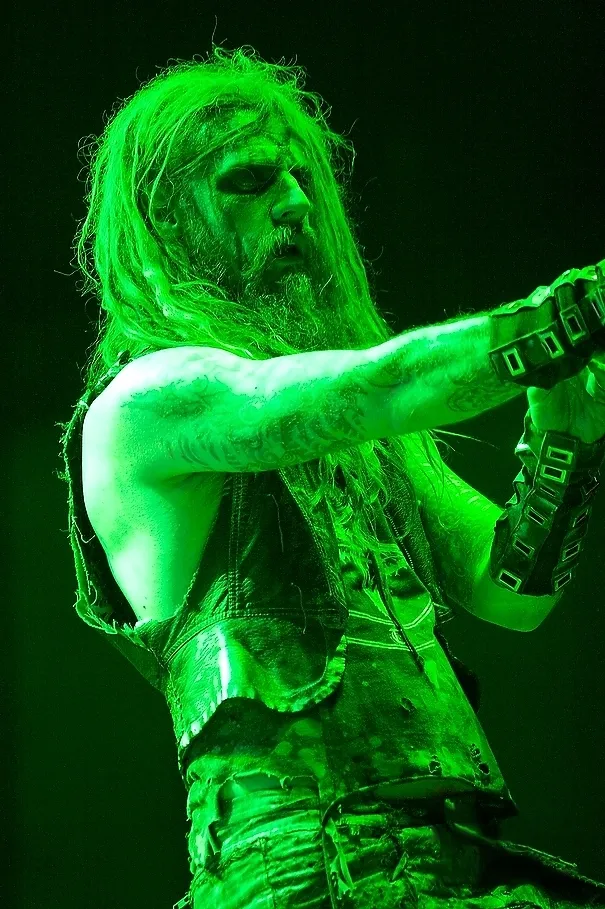
Photo by chickswithguns , licensed under CC BY-SA 2.0 · Wikimedia Commons
Rank #222
Rob Zombie
From Wikipedia
Robert Bartleh Cummings, known professionally as Rob Zombie, is an American singer, songwriter, record producer, filmmaker, and actor. His music and lyrics are notable for their horror and sci-fi themes, and his live shows have been praised for their elaborate shock rock theatricality. He has sold an estimated 15 million albums worldwide. He rose to fame as a founding member and the frontman of heavy metal band White Zombie, with whom he released five studio albums and one techno remix album.
Discography & Previews
Browse through and click an album to open and play 30-second previews streamed from Apple Music.

The Sinister Urge
2001 · 12 tracks
- 1 Sinner's, Inc ↗ 1:18
- 2 Demon Speeding ↗ 3:44
- 3 Dead Girl Superstar ↗ 2:28
- 4 Never Gonna Stop (The Red, Red Kroovy) ↗ 3:09
- 5 Iron Head (feat. Ozzy Osbourne) ↗ 4:11
- 6 (Go To) California ↗ 3:25
- 7 Feel So Numb ↗ 3:54
- 8 Transylvanian Transmissions, Pt. 1 ↗ 1:10
- 9 Bring Her Down (To Crippletown) ↗ 3:59
- 10 Scum of the Earth ↗ 2:55
- 11 House of 1000 Corpses ↗ 6:26
- 12 Unholy 3 ↗ 3:02
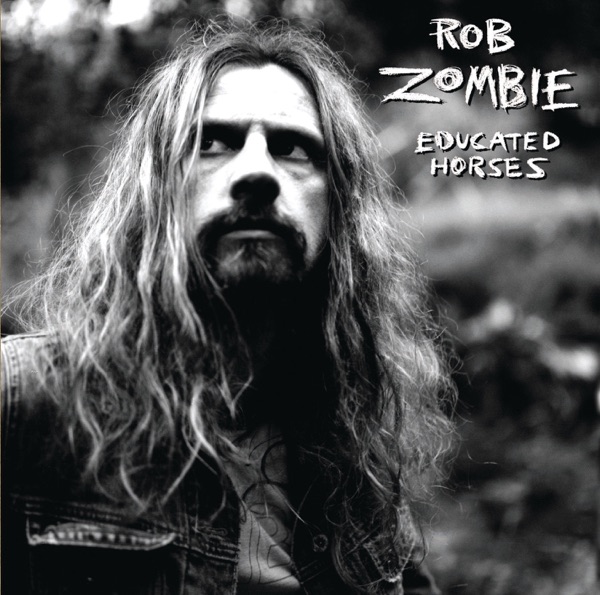
Educated Horses
2006 · 11 tracks

Venomous Rat Regeneration Vendor
2013 · 12 tracks
- 1 Teenage Nosferatu P***y ↗ 4:34
- 2 Dead City Radio and the New Gods of Supertown ↗ 3:28
- 3 Revelation Revolution ↗ 3:10
- 4 Theme for the Rat Vendor ↗ 1:02
- 5 Ging Gang Gong De Do Gong De Laga Raga ↗ 3:19
- 6 Rock and Roll (In a Black Hole) ↗ 4:14
- 7 Behold, the Pretty Filthy Creatures! ↗ 2:55
- 8 White Trash Freaks ↗ 3:12
- 9 We're An American Band ↗ 3:30
- 10 Lucifer Rising ↗ 3:19
- 11 The Girl Who Loved the Monsters ↗ 3:57
- 12 Trade In Your Guns for a Coffin ↗ 2:11

The Electric Warlock Acid Witch Satanic Orgy Celebration Dispenser
2016 · 12 tracks
- 1 The Last of the Demons Defeated ↗ 1:33
- 2 Satanic Cyanide! The Killer Rocks On! ↗ 2:58
- 3 The Life and Times of a Teenage Rock God ↗ 2:54
- 4 Well, Everybody's F*****g in a U.F.O. ↗ 2:43
- 5 A Hearse That Overturns with the Coffin Bursting Open ↗ 1:30
- 6 The Hideous Exhibitions of a Dedicated Gore Whore ↗ 2:47
- 7 Medication for the Melancholy ↗ 2:27
- 8 In the Age of the Consecrated Vampire We All Get High ↗ 2:16
- 9 Super-Doom-Hex-Gloom, Pt. 1 ↗ 1:30
- 10 In the Bone Pile ↗ 2:33
- 11 Get Your Boots On! That's the End of Rock and Roll ↗ 2:47
- 12 Wurdalak ↗ 5:31
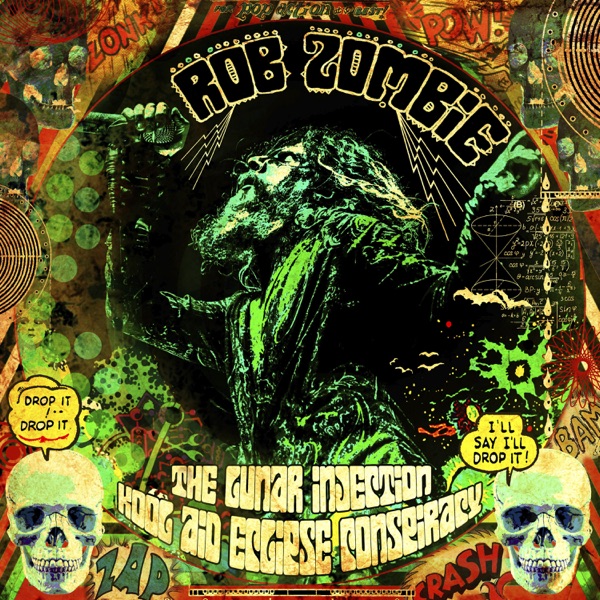
The Lunar Injection Kool Aid Eclipse Conspiracy
2021 · 17 tracks
- 1 Expanding the Head of Zed ↗ 0:54
- 2 The Triumph of King Freak (A Crypt of Preservation and Superstition) ↗ 4:07
- 3 The Ballad of Sleazy Rider ↗ 3:04
- 4 Hovering over the Dull Earth ↗ 0:23
- 5 Shadow of the Cemetery Man ↗ 3:15
- 6 A Brief Static Hum and Then the Radio Blared ↗ 0:43
- 7 18th Century Cannibals, Excitable Morlocks and a One-Way Ticket on the Ghost Train ↗ 3:27
- 8 The Eternal Struggles of the Howling Man ↗ 4:16
- 9 The Much Talked Of Metamorphosis ↗ 2:06
- 10 The Satanic Rites of Blacula ↗ 2:18
- 11 Shower of Stones ↗ 0:28
- 12 Shake Your Ass-Smoke Your Grass ↗ 3:11
- 13 Boom-Boom-Boom ↗ 3:21
- 14 What You Gonna Do with That Gun Mama? ↗ 1:00
- 15 Get Loose ↗ 3:27
- 16 The Serenity of Witches ↗ 0:57
- 17 Crow Killer Blues ↗ 5:00
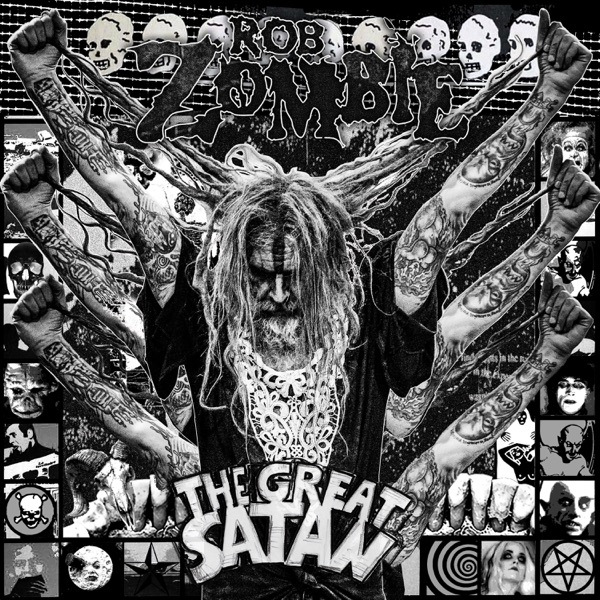
The Great Satan
2026 · 15 tracks
- 1 F.T.W. 84 ↗ 3:56
- 2 Tarantula ↗ 3:02
- 3 (I'm a) Rock "N" Roller ↗ 3:33
- 4 Heathen Days ↗ 2:18
- 5 Who Am I? ↗ 0:35
- 6 Black Rat Coffin ↗ 3:05
- 7 Sir Lord Acid Wolfman ↗ 3:46
- 8 Punks And Demons ↗ 2:37
- 9 The Devilman ↗ 3:26
- 10 Out Of Sight ↗ 2:47
- 11 Revolution M***********s ↗ 2:33
- 12 Welcome To The Electric Age ↗ 0:54
- 13 The Black Scorpion ↗ 1:33
- 14 Unclean Animals ↗ 3:34
- 15 Grave Discontent ↗ 1:01
-
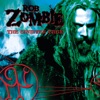 The Sinister UrgeRob Zombie200112 tracks
 -
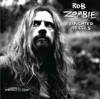 Educated HorsesRob Zombie200611 tracks
 -
 Venomous Rat Regeneration VendorRob Zombie201312 tracks
 -
 The Electric Warlock Acid Witch Satanic Orgy Celebration DispenserRob Zombie201612 tracks
 -
 The Lunar Injection Kool Aid Eclipse ConspiracyRob Zombie202117 tracks
 -
 The Great SatanRob Zombie202615 tracks
Deep Dive
Overview
Rob Zombie stands as one of rock music’s most visually theatrical and thematically consistent artists, a figure whose career spans two distinct but complementary phases: his work as frontman of the industrial-metal band White Zombie and a prolific solo career spanning from 1998 onward. Born Robert Bartleh Cummings in 1965, Zombie has built a multimedia presence rooted in horror and science-fiction aesthetics, bridging music, filmmaking, and shock-rock performance. His solo output—eight studio albums to date—maintains the genre-blending approach that defined White Zombie: a fusion of heavy metal machinery, industrial noise, nu-metal rhythms, and punk aggression, all wrapped in lyrics and visuals that court the grotesque and the macabre. With an estimated 15 million albums sold worldwide, Zombie represents a strain of rock artistry for which presentation and concept are inseparable from the music itself.
Formation Story
Rob Zombie’s path to rock music began in the 1980s, when he formed White Zombie alongside bassist Sean Yseult and early drummer Ivan de Prume. The band emerged from New York’s Lower East Side underground, operating within the post-punk and industrial-metal ferment of that era. White Zombie released five studio albums between 1987 and 1995, becoming fixtures of MTV’s Headbangers Ball and establishing Zombie’s reputation for elaborate, horror-themed visuals and a persona deliberately courting transgression and camp. By the mid-1990s, White Zombie had achieved mainstream recognition, yet Zombie’s ambitions extended beyond the band format. The desire to explore his own songwriting more expansively, combined with a growing interest in filmmaking, led him to launch a solo career in 1998 while White Zombie was still active, effectively setting the stage for the band’s eventual dissolution.
Breakthrough Moment
Rob Zombie’s solo debut, Hellbilly Deluxe: 13 Tales of Cadaverous Cavorting Inside the Spookshow International (1998), arrived fully formed as a statement of intent. The album synthesized his metal-punk roots with industrial production, sequencers, and a narrative concept centered on carnival grotesquerie and B-movie horror. Tracks like “Dragula”—a stomping, synth-driven metal anthem—and “Superbeast” gave rock radio and MTV a point of entry into Zombie’s aesthetic without diluting its essential strangeness. The album’s commercial success, supported by elaborate music videos and live performances that incorporated film projections and elaborate staging, established Zombie as a viable solo artist with a distinct identity separate from White Zombie. The album’s success proved that audiences would embrace a rock artist whose primary innovation lay in the fusion of horror-film aesthetics with heavy-metal mechanics.
Peak Era
The period spanning 1998 to 2006 represents Rob Zombie’s most creatively restless and commercially vigorous solo phase. Hellbilly Deluxe established the template; The Sinister Urge (2001) refined and deepened it, doubling down on nu-metal grooves and industrial-metal textures while maintaining the shock-rock theatricality. Between these two albums, Zombie also began directing feature films—including House of 1000 Corpses (2003) and The Devil’s Rejects (2005)—signaling a major artistic expansion beyond music. Educated Horses (2006) arrived as a statement of consolidation, representing eight years of solo output in which Zombie had become not merely a rock musician but a multimedia provocateur with a consistent vision spanning sound and vision. Throughout this period, his live shows became legendary for their technical ambition and conceptual coherence, treating the stage as a Gesamtkunstwerk—a total artwork merging metal performance, horror-film imagery, and avant-garde theatricality.
Musical Style
Rob Zombie’s sonic identity blends several traditions into a cohesive whole. At the foundation lie heavy-metal riffs and rhythmic structures, often built around down-tuned guitars and thunderous drums, but Zombie layers these with industrial-era production techniques: synthesizers, samples, distortion processing, and noise textures that recall Nine Inch Nails and Ministry. His vocal delivery sits somewhere between spoken-word performance and metal singing—rhythmic, often deadpan, sometimes pushing into a kind of theatrical growl, but rarely soaring into melodic display. Lyrically, he commits fully to horror and science-fiction imagery: carnival freaks, zombie apocalypses, satanic rituals, alien abduction, and general transgressive excess populate his songwriting. Unlike shock-rock purely for its own sake, however, Zombie’s horror themes carry a genuine appreciation for B-movies, carnival culture, and the grotesque as legitimate aesthetic categories. His production choices have evolved across albums—from the raw industrial-metal assault of Hellbilly Deluxe toward more groove-oriented, hip-hop-influenced rhythms in later work—but the commitment to a theatrical, visually-minded metal sound remains constant.
Major Albums
Hellbilly Deluxe: 13 Tales of Cadaverous Cavorting Inside the Spookshow International (1998)
Zombie’s debut solo album established his solo sound and philosophy fully realized: industrial-metal riffs paired with synth sequences, horror-movie aesthetics, and a narrative arc centered on carnival grotesquerie. “Dragula” became a radio staple and cultural touchstone for late-1990s shock rock.
The Sinister Urge (2001)
The follow-up deepened the nu-metal and industrial-metal approach, incorporating heavier grooves and more elaborate production. The album solidified Zombie’s standing as a solo force, moving beyond the novelty of the White Zombie frontman’s solo project into something with its own momentum.
Educated Horses (2006)
Released after Zombie had established himself as a filmmaker, this album represented a creative consolidation: heavier, groove-oriented riffing married to his signature horror-carnival imagery and continued expansion of theatrical live performance.
Hellbilly Deluxe 2: Noble Jackals, Penny Dreadfuls and the Systematic Dehumanization of Cool (2010)
A return to the sonic and thematic framework of the original Hellbilly Deluxe, this sequel reunited Zombie with earlier production approaches while incorporating more than a decade’s worth of evolving metal and alternative-rock trends.
Venomous Rat Regeneration Vendor (2013)
Maintaining the groove-metal and industrial-metal fusion, this album continued Zombie’s pattern of balancing accessibility with experimental texturing and conceptual coherence.
The Electric Warlock Acid Witch Satanic Orgy Celebration Dispenser (2016)
With an album title exemplifying his commitment to transgressive humor and shock-rock nomenclature, this release represented Zombie’s continued embrace of both heavy-metal mechanics and industrial noise, demonstrating sustained vitality in his core sound.
Signature Songs
- “Dragula” — A synth-driven metal stomp that became rock radio’s primary entry point into Zombie’s shock-rock world, built on a deceptively simple industrial-metal riff.
- “Superbeast” — A grinding, groove-oriented metal track that showcases Zombie’s ability to make accessible heavy-metal hooks without compromising sonic abrasiveness.
- “More Human Than Human” — Originally from White Zombie’s catalog, it demonstrates the transational sonic overlap between Zombie’s band and solo work.
- “Demonoid Phenomenon” — A darker, noise-heavy track exemplifying Zombie’s willingness to embrace industrial-metal texture and experimental production.
- “Educated Horses” — The title track from his 2006 album, balancing accessible groove metal with horror-carnival imagery.
- “Sick Bubblegum” — A synth-heavy composition showcasing Zombie’s multimedia approach to songwriting, with emphasis on texture over traditional melody.
Influence on Rock
Rob Zombie’s solo career has been instrumental in demonstrating the viability of multimedia rock artistry in the 21st century—proving that a rock musician could expand into filmmaking, visual design, and conceptual staging without fragmenting their core audience. His embrace of horror and carnival aesthetics as legitimate thematic content helped normalize shock-rock as a sustained artistic practice rather than a novelty; he showed that you could build eight albums and numerous films around these themes without exhausting them. Within metal and alternative-rock, Zombie’s fusion of industrial production, nu-metal grooves, and horror-punk attitude influenced subsequent artists to treat production texture and visual presentation as primary creative concerns rather than decorative elements. His work also revitalized interest in B-movie horror culture, carnival aesthetics, and kitsch within rock music, opening space for other artists to explore similarly transgressive visual and thematic territory.
Legacy
Rob Zombie has maintained an active recording and touring presence for nearly three decades as a solo artist, with his most recent album, The Lunar Injection Kool Aid Eclipse Conspiracy (2021), and a forthcoming release, The Great Satan (2026), confirming his status as an active, evolving figure rather than a legacy act. His dual career as filmmaker and musician has solidified a consistent multimedia brand—one in which the visual and sonic elements are interdependent and equally considered. The estimated 15 million albums sold worldwide place him among rock’s commercial successes, while his influence on shock-rock performance and horror-themed heavy metal remains substantial. Zombie’s refusal to soften or commercialize his aesthetic as he has aged—maintaining commitment to horror imagery, transgressive humor, and industrial-metal sonics well into his solo career’s fourth decade—has earned him respect among both fans and critics as an artist of genuine vision and consistency. His transition from band frontman to solo artist and filmmaker represents a successful model for rock-era artists seeking to expand their creative purview while maintaining core audience loyalty.
Fun Facts
- Rob Zombie’s birth name, Robert Bartleh Cummings, belongs to a completely separate celebrity: the 1950s Hollywood actor of the same name, a fact that has occasionally led to amusing database and credit confusions.
- His album titles have become increasingly baroque and absurd as his career has progressed, from straightforward Hellbilly Deluxe to entries like The Electric Warlock Acid Witch Satanic Orgy Celebration Dispenser, reflecting his commitment to shock-rock excess as a conceptual principle.
- While primarily known for shock rock and heavy metal, Zombie’s influences and sonic palette draw from industrial music, hip-hop production, and avant-garde noise—a genre-spanning eclecticism that has kept his sound distinct from traditional heavy-metal peers.
- His elaborate live shows incorporate film projection, props, and theatrical staging that rival Broadway productions in technical complexity, transforming rock concerts into multimedia spectacles.
- Zombie founded Fangoria magazine’s partnership ventures and maintained close ties to horror-cinema culture throughout his career, positioning himself as a figure bridging rock music and genre filmmaking.