
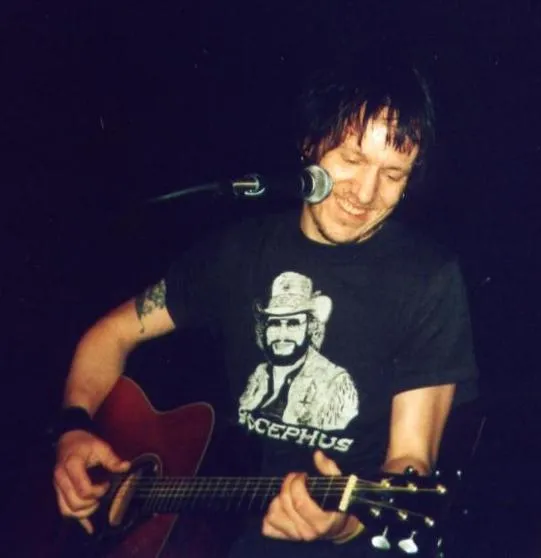
Photo by llaurens , licensed under CC BY-SA 3.0 · Wikimedia Commons
Rank #31
Elliott Smith
From Wikipedia
Steven Paul Smith, known as Elliott Smith, was an American musician and singer-songwriter. He was born in Omaha, Nebraska, raised primarily in Texas, and lived much of his life in Portland, Oregon, where he gained popularity. Smith's primary instrument was the guitar, though he also played piano, clarinet, bass guitar, drums, and harmonica. He had a distinctive vocal style characterized by his "whispery, spiderweb-thin delivery", and he often used multi-tracking to create vocal layers, textures, and harmonies that were usually fingerpicked and recorded with tape.
Discography & Previews
Browse through and click an album to open and play 30-second previews streamed from Apple Music.


Elliott Smith
1995 · 12 tracks
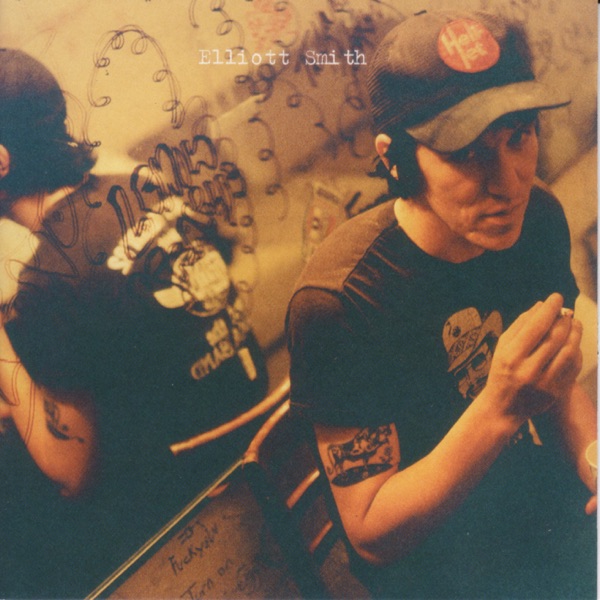

XO
1998 · 14 tracks
- 1 Sweet Adeline ↗ 3:16
- 2 Tomorrow Tomorrow ↗ 3:07
- 3 Waltz, No. 2 (XO) ↗ 4:40
- 4 Baby Britain ↗ 3:14
- 5 Pitseleh ↗ 3:23
- 6 Independence Day ↗ 3:05
- 7 Bled White ↗ 3:23
- 8 Waltz, No. 1 ↗ 3:22
- 9 Amity ↗ 2:20
- 10 Oh Well, OK ↗ 2:33
- 11 Bottle Up and Explode! ↗ 2:58
- 12 A Question Mark ↗ 2:41
- 13 Everybody Cares, Everybody Understands ↗ 4:25
- 14 I Didn't Understand ↗ 2:18

Figure 8
2000 · 16 tracks
- 1 Son of Sam ↗ 3:04
- 2 Somebody That I Used to Know ↗ 2:09
- 3 Junk Bond Trader ↗ 3:50
- 4 Everything Reminds Me of Her ↗ 2:38
- 5 Everything Means Nothing to Me ↗ 2:23
- 6 L.A. ↗ 3:14
- 7 In the Lost and Found (Honky Bach)/The Roost ↗ 4:33
- 8 Stupidity Tries ↗ 4:24
- 9 Easy Way Out ↗ 2:44
- 10 Wouldn't Mama Be Proud ↗ 3:26
- 11 Color Bars ↗ 2:20
- 12 Happiness/The Gondola Man ↗ 5:04
- 13 Pretty Mary Kay ↗ 2:36
- 14 Better Be Quiet Now ↗ 3:35
- 15 Can't Make a Sound ↗ 4:15
- 16 Bye ↗ 1:53
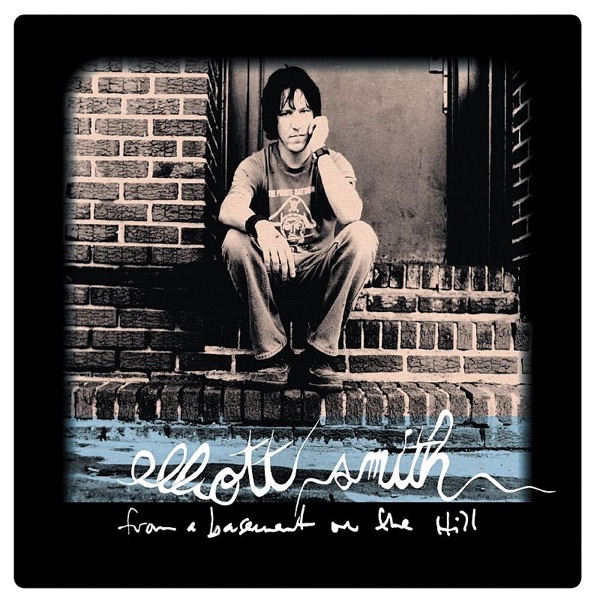
From a Basement on the Hill
2004 · 15 tracks
- 1 Coast to Coast ↗ 5:34
- 2 Let's Get Lost ↗ 2:27
- 3 Pretty (Ugly Before) ↗ 4:46
- 4 Don't Go Down ↗ 4:34
- 5 Strung Out Again ↗ 3:13
- 6 A Fond Farewell ↗ 3:58
- 7 King's Crossing ↗ 4:58
- 8 Ostrich & Chirping ↗ 0:34
- 9 Twilight ↗ 4:29
- 10 A Passing Feeling ↗ 3:32
- 11 The Last Hour ↗ 3:28
- 12 Shooting Star ↗ 6:02
- 13 Memory Lane ↗ 2:31
- 14 Little One ↗ 3:15
- 15 A Distorted Reality is Now a Necessity to be Free ↗ 4:33
-
 Roman CandleElliott Smith19949 tracks
 -
 Elliott SmithElliott Smith199512 tracks
 -
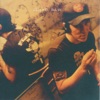 Either/OrElliott Smith199712 tracks
 -
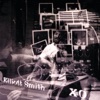 XOElliott Smith199814 tracks
 -
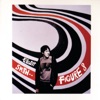 Figure 8Elliott Smith200016 tracks
 -
 From a Basement on the HillElliott Smith200415 tracks
Deep Dive
Overview
Elliott Smith was an American singer-songwriter and multi-instrumentalist who became one of the most influential figures in 1990s indie rock through a deceptively simple aesthetic: fingerpicked acoustic guitars, whispery vocals layered through meticulous tape multitracking, and songs of intimate emotional precision. Born Steven Paul Smith in Omaha, Nebraska in 1969, he carved a distinctive path in underground and alternative rock by rejecting the bombast and production excess that dominated mainstream music. His influence extended far beyond indie rock’s traditional boundaries, shaping how subsequent generations of artists approached songwriting, recording, and the possibilities of DIY aesthetics in the digital age.
Formation Story
Smith was born in Omaha, Nebraska and raised primarily in Texas before eventually settling in Portland, Oregon, where he would gain his widest recognition. His journey toward music emerged from those formative years in the American South and Pacific Northwest, regions that shaped both his sensibility and his eventual connection to Portland’s thriving independent music scene. Portland in the early 1990s offered a fertile ground for artists interested in lo-fi production, intimate songwriting, and the kind of uncompromising artistic vision that major labels had little interest in supporting. Smith’s multi-instrumental facility—guitar, piano, clarinet, bass guitar, drums, and harmonica—allowed him to work with remarkable self-sufficiency, a crucial advantage for an artist operating outside mainstream industry structures.
Breakthrough Moment
Smith’s early recordings on independent labels established his core aesthetic, but his breakthrough came with the release of Either/Or in 1997. The album showcased his fully realized songwriting voice: sparse arrangements built around fingerpicked guitars and overlapping vocals that created intricate harmonic textures without sacrificing emotional directness. Either/Or demonstrated that a recording made with minimal resources and maximum restraint could compete artistically with slicker commercial productions. The album’s success on college radio and among independent rock audiences marked Smith as a significant artist beyond Portland’s local scene, establishing him as a central figure in 1990s indie rock at a moment when that genre was beginning to achieve broader cultural visibility.
Peak Era
Smith’s most commercially successful and creatively accomplished period came between 1997 and 2000, spanning Either/Or, XO (1998), and Figure 8 (2000). XO in particular represented a consolidation of his artistic vision: carefully arranged songs that balanced acoustic intimacy with subtle orchestration, maintained his trademark vocal layering and multitracking techniques, and deepened his exploration of melody and harmonic complexity. These three albums established Smith as an essential artist in independent rock, one whose approach to songwriting, production, and arrangement influenced a generation of musicians working in the lo-fi and indie folk traditions. Throughout this period, Smith’s willingness to work across multiple independent and major labels—including Cavity Search Records, DreamWorks Records, Kill Rock Stars, and Domino Recording Company—reflected his artistic autonomy and the increasing legitimacy of indie rock as a commercial category.
Musical Style
Smith’s sound was defined by his distinctive vocal delivery and his meticulous approach to production. His voice—described as “whispery, spiderweb-thin”—became his primary instrument, used not merely to convey lyrics but as a textural and harmonic element in its own right. His standard technique involved multitracking vocals to create layered harmonies and thickly woven vocal arrangements that suggested emotional complexity and internal contradiction through pure sound. This approach, combined with his fingerpicked guitar work and frequent use of piano, created music that sounded simultaneously sparse and richly detailed. Smith’s primary instruments were guitar and piano, but his command of clarinet, bass guitar, drums, and harmonica allowed him to orchestrate his recordings with remarkable economy, building substantial sonic worlds from minimal instrumental forces. His use of tape recording and lo-fi production values was not a limitation but a deliberate aesthetic choice, one that emphasized intimacy, imperfection, and the human traces left by the recording process itself. This approach stood in sharp contrast to the polish and digital perfection increasingly standard in 1990s music production.
Major Albums
Roman Candle (1994)
Smith’s debut album established his essential songwriting voice and production philosophy: intimate acoustic arrangements, layered vocals, and a focus on emotional vulnerability over technical display.
Elliott Smith (1995)
His self-titled second album deepened the sonic palette introduced on Roman Candle, demonstrating his growing confidence with multitracking and arrangement.
Either/Or (1997)
This album became his breakthrough moment, showcasing fully realized songs that balanced fingerpicked guitar minimalism with complex vocal harmonies and subtle orchestration, establishing him as a major figure in 1990s indie rock.
XO (1998)
An artistic and commercial peak, XO presented Smith’s most carefully arranged work to date, combining his trademark vocal layering with subtle instrumentation that suggested greater production sophistication while maintaining his core aesthetic of emotional restraint.
Figure 8 (2000)
Smith’s final album of the 1990s continued his evolution, exploring new production textures and arrangements while preserving the intimate vocal approach that defined his artistic identity.
Signature Songs
- “Between the Bars” — A defining song built on fingerpicked guitar and multi-tracked vocals that exemplifies Smith’s approach to melody and production minimalism.
- “Waltz #2” — A stark, emotionally direct composition that showcases his ability to convey profound feeling through restraint and vocal precision.
- “Miss Misery” — A deeply personal song that gained broader recognition and demonstrated Smith’s commercial potential without compromising his artistic vision.
- “Angeles” — A haunting meditation on loss and geography, built around layered vocals and sparse guitar that became one of his most enduring compositions.
- “Between the Bars” — An acoustic miniature that achieves maximum emotional impact through careful attention to vocal harmony and fingerpicking detail.
- “Somebody’s Baby” — A song that captures Smith’s gift for melody and his ability to infuse simple instrumental arrangements with complex emotional weight.
Influence on Rock
Smith’s influence on rock and alternative music emerged from his demonstration that lo-fi production values and intimate songwriting could achieve both artistic validity and cultural significance. His meticulous approach to vocal multitracking, combined with his rejection of conventional production polish, provided a template for numerous indie rock and folk musicians who emerged in the 2000s and beyond. Smith proved that artistic seriousness and commercial viability were not mutually exclusive categories, even for an artist working largely outside mainstream industry structures. His influence can be traced through subsequent generations of singer-songwriters and indie rock artists who adopted his techniques of vocal layering, acoustic instrumentation, and emotional directness. Smith’s work also helped legitimize lo-fi and home recording as serious artistic approaches rather than merely budget constraints, a shift that became increasingly important as digital recording technology democratized music production in the 2000s.
Legacy
Elliott Smith’s cultural impact extended beyond his lifetime, establishing him as one of the most important alternative rock figures of the 1990s. His recordings have remained continuously in print and widely available through digital platforms, maintaining a steady audience of listeners who value his particular approach to songwriting and production. The lo-fi and indie folk genres that he helped pioneer continued to shape independent and alternative music into the 2000s and beyond, with countless artists citing his influence on their own work. Smith’s artistic legacy rests on his demonstration that genuine emotional expression and meticulous artistic craftsmanship could exist without the production apparatus and commercial machinery typically associated with major-label rock music. His body of work stands as a touchstone for artists interested in the intersection of technical precision, emotional authenticity, and alternative approaches to sound production.
Fun Facts
- Smith was proficient on eight instruments including guitar, piano, clarinet, bass guitar, drums, and harmonica, often playing multiple parts on his recordings.
- His preferred recording technique used tape multitracking to layer vocals and instruments, creating densely textured arrangements from individually recorded tracks.
- Portland, Oregon became the primary artistic home where Smith gained his widest recognition and built his career outside mainstream industry structures.