
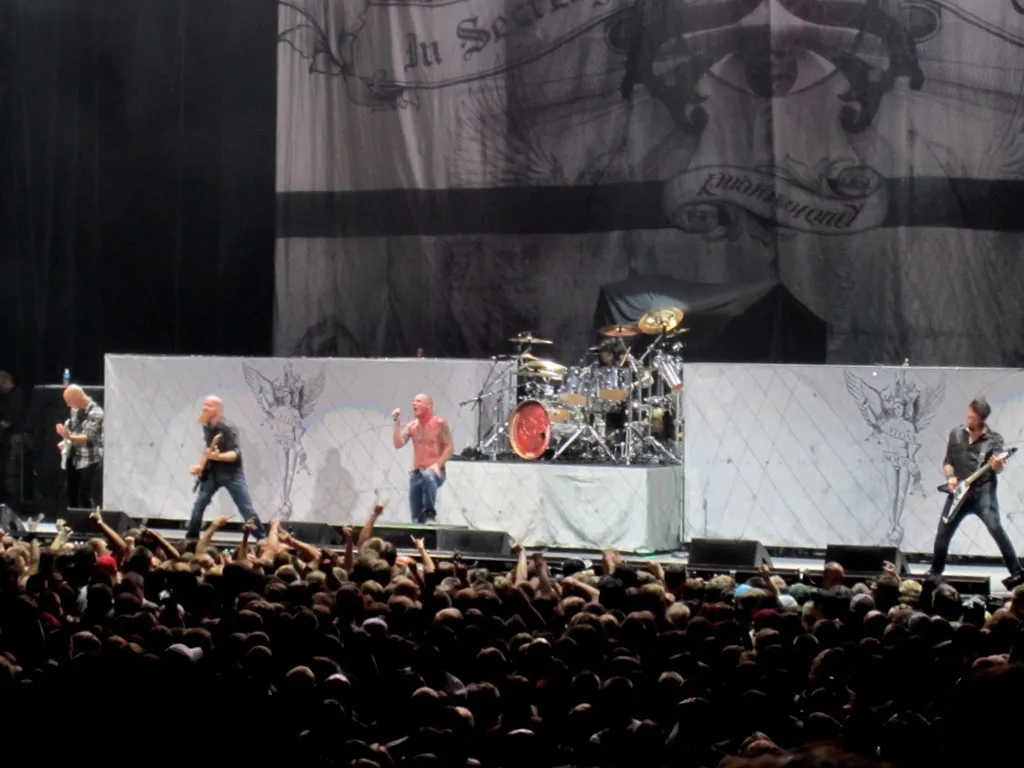
Photo by Laura , licensed under CC BY 2.0 · Wikimedia Commons
Rank #326
Stone Sour
From Wikipedia
Stone Sour was an American rock band formed in Des Moines, Iowa, in 1992. The band performed for five years before disbanding in 1997. They reunited in 2000; since 2015, the group has consisted of lead vocalist Corey Taylor, rhythm guitarist Josh Rand, drummer Roy Mayorga, bassist Johny Chow and lead guitarist Christian Martucci. Longtime members Joel Ekman and Shawn Economaki left the band in 2006 and 2011, respectively. Former lead guitarist Jim Root left in 2014. The band has been on an indefinite hiatus since 2020.
Members
- Christian Martucci
- Corey Taylor
- Johny Chow
- Josh Rand
- Roy Mayorga
- Shawn Economaki
Discography & Previews
Browse through and click an album to open and play 30-second previews streamed from Apple Music.


Audio Secrecy
2010 · 14 tracks
- 1 Audio Secrecy ↗ 1:46
- 2 Mission Statement ↗ 3:50
- 3 Digital (Did You Tell) ↗ 4:00
- 4 Say You'll Haunt Me ↗ 4:24
- 5 Dying ↗ 3:01
- 6 Let's Be Honest ↗ 3:44
- 7 Unfinished ↗ 3:10
- 8 Hesitate ↗ 4:16
- 9 Nylon 6/6 ↗ 3:38
- 10 Miracles ↗ 4:07
- 11 Pieces ↗ 4:31
- 12 The Bitter End ↗ 3:34
- 13 Imperfect ↗ 4:22
- 14 Threadbare ↗ 5:47

Hydrograd
2017 · 15 tracks
- 1 YSIF ↗ 2:02
- 2 Taipei Person / Allah Tea ↗ 5:17
- 3 Knievel Has Landed ↗ 4:01
- 4 Hydrograd ↗ 4:37
- 5 Song #3 ↗ 4:17
- 6 Fabuless ↗ 4:01
- 7 The Witness Trees ↗ 4:46
- 8 Rose Red Violent Blue (This Song Is Dumb & So Am I) ↗ 4:56
- 9 Thank God It's Over ↗ 3:37
- 10 St. Marie ↗ 4:27
- 11 Mercy ↗ 3:24
- 12 Whiplash Pants ↗ 4:19
- 13 Friday Knights ↗ 5:17
- 14 Somebody Stole My Eyes ↗ 3:48
- 15 When the Fever Broke ↗ 6:32
-
 Stone SourStone Sour200213 tracks
 -
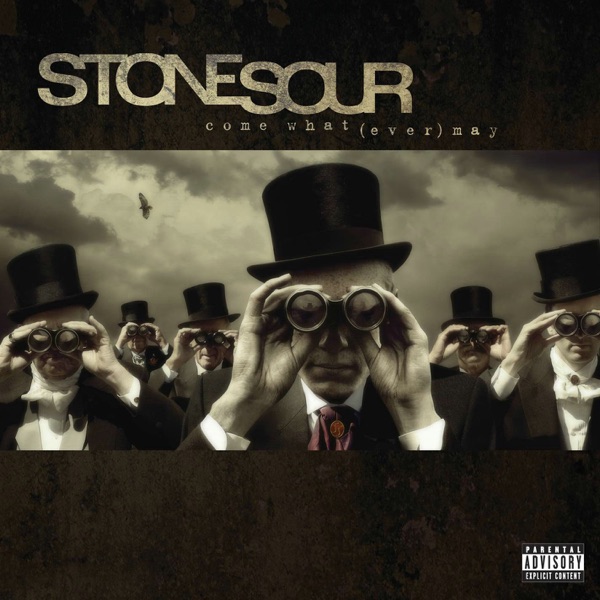
 Come What(ever) MayStone Sour200612 tracks
 -
 Audio SecrecyStone Sour201014 tracks
 -
 HydrogradStone Sour201715 tracks
Deep Dive
Overview
Stone Sour is an American hard rock band formed in Des Moines, Iowa, in 1992. The group emerged from the post-grunge era and built a catalog that bridges hard rock aggression with alternative sensibilities. Though the band disbanded in 1997 after five years of initial activity, a reunion in 2000 reset their trajectory entirely, leading to a nearly two-decade run of studio albums and touring that positioned them as a sustained force in early-2000s rock.
Formation Story
Stone Sour coalesced in Des Moines in 1992, a city not known as a major rock breeding ground but one that contributed a distinctive Midwestern perspective to the emerging post-grunge landscape. The band’s early lineup laid the groundwork for the sound that would define their catalog once they reunited. The initial five-year run, from 1992 to 1997, saw the group develop their craft in a region where hard rock and alternative rock were not yet consolidated into the mainstream acceptance they would gain by the late 1990s. Despite their regional foundation, the band’s dissolution in 1997 marked the end of that first chapter, a common story for rock acts caught between the waning days of grunge dominance and the uncertainty of what came next.
Breakthrough Moment
Stone Sour’s real commercial and critical breakthrough arrived with their 2002 reunion and the release of two albums that year: Ultra X-treme and the self-titled Stone Sour. The 2000 reunification had reset expectations, but these back-to-back releases established the band as a credible force in the hard rock landscape of the early 2000s. With Corey Taylor’s presence as lead vocalist—a figure already established in rock circles—the band had clarity of purpose that their early 1990s iteration had lacked. The albums demonstrated a maturation in songwriting and production that justified the three-year gap and positioned Stone Sour as more than a nostalgia act.
Peak Era
Stone Sour’s most productive and commercially visible period spanned 2006 to 2013. Come What(ever) May in 2006 solidified their standing, followed by Audio Secrecy in 2010, which deepened their exploration of the intersection between hard rock riffing and alternative textures. The double album House of Gold & Bones—released across two calendar years in 2012 and 2013—represented the band’s most ambitious project, a conceptually driven effort that showcased their range and willingness to engage with narrative and thematic depth. This seven-year stretch saw the band touring extensively and maintaining a steady presence in rock radio and festivals, cementing their place among the generation of bands that carried post-grunge and hard rock into the 2010s.
Musical Style
Stone Sour’s sound is rooted in hard rock but inflected with the melodic sensibilities and textural experimentation of alternative rock. Corey Taylor’s vocals sit at the center of their approach—capable of raw power but equally comfortable with melody and dynamic range. The band’s guitar work, anchored by Christian Martucci’s lead playing and Josh Rand’s rhythm contributions, blends crunching riffs with atmospheric passages and clean-toned moments that acknowledge influence from both 1970s rock and the alternative-metal fusion that emerged in the 1990s. Rhythmically, Roy Mayorga’s drumming and Johny Chow’s bass anchor the songs with precision, allowing the guitars to explore texture without losing pocket. The genre classifications of hard rock, post-grunge, and alternative metal all apply; Stone Sour occupies the space where these territories overlap, neither pure metal nor pure alternative, but a band that moves fluidly between both territories within a single song.
Major Albums
Stone Sour (2002)
The self-titled debut marked the band’s formal restart and introduced the reunited lineup to a broader audience. It established the template for their post-reunion identity: heavy riffs balanced with melodic hooks and introspective passages.
Come What(ever) May (2006)
This album deepened Stone Sour’s sonic vocabulary and demonstrated increased confidence in their songwriting. It became their most commercially successful release and a landmark in their discography.
Audio Secrecy (2010)
A continuation of their maturing approach, Audio Secrecy explored darker textures and more complex arrangements while maintaining the accessibility that defined their appeal.
House of Gold & Bones, Part 1 (2012)
The first installment of an ambitious double-album project, it introduced a more conceptual framework to Stone Sour’s work and showcased ambitious songwriting and production choices.
House of Gold & Bones, Part 2 (2013)
The conclusion of the conceptual statement, part two deepened the thematic exploration and cemented the double album as Stone Sour’s most elaborate undertaking.
Hydrograd (2017)
Their final studio release before the indefinite hiatus, Hydrograd saw the band refining their established formula with new material that suggested their creative trajectory was far from exhausted.
Signature Songs
- “Stalemate” — A mid-tempo showcase for Taylor’s vocal dynamics and the band’s ability to shift between heavy and melodic passages within a single composition.
- “Pecked” — Demonstrates Stone Sour’s knack for building intensity through instrumentation and vocal delivery.
- “Blue Study” — A track that highlights the band’s softer, alternative-rock sensibility and emotional nuance.
- “Digital (Oh, Oh)” — An example of the band’s radio-ready but substantive approach to hard rock songwriting.
Influence on Rock
Stone Sour arrived at a moment when hard rock was being redefined in the aftermath of grunge’s commercial peak. Their combination of post-grunge foundation with willingness to engage alternative-rock textures and introspection made them part of a broader wave of bands that prevented hard rock from calcifying into self-parody. They maintained the genre’s viability through the 2000s and 2010s, a period when hard rock struggled for mainstream relevance. Their consistent touring and album output offered a model for longevity—a band that could reunite, rebuild, and sustain activity over nearly two decades despite changing radio formats and industry conditions. Though not as commercially dominant as some of their contemporaries, Stone Sour’s presence in rock contributed to the survival of guitar-based rock in an era increasingly dominated by hip-hop and electronic music.
Legacy
Stone Sour’s legacy rests on their demonstrated ability to maintain artistic credibility and fan engagement across a fragmented career arc. The reunification in 2000 proved that a broken band could return with renewed purpose rather than diminished returns, a pattern that influenced how rock bands approached revival tours and reissues. Their body of work—particularly the mid-career albums from 2006 onward—remains present in rock streaming catalogs and continues to find audiences among listeners interested in the post-grunge and alternative-metal lineage. The band’s indefinite hiatus since 2020 leaves open the possibility of future activity, a pattern common among established rock bands in the 2020s. Though the period of consistent album releases has concluded, Stone Sour’s discography endures as a document of hard rock’s evolution in the 21st century.
Fun Facts
- The band was initially active for exactly five years before disbanding, a relatively brief first run that stood in contrast to their much longer post-2000 existence.
- Longtime members Joel Ekman and Shawn Economaki departed in 2006 and 2011 respectively, reflecting the typical churn of rock bands navigating lineup changes during periods of sustained touring.
- Former lead guitarist Jim Root, who was part of the band during their peak commercial period, left in 2014, marking a significant transition in their guitar lineup shortly before the Hydrograd era.
- Stone Sour released two albums in a single year (2002), a pace that demonstrated their creative momentum following the reunion and established them immediately as an active force.