
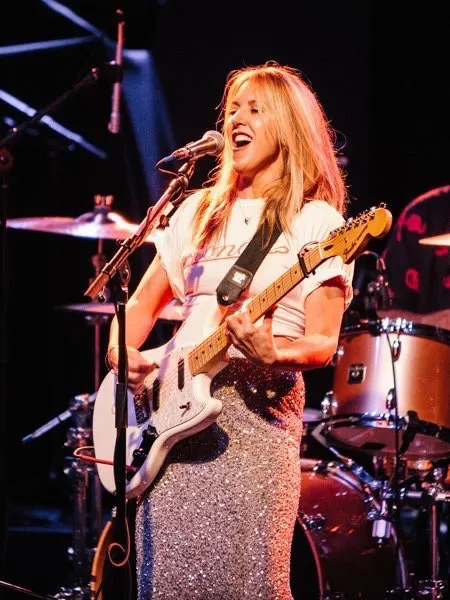
Photo by Anthony Bauer , licensed under CC BY-SA 4.0 · Wikimedia Commons
Rank #120
Liz Phair
From Wikipedia
Elizabeth Clark Phair is an American singer-songwriter and musician. Born in New Haven, Connecticut, Phair was raised primarily in the Chicago area. After graduating from Oberlin College in 1990, she attempted to start a musical career in San Francisco; however, she returned to her home in Chicago, where she began self-releasing audio cassettes under the name Girly-Sound. The tapes led to a recording contract with the independent record label Matador Records.
Discography & Previews
Browse through and click an album to open and play 30-second previews streamed from Apple Music.

Exile in Guyville
1993 · 18 tracks
- 1 6'1" (2018 Remaster) ↗ 3:07
- 2 Help Me Mary (2018 Remaster) ↗ 2:16
- 3 Glory (2018 Remaster) ↗ 1:30
- 4 Dance of the Seven Veils (2018 Remaster) ↗ 2:30
- 5 Never Said (2018 Remaster) ↗ 3:16
- 6 Soap Star Joe (2018 Remaster) ↗ 2:44
- 7 Explain It To Me (2018 Remaster) ↗ 3:12
- 8 Canary (2018 Remaster) ↗ 3:20
- 9 Mesmerizing (2018 Remaster) ↗ 3:56
- 10 F**k and Run (2018 Remaster) ↗ 3:08
- 11 Girls! Girls! Girls! (2018 Remaster) ↗ 2:20
- 12 Divorce Song (2018 Remaster) ↗ 3:20
- 13 Shatter (2018 Remaster) ↗ 5:29
- 14 Flower (2018 Remaster) ↗ 2:03
- 15 Johnny Sunshine (2018 Remaster) ↗ 3:27
- 16 Gunshy (2018 Remaster) ↗ 3:15
- 17 Stratford-On-Guy (2018 Remaster) ↗ 2:59
- 18 Strange Loop (2018 Remaster) ↗ 4:57

Whip‐Smart
1994 · 14 tracks

whitechocolatespaceegg
1998 · 16 tracks
- 1 White Chocolate Space Egg ↗ 4:36
- 2 Big Tall Man ↗ 3:49
- 3 Perfect World ↗ 2:15
- 4 Johnny Feelgood ↗ 3:22
- 5 Polyester Bride ↗ 4:05
- 6 Love Is Nothing ↗ 2:17
- 7 Baby Got Going ↗ 2:03
- 8 Uncle Alvarez ↗ 3:53
- 9 Only Son ↗ 5:09
- 10 Go On Ahead ↗ 2:53
- 11 Headache ↗ 2:53
- 12 Ride ↗ 3:04
- 13 What Makes You Happy ↗ 3:37
- 14 Fantasize ↗ 1:56
- 15 Shitloads of Money ↗ 3:40
- 16 Girls' Room ↗ 1:47

Liz Phair
2003 · 13 tracks

Somebody’s Miracle
2005 · 14 tracks
- 1 Leap of Innocence ↗ 4:22
- 2 Wind and the Mountain ↗ 5:34
- 3 Stars and Planets ↗ 3:54
- 4 Somebody's Miracle ↗ 4:23
- 5 Got My Own Thing ↗ 4:35
- 6 Count On My Love ↗ 3:41
- 7 Lazy Dreamer ↗ 4:56
- 8 Everything to Me ↗ 3:19
- 9 Closer to You ↗ 3:37
- 10 Table for One ↗ 4:12
- 11 Why I Lie ↗ 3:21
- 12 Lost Tonight ↗ 4:03
- 13 Everything (Between Us) ↗ 4:35
- 14 Giving It All to You ↗ 3:45


-
 Exile in GuyvilleLiz Phair199318 tracks
 -
 Whip‐SmartLiz Phair199414 tracks
 -
 whitechocolatespaceeggLiz Phair199816 tracks
 -
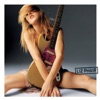 Liz PhairLiz Phair200313 tracks
 -
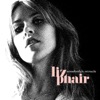 Somebody’s MiracleLiz Phair200514 tracks
 -
 FunstyleLiz Phair201011 tracks
 -
 SoberishLiz Phair202113 tracks
Deep Dive
Overview
Liz Phair is an American singer-songwriter and musician who emerged from the Chicago indie underground in the early 1990s and became one of the defining voices of alternative rock and pop rock across three decades. Born Elizabeth Clark Phair in New Haven, Connecticut in 1967, she built her reputation through deliberately lo-fi home recordings, explicit songwriting, and an uncompromising artistic vision that challenged genre conventions and audience expectations. Her early work on cassette and her first two studio albums established her as a significant force in indie rock, while her later recordings pushed toward pop rock experimentation, securing her a lasting place in the history of alternative music.
Formation Story
Phair grew up primarily in the Chicago area after her birth in New Haven. She attended Oberlin College, graduating in 1990 with ambitions to launch a musical career. Following graduation, she moved to San Francisco in pursuit of a recording deal, but the venture proved unsuccessful. Returning to Chicago and living at home while in her early twenties, Phair began recording music independently on audio cassettes under the project name Girly-Sound. These homemade recordings, distributed through her own effort, became the genesis of her artistic identity—raw, confessional, and produced in a deliberately lo-fi aesthetic that would later define early-1990s indie rock. The cassettes circulated within underground music networks, eventually attracting the attention of independent record label Matador Records, which offered her a recording contract and provided the platform for her breakthrough into the wider music world.
Breakthrough Moment
Phair’s debut album Exile in Guyville, released in 1993, established her as a major voice in independent music. Built partly from reworked Girly-Sound material and recorded with the stripped-down, bedroom-pop production style that defined the album’s character, Exile in Guyville received significant critical attention for its frank lyrics about sex, relationships, and female desire—subjects addressed with a candor that was less common in mainstream rock at the time. The album’s success on college radio and within indie rock circles led directly to her second album, Whip-Smart, released in 1994, which further solidified her reputation and brought her music to a broader audience. By the mid-1990s, Phair had transitioned from DIY cassette artist to recognized recording musician with a significant following in alternative and indie rock.
Peak Era
The period spanning the mid-1990s through the early 2000s marked Phair’s most commercially visible and creatively ambitious years. Following the success of Whip-Smart, she released whitechocolatespaceegg in 1998, continuing her exploration of indie rock and lo-fi aesthetics while developing her songwriting craft. In 2003, she released a self-titled album, Liz Phair, which marked a shift toward more polished pop rock production and broader mainstream appeal. This era demonstrated her willingness to evolve her sound and working methods while maintaining her core identity as a singer-songwriter. The album Somebody’s Miracle followed in 2005, further exploring pop rock territory and confirming her transition from underground indie artist to recording musician working across multiple genres and production approaches.
Musical Style
Phair’s sound emerged from and helped define the lo-fi indie rock movement of the early 1990s, characterized by intentionally minimal production, confessional lyrics, and bedroom-recorded aesthetics that prioritized songwriting and emotional directness over commercial polish. Her early work drew from indie rock and alternative rock lineages while incorporating elements of pop rock and lo-fi music production techniques. Vocally, Phair adopted a conversational, often deadpan delivery that emphasized lyrical content and narrative over vocal virtuosity. As her career progressed, particularly from the late 1990s onward, her production values increased and her sound moved toward more structured pop rock arrangements, though she retained her fundamental identity as a singer-songwriter writing from personal experience and observation. Her instrumentation ranged from sparse acoustic and electric guitar-based arrangements in her early work to fuller band arrangements in her later studio albums, reflecting both the evolution of indie rock production standards and her own artistic choices.
Major Albums
Exile in Guyville (1993)
Phair’s debut and most acclaimed work, built from reworked Girly-Sound cassette recordings and lo-fi studio sessions. The album established her as a major voice in indie rock and became a touchstone for 1990s alternative music.
Whip-Smart (1994)
Her second album, which expanded on the success of Exile in Guyville and brought her music to a wider audience within alternative and indie rock communities while maintaining the songwriting intensity of her debut.
whitechocolatespaceegg (1998)
Continuing her exploration of indie rock aesthetics, this album demonstrated her evolving approach to production and songwriting while staying rooted in the alternative rock sensibilities that defined her early reputation.
Liz Phair (2003)
A self-titled work marking a significant shift toward polished pop rock production and mainstream accessibility, representing her willingness to expand her sonic palette beyond indie rock conventions.
Somebody’s Miracle (2005)
Building on the pop rock direction established with her self-titled album, this record further demonstrated her range as a songwriter working in more commercially oriented pop rock arrangements.
Soberish (2021)
Phair’s most recent studio album, demonstrating her continued activity and evolution as a recording artist into the 2020s.
Signature Songs
- “6 AM” — A defining track from Exile in Guyville capturing the lo-fi bedroom-pop aesthetic and confessional lyrical approach that established her early reputation.
- “Never Said I Was a Nice Girl” — An early anthem asserting her uncompromising artistic identity and willingness to challenge conventional expectations of female performers.
- “My Wonderful Life” — A standout song showcasing her ability to combine indie rock instrumentation with direct, emotionally honest songwriting.
- “Oh, Bangladesh” — A track demonstrating her range as a songwriter within the indie rock context.
- “Red Light Special” — An example of her evolution toward pop rock production while maintaining her core songwriting sensibility.
Influence on Rock
Phair’s emergence from the bedroom lo-fi recording movement in the early 1990s helped legitimize DIY production aesthetics as a viable artistic approach in indie and alternative rock. Her frank, explicitly sexual songwriting and refusal to conform to conventional presentations of female musicians influenced subsequent generations of singer-songwriters working in indie and alternative rock. Her early work demonstrated that commercial viability could coexist with artistic uncompromisingness, establishing a template for indie musicians transitioning to larger independent and major labels. The success of Exile in Guyville and Whip-Smart positioned her as a significant contemporary of other 1990s alternative rock artists and helped shape the sound and sensibility of indie rock during that decade. Her later willingness to explore pop rock production, rather than remaining fixed in lo-fi aesthetics, demonstrated the possibility of artistic evolution within alternative music circles.
Legacy
Phair’s career spanning from the early 1990s through the 2020s establishes her as a significant figure in American alternative rock and indie rock history. Her early albums remain touchstones of 1990s independent music, studied and referenced by musicians and critics examining the era’s aesthetics and sensibilities. Her transition from DIY cassette artist to signed recording musician on major independent labels became a model for how underground artists could achieve broader recognition without abandoning artistic principles. Her recordings across three decades demonstrate sustained creative engagement with songwriting and production, securing her place in the longer history of American singer-songwriters. Her work continues to be available through streaming and physical formats, ensuring ongoing access to new and existing listeners.
Fun Facts
- Phair recorded her initial Girly-Sound cassettes entirely at home in Chicago, creating recordings that would eventually lead to her Matador Records contract without ever attending a professional recording studio for those early sessions.
- She attended Oberlin College, the same institution that produced numerous other significant figures in alternative and indie rock, underscoring the college’s role in fostering alternative music communities during the 1980s and early 1990s.
- Her project name “Girly-Sound” deliberately invoked feminine imagery and sensibility in contradiction to 1990s indie rock’s often masculinist presentation, positioning her work within broader conversations about gender and alternative music aesthetics.